Bedside Table Reads, Blog

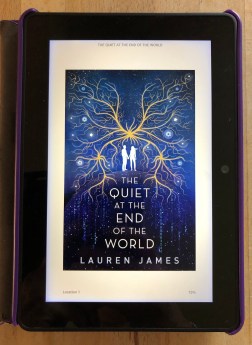
Shortlist Read: All Quiet at the End of The World


IMG_7035

Hello!

This week I have chosen All Quiet at the End of the World by Lauren James, from the YA Book Prize Shortlist 2020. This is a dystopian fiction set in the future that explores not only the existential crisis of humanity, but the very nature of what it means to be human.

Inspired by Carlo Rovelli’s Seven Brief Lessons on Physics, who states that ‘I believe that our species will not last long’. All Quiet at the End of the World runs with Rovelli’s thread that ‘we belong to a short-lived genus of species’ and that ‘the brutal climate and environmental changes which we have triggered are unlikely to spare us’.

These themes could make for heavy reading combined with the premise of a virus that stops fertility in humans. However, the narrative, set in London, is firmly about Lowrie (16 years old) and Shen (17 years old), their relationship with each other, their parents and their responsibility to world as the youngest remaining humans. Born from frozen eggs seventy years after the virus, in the time of sterility, they are waiting for scientists to find a cure. Themes of environmental action, a previously unknown virus, quarantine, waiting for a cure are never more pressing than in the current Covid-19 environment for not only a YA, but for an adult audience.

The narrative takes the form of a dual storyline and opens in the past when the virus first emerged with a call log for Maya Waverley to the emergency services. The narrative skips eighty-five years and is written in the first person from Lowrie’s point of view, as she and Shen explore the London underground with her Dad (a horticulturist). Lowrie finds Maya’s purse in an abandoned tube ‘the purse flops open, revealing rows of plastic cards’ and thus the scene is set for the link between the two narratives.

Lowrie and Shen are teenage explorers, detectives and scientists who try to unravel what has happened over the decades since the virus. Shen (from China, deaf in one ear and afraid of rats) is presented as being ‘the best at intellectual things’ but for Lowrie, ‘fixing stuff is my speciality’. Through their mudlarking they find and document pieces that are buried in the Thames and anywhere they can explore and is shown in a log at the beginning of each chapter. Their parents work together to teach them all they will need to know to survive in this new world.

Their futuristic world is defined with reference to bots who ‘keep things safe’ specifically ‘Mitch’ who befriends Lowrie and Shen and is describes as having ‘spindly metal legs’ that ‘have sprouted out of the robots rusted spherical body’.

Maya’s story is told through Lowrie’s research from what is left of Maya’s social media feeds where Maya revealing her feelings: ‘So much for feeling calmer! Today I can’t stop showering and showering, trying to get the virus off me’ and identifying a post virus world: ‘that was my first day of our new normal’ as well as her fears ‘I’m still having nightmares about the virus’. Maya attaches new items in her feed: ‘NEWSBREAKING.com: Doctors report Drop in Women Conceiving’, providing an external eye on the changing situation due to the virus.

The conflicting feelings of being a teenager are explored as Lowrie questions her sexuality, ‘I might be maybe probably definitely bisexual’ as well as and her attraction to Shen, ‘I find myself eyeing his forearms again’. The need to get away from her parents and experience independence also raises conflicting feelings, ‘now that we’re finally independent, I just miss him terribly’.

All Quiet at the End of the World questions evolution and what it means to be human. The extinction of humanity, climate change, the restoration of eco systems, prejudice and the ethics of assisted suicide are all seen through the love story of Lowrie and Shen. It is told in simple language, ‘I fill my utility belt with the essentials – a penknife, screwdriver, chisel and spanner’ that affirm Lowrie’s voice and power.

Themes: love, death, climate change, pandemic, nature of humans, existence, existential crisis, independence, parent-child relationships, bullying, prejudice, sacrifice.


All pictures and writing are my own unless otherwise credited. Permission must be obtained before any image reproduction and credit must be issued in any image reproduction or quotations. 


Blog, Creative Shorts, New Writing

Natodola


IMG_5357

It was a biting mid-winter day. The journey began, clear and cold, as the train left London, but as it cut through the countryside, the skies clouded and by the time it arrived by the coast in north Wales, there was a sharp wind and an unrelenting slashing rain that came from black and blue thunder clouds.

The taxi driver looked away as Celebes exited the train station. She pulled her hood up and tapped on the window.  Begrudgingly, he lowered the window enough for her to say, ‘Natadola please’. He grunted, hit a button and the boot opened. Celebes let her one large suitcase drop into the boot with a thud, then lowered her backpack letting it slide in next to the dirty wheels.

The taxi was freezing, and the driver wore a coat buttoned up so high to his nose and a hat pulled down so close to his eyes that she couldn’t imagine how he could safely drive the car. Mum would not have approved. The driver tore through the countryside and puddles splashed up over the windscreen, the wipers not fast enough to clear the water as the taxi moved blindly through the narrow roads.

He turned down a wooded lane and came to an abrupt stop outside a large gate. Celebes sighed and said under her breath, ‘Christmas with Grandma Sia at Natadola’. It was clear that the driver was not going any further. Celebes could not remember exactly how far the Natadola was from the gate but if the driver would not go any further, she had no choice but to walk. Hauling her luggage out of the boot, she paid the driver and watched as he did a messy three-point turn that her driving instructor would have failed. The driver did not want to be here anymore than she did.

The black iron gate had rusted, and ivy grew wild up the large stone posts. A gargoyle sat on top of each post, resting on their haunches ready to pounce. Their stone eyes followed every movement.

Celebes approached the gate, pulling the case over the thick veins that crossed the pathway. She lifted the latch and pushed the gate wide enough to pass through.

The hill up to Natadola was steep. The closer she came to the clearing, the more the rain had eased to a misty drizzle. Seagulls squawked and circled above as she emerged from the wood. The top of the house, Natadola, was ahead.

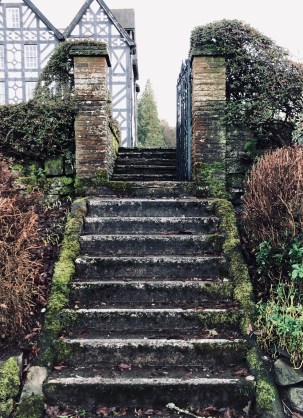
There was no direct entrance for cars. No driveway to the front door. No dropping off point. Only side paths and roads. Celebes approached the house from the left side and stopped in front of the stone steps that led to the front of the house. Steep and narrow, moss grew along both sides the steps. The skeleton plants that grew along the bank did not offer any sense of welcome. About halfway up the steps, there was a small landing with two pillars of red brick and a smaller iron gate. Celebes balanced the suitcase on the last step and pulled the gate open. It scraped a well-worn track on the stone, and as she ascended the final few steps, Celebes pushed her hood back and Natodola came into full view.


All pictures and writing are my own unless otherwise credited. Permission must be obtained before any image reproduction and credit must be issued in any image reproduction or quotations. 


Bedside Table Reads, Blog

Longlist Read: How Much of These Hills is Gold


IMG_7018

Hello!

How Much of These Hills is Gold by C Pam Zhang, from the Booker Prize Longlist 2020, is my book choice this week. It is a story of two orphaned native-born Chinese sisters, Lucy (12) and Sam (11), set in the wake of the California gold rush and their journey to bury their deceased father and search for home.

The narrative is written in the present tense immersing the reader into the action and creating a sense that we are living it along with Lucy and Sam. Using simple prose, it is divided into four parts. Parts One and Two are written in the third person and opens when ‘Ba dies in the night, prompting them to seek two silver dollars.’ And a few pages later we learn they are alone as ‘And long gone, Ma.’ The death of Ba sets the sisters on a journey to bury him.

The backdrop of the wild west in the 1800’s subverts expectations of white cowboy protagonists. The writing feels YA initially: with both parents removed from the narrative through death in the first few pages of the story, the sisters are propelled on their adventure. However, knitted in the simple prose and initial YA feel, is the image of the two children trailing the corpse of their dead father in a crate through the desert. This morbid image contrasts a sense of black humour, where bits of the corpse fall off as it decays in the heat of arid plains, described by Lucy who realises that ‘the hand has not one but two missing fingers.’ This is furthered when she decides to preserve the body in salt, like a piece of meat, to rid it of maggots and flies: ‘Sprinkled over Ba’s body, the salt looks like ash.’

With a thematic feel of Steinbeck’s Of Mice and Men’s the American Dream, where George describes ‘a little house and a couple of acres’ and Lennie’s desire to ‘live off the fatta the lan’, Lucy and Sam are fully aware of Ba’s dream: ‘I’ve got my eye on a piece of land eight miles toward the ocean. Between two hills, forty acres.’

Layered within the narrative, Chinese tradition appears throughout, where the sisters search for two silver dollars to place over their father’s eyes ‘sending the soul to its final good sleep’. A sense of family and responsibility drives the sisters on their journey as Ba says, ‘Family comes first.’ Animal and insect imagery add texture to the layers with reference to: snakes, buffalos, horses, tigers, flies and maggots. The buffalo descriptions are particularly striking: ‘the skeleton rises from the earth. Like a great white island…they’ve seen buffalo bone in pieces along the wagon trail, but never whole.’

The narrative also explores a search for identity and home. Sam, androgynous, becomes the boy Ba never had and is ‘prized by a father who wanted a son’. As Lucy searches for ‘What makes a home a home?’ she also seeks an understanding of identity through appearance, location and language with realisations such as: ‘For the first time Lucy understands that the language Ma shared with them in bits and pieces, was only a child’s game’.

The narrative cleverly shifts to the first person in Part Three where Ba’s perspective reveals an adult version of past events and then switches back to the third person in Part Four, fast forwarding five years. The relationship between gold, salt, earth and the elements interplay and are linked with plums, blood and skull imagery. The Parts are identified with dates (XX62, XX59, XX42/XX62, XX67) indicating the actual year (1862, 1869, 1842/1862, 1867) but also potentially representing any year creating a sense of timelessness to the narrative.

This coming of age story of Lucy and Sam takes the reader on a meandering journey through savage events, vast sorrow and parched deserts but it also through personal sacrifice, belonging, family and hope. How Much of These Hills is Gold sets out a new vision of the immigrant experience in forming the history of the American West.

Themes: coming of age, American Dream, heritage, tradition, death, loneliness, family, parent-child relationships, sibling relationships, gender, identity, sacrifice, loss, hope


All pictures and writing are my own unless otherwise credited. Permission must be obtained before any image reproduction and credit must be issued in any image reproduction or quotations. 


Blog, Creative Shorts, New Writing

To The Tower

IMG_4255

Lucy crept along the rough stones of the arrow loop. The light illuminated the stone wall but was blinding the closer she came to the narrow slit. The space was narrower than she thought towards the end; it was just big enough for her slim body. She had no idea how a grown man fit in the arrow loop to rain arrows down at the enemy. She paused, squatted down and leaned her head towards the opening as she lifted her skirt up and pushed it backwards. She squeezed in further.

‘What do you see? What do you see?’ her Clem asked from behind her.

‘Will you be quiet for just a minute.’ Lucy said craning her neck further towards the light.

‘Are they coming? They’re going to kill us all, aren’t they?’ Clem began to pace and down the walk between the castle walls, clenching and unclenching his hands.

‘I can’t…I can’t see enough.’ Lucy said.

‘They’ll break in…maybe from underground. Or swim the moat. Scale the batter at the bottom of the castle wall, shimmy up the stones and over the top and onto the wall walk and then boom…arrow after arrow…they’ll take down every defender until they get to us and…’

‘Will you stop talking. I can’t hear.’ She said calmly.

Clem stood still with his hands behind his back like his father, like he was in control. He looked down at the stones and counted them from one side of the wall to the other as his mother told him when he felt the panic rising. He had wished he had taken a knife from the kitchen and looped it in his belt like the men, but when he went to put his arm out, it froze to his side as if it was tied to his body with the strongest leather.

‘Nothing. There is no one attacking from this side of the castle. It must be from the other side.’ Lucy said as she crept backwards.  Stepping down on to the walkway, Lucy stood up straight and said, ‘Come on. Let’s run to the other side.’

Lucy grabbed Clem’s hand, her twin and Gemini, alike in many ways except she was older, but only by a minute or two which gave her a commanding nature. She was stronger, but only because she was taller. She was quicker, but only because she practiced racing against the fastest soldiers when she was allowed. She pulled him along the castle walkway. Lucy loved this part of the castle was because instead of filling the whole space in between the walls with rubble, they build a walkway halfway up, so you travel all around the castle walls and still be inside and access to the first level of arrow loops. Most of the men went up to the walk at the top of the castle to prepare for the attack. But a few stayed back and took up positions near Lucy and Clem.

A door crashed open behind them. Stopped abruptly, they held their breath and waited for the arrows to pierce their backs. Nothing. Strong fingers curled around their necks.

‘Lady Lucinda and Prince Clement. What do you think you’re doing?’ The hands shook their bodies and their heads wobbled in a strange detached way.

‘Nurse!’ They said in unison relieved and frightened at the same time. Clem was sure that being captured by the enemy would be far better than being caught by Nurse.

‘Nurse indeed. Your Mother will have your heads if you two are not upstairs in the tower immediately.’

Nurse pushed them through the door and up several flights of steps. Screams came from below. As they reached the tower, the noise below grew faint, and Nurse let go of them long enough unlock the large oak door to the top tower room with the key that always hung from her skirt.

‘Hurry.’ She said stepping aside.

They crossed the threshold. Mother turned to greet them, a sword in each hand.


All pictures and writing are my own unless otherwise credited. Permission must be obtained before any image reproduction and credit must be issued in any image reproduction or quotations. 


Bedside Table Reads, Blog

First Shortlist Read

Hello!

IMG_9638

The YA Book Prize 2020 Shortlist and The 2020 Booker Prize Longlist have been announced and it’s that time of year to get reading. My bedside table and Kindle are stacked up and ready to go!

My first read, Meat Market by Juno Dawson, is from the YA Book Prize 2020 Short List about the fashion industry, its attraction and iniquitous underbelly.

Meat Market follows the journey of sixteen-year-old Jana Novak (an average teenager from an estate in London) through the treacherous world of modelling. Scouted at Thorpe Park for her androgynous looks and height, Jana is propelled into a whirlwind of fashion shoots, travelling and worldwide fashion weeks. Forced to choose between the lure of money through modelling and sixth form college, Jana opts for the former and embarks on a journey that takes her further and further away from her family, friends and herself. Her friends Sabah, Laurel and boyfriend Ferdy (Kai Ferdinand) oscillate in and out of Jana’s life initially keeping her grounded in reality, but as the novel progresses the distance between them grows as does Jana’s dependence on anti-anxiety medication and sleeping tablets.

Dawson systematically cuts away the glamour of the fashion industry and life of the models exposing raw truths: long hours, grotty accommodation, jet lag, eating disorders, drug abuse, sexual abuse and the dehumanising effect of the industry.

You would expect the novel to follow an arc of doom and gloom with our protagonist, Jana, self-destructing. However, the journey Dawson takes us on is one of hope, with Jana finding courage, strength, friendship and most importantly, herself, as well as exposing the fashion industry’s darkest secrets.

Written from the first-person point of view, we have an intimate knowledge of Jana’s life, her loneliness and confusion. This is enhanced by alternating the first-person narrative of past events with short interviews in the present. The opening interview of the book:

‘ – What am I supposed to say?’

‘ – Well, why did you want to make this film?’

‘ – It’s time, I think.’

sets the scene for the first-person narrative to catch up to this moment. The narration is interspersed with texts, newspaper articles and a celebrity review providing the reader a momentary opportunity to observe events from an outside perspective creating a concrete link to the real world. Our world. This makes the events feel not only tangible but frighteningly realistic. Reference to specific magazines, locations in London and around the world anchor the story in reality. Jana’s voice is clear, distinct and entirely relatable with Dawson capturing the essence of a London teenager through both dialogue and internal monologue. Jana’s opening thought, ‘Why are men such trash?’ is simple and brutal establishing the foundation on which Dawson builds her story.

Dawson’s gaze on the modelling industry in Meat Market is a call for greater regulation to safeguard the health and safety of models around the world.

Meat Market is a great read to kick start the nominations. The rest of the YA Book Prize Shortlist 2020 has a lot to live up to – very much looking forward to reading another from the list!

Key themes: identity, mental health, abuse, power, ethics, drugs, money, vulnerability, glamour, loneliness, courage, friendship and love.


All pictures and writing are my own unless otherwise credited. Permission must be obtained before any image reproduction and credit must be issued in any image reproduction or quotations. 


Blog, Creative Shorts, New Writing

Moon Shadows

IMG_9084

I rowed faster. The sun was setting and soon the reflection of the clouds on the river would dissipate and the darkening sky would meld with the blackening river. It would not be safe once the sky and river fused, where the clouds met clouds, and the sun met sun. The duality of the day would be released into singular Moon Shadows and the river was no place to be when the Moon Shadows reared their ugly heads. I rowed faster.

The bridge in the distance held hands with the sky and river, swinging between them like a child between its parents on a walk. More sinister with every passing moment, the bridge in the distance extended its fingers and each claw clung to the darkening sky above and the resistant river below.

I rowed faster. Light was not on my side. The ripples of the clouds reflected in the river giving a sense that in their whiteness, a goodness could see me across. But the river current grew strong with the setting sun and the cumulus clouds fractured into featureless horizontal threads and exposed the night seeping through from above. I rowed faster.

I blinked. It was a moment, but that was all it took. The sun fell behind the bridge and it amalgamated the sky and river. Blackness descended. I was alone on the river. There was no telling where I had started and where I was going. I stopped rowing.

The Moon Shadows would not be long. I pulled the oars out of the river and let them lay longways in the boat, resting against my legs and sat still not daring more than shallow breaths. I would have to wait until sunrise, until the Moon Shadows disappeared. The blackness eased slightly, and in the distance, a faint glow seeped through the stratus clouds. The moon. I crossed my arms as if I could hug away the Moon Shadows. Rising and falling with the flow of the river, I felt the boat shift. Who knew where I would end up?

Could I remain frozen, petrified, in one position all night and avoid the Moon Shadows? Would it be safer to continue rowing to the other side? Mother and Father would surely have said no.

Out of the corner of my eye, I caught a glimmer of the moon rising opposite to where the sun had set. This was it. The Moon Shadows would start to ascend. The air was still but river current swelled and the white caps formed catching the glimmer of the moon as they grew.

Everyone knew to beware of the white caps. Everyone knew. Yet, here I was. In between the white caps and the soaring Moon Shadows. Majestic and mesmerising yet malignant. Their deleterious effects well known; I would be lucky to see morning with only hint of madness on my soul.


All pictures and writing are my own unless otherwise credited. Permission must be obtained before any image reproduction and credit must be issued in any image reproduction or quotations. 


Blog

Hello!

IMG_2512

Hello all,

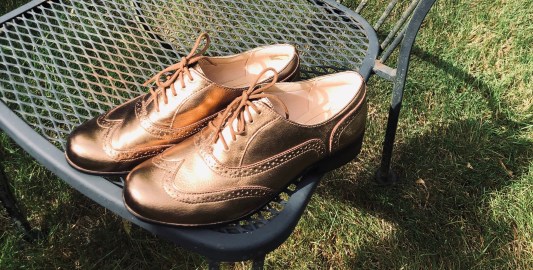
Welcome to my blog! I am Pamela Price – mum to two children and a 3rd year PhD Candidate. With my gold shoes on, I wear many hats – as well as a mum and student, I am a writer, a researcher, an educator and a lover of all genres of book.

My favourite books to read and write are YA novels. But I enjoy all types of fiction, poetry and plays. For me, there is nothing better than opening a book and it having that book smell, the print on the page, the paper, sometimes musty, transporting you to another time and place.

Here you will find some of my favourite bedside table reading, thoughts on prose and poetry and maybe even a play or two. This is a space to share what inspires me, any interesting tidbits that I’ve picked up along the way and even my own work.

So glad you have come along for the ride!