
Bedside Table Reads, Blog

Shortlist Read: Burnt Sugar

Hello!

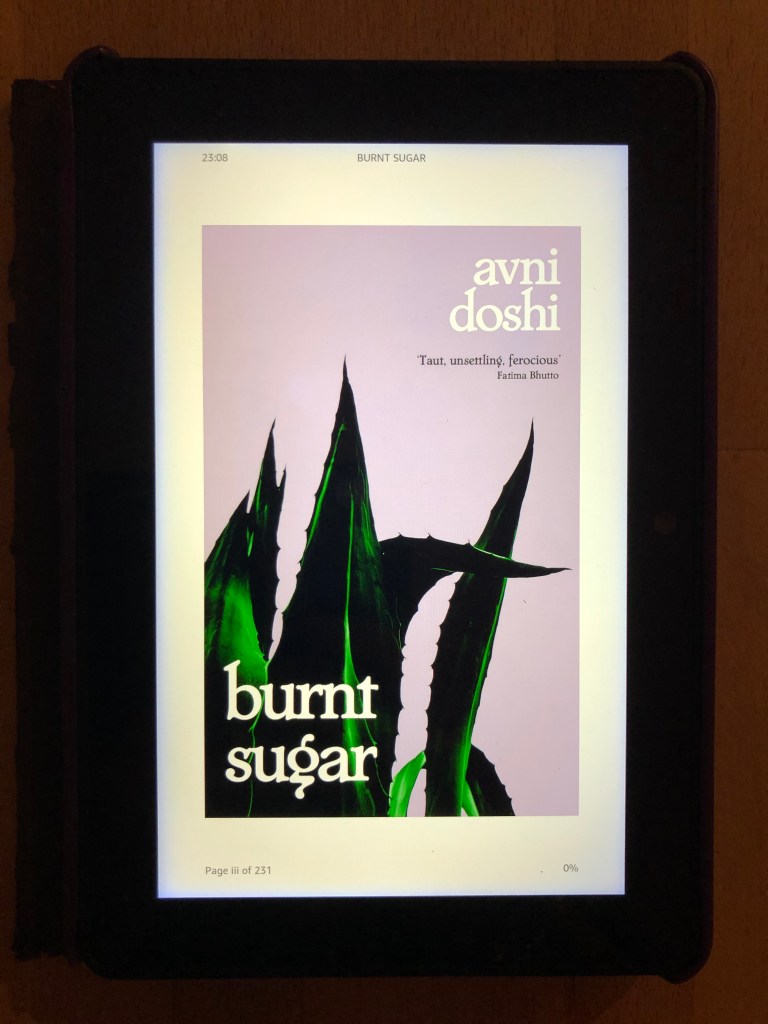
This week I have read Burnt Sugar by Avni Doshi. I am still working my way through the Booker Prize Longlist 2020, but the Shortlist has recently been announced, with Burnt Sugar being one of the six listed.

Burnt Sugar, written in the first person, is set in the Indian city of Pune. The narrative follows Antara’s present life and flashbacks to her childhood. The two narratives mingle with intertwining events as Antara tries to make sense of her relationship with her mother. Antara was named after her mother, Tara. She explains that this was ‘not because she [her mother] loved the name but because she [her mother] hated herself.’ The name, Antara, being opposite to Tara or ‘Un-Tara’.  Antara sees this not as a way of differentiating them, but rather that they were ‘pitted against each other’.

Throughout the narrative, Antara attempts to understand her past and her mother’s decision to leave her father and join an ashram (spiritual retreat). The past pushes through the narrative, influencing the present, challenging what Antara understands to be the truth or perceived truths.

Antara struggles with the present. Her mother seemingly suffers from early onset dementia, though her brain scans are normal. Antara seeks doctors and researches the disease stating, ‘I have read that the disease is caused by insulin resistance in the brain’ or ‘some studies…link cognitive health with problems of the intestines’. The absence of her father leaves Antara isolated in the care of her mother. Even her grandmother had ‘only one positive memory […] of her own child’.

The actions of Antara’s mother are unpredictable and at times dangerous. However, this unpredictability is echoed in Antara’s childhood, specifically when mother left her father, when they were beggars and when she was sent to boarding school and was ‘already in the car when they explained to me where we were going’.  

The anger Antara feels towards her mother simmers as she is forced into a position not only care for her but prove that that there is, in fact, something wrong with her. This complex relationship oscillates between resentment for her childhood and her duty as an adult. Recalling her year at boarding school, Antara describes how Sister Maria Theresa ‘without warning, stabbed the pencil in the back of my palm’ and how she had to hold her ‘soiled sheets above my head’ as her ‘classmates walked past […] giggling under their breath’.

Antara states that ‘my mother leaving my father, and my father letting us both go, has coloured my view of all relationships’. The theme of dysfunctional relationships extends to Antara’s own relationship with her husband, Dilip. She contemplates leaving him, even ‘packing a small handbag’ with her ‘passport and some jewellery’ only to return that evening with Dilip unaware of her actions.

This dysfunctional relationship between Antara and Tara is summarised by the narration ‘I understood how deeply connected we were, and how her destruction would irrevocably lead to my own.’ The fragility of the relationships is laid bare through the exploration of memory and ‘remaking memories’ into the ‘image of what other people remember’. The making and remaking of memories is a consistent theme throughout with Antara wondering ‘if a falsehood is enacted enough, does it begin to sound factual?’

The strain of the mother-daughter relationship is clear. Antara’s anger at having to care for her mother throughout her cognitive decline leads her contemplate if she is ‘becoming my mother’. She further wonders if she too, would see her own child as ‘a competitor or, rather an enemy’.

Through unravelling the past, secrets are uncovered, and the line between reality and falsehood blurs revealing two generations of women who struggle as mothers. Burnt Sugar is a soul-searching narrative of motherhood and the ‘striking sensation that life is short’. As the title suggests, there is a residue of bitterness that remains for Antara, the relationship with her mother and even for the reader.

Themes: memory, betrayal, mother and daughter relationships, betrayal, Alzheimer’s, love-hate relationship, parenthood, postpartum depression, dysfunctional relationships, motherhood, class inequality


All pictures and writing are my own unless otherwise credited. Permission must be obtained before any image reproduction and credit must be issued in any image reproduction or quotations. 


Blog, Creative Shorts, New Writing

Underground

She had a plan. That’s how it began. We had sat in silence for some time when she leaned over to me and said, she had a plan. No one could possibly guess the thing she proposed we do. At first, I thought she was funny. I smiled. I even laughed out loud. But as she kept talking, I realised that she was as far from funny as you could get. She insisted that the fact that we were strangers made it all the better, me wearing a cheap dress and her, a school uniform – a generic blazer and pleated skirt.

I would do it. What else are you to do when you’re put on the spot?

Now, anyone would have thought meeting a stranger in the train station and agreeing to do anything was mad. The madness, I think and still believe, was with the stranger and not myself. It was only my curiosity that led me to agree in the first place. And curiosity is not madness. It’s not madness at all, is it?

This particular train station was deep underground. The arched walls were high and carved out of the rock. There were no tiles or plaster to lessen the feeling that you were deep underground. As you descended the steep escalator, the air changed about halfway, a noticeable shift from the fresh, dry air above to the damp, chilled earthy air below. It latched onto your skin and as you breathed in, it felt as though you were taking part of the earth into the core of your lungs.

When I had reached the platform, a mottled blood-red laminate stretched for as far as the eye could see and disappeared at the far end of the tunnel. Two parallel lines of dark grey pillars, like soldiers, held up the high rocky ceiling of the tunnel. If I shouted, I was sure it would echo. But I didn’t shout, even though the platform was empty.

The station was illuminated with what appeared to be operating theatre lights that hissed white light and the glare reflected dizzying white spots on the polished platform. Wires, thick as snakes, crawled between the lights. I kept my eyes focused towards the end and found a bench situated between two pillars. I slid the bag off of my shoulder and put it on my lap. I hugged it. Mostly to keep warm. But more because being alone so deep underground was unnerving.

From this position, all I could see was the charcoal tunnel that arched over the tracks; I could not see her until she was almost upon me.

And then it was too late.

Too late to get up. Too late move seat. Too late shift along without being obvious. We sat and waited. Little by little, more people arrived, and I loosened my arms from around my bag. It was then, as my arms relaxed, that she leaned over and said, “I have a plan!”

I should have left then. Moved towards the family with three children, or the businesspeople, or the tourists with their suitcases. But I didn’t move. I listened and nodded. And as it turns out, we did not live that far from each other. In opposite directions, but not far. We would walk out of the station, her to the left, and me to the right. And no one would be none the wiser.

“We could get caught.” I said.

But she was compelling, convincing and certain of her plan. We would walk off the train at our destination richer than when we got on. So, every other car, I grew in confidence, we put on a show worthy of an Oscar. Me doubled up in pain, and her blocking the CCTV with her body, light fingered, on repeat. I was nervous and thrilled as adrenaline flowed through my body. This was not her first time. She was too calm and careful. Too sure of herself from the start.

One train ride. I walked right and saw my reflection in the window of the chocolate shop as I left the station behind me. I was no longer the same girl. I was an accomplice. I was a thief.


Inspired by the Alfred Hitchcock movie, ‘Strangers on a Train‘.


All pictures and writing are my own unless otherwise credited. Permission must be obtained before any image reproduction and credit must be issued in any image reproduction or quotations. 


Bedside Table Reads, Blog

Shortlist Read: Furious Thing

Hello!

This week, I have read Furious Thing by Jenny Downham, from the YA Book Prize Shortlist 2020. Downham explores both the destructive and constructive natures of power and love in her novel.  It is about emotional abuse, teenage angst, the power to protect and being able to ‘open the Forbidden Door.’

The novel is divided by three fairy-tale style chapters, ‘A Tale of Love and Death, Another Tale of Love and Death and a Third Tale of Love and Death’, written in the third person reflecting Lex’s own narrative: It opens with, ‘Once there was a girl who grew up wicked. She slammed things and swore.’ These two opening lines, especially the reference to ‘wicked’ set the scene for the link between Lex’s world and fairy-tales reminiscent of the wicked stepmother in Cinderella, the wolf in Little Red Riding Hood and The White Witch in Narnia. References to fairy tales run throughout ‘like a fairy-tale daughter’, a ‘fairy-tale wedding’ and ‘it’s the thing fairy-tales teach us’ contrasting the ideal that is expected of Lex with the reality of her disappointments and struggles.

The main story is written in the first person. Protagonist, Lex (Alexandra), is fifteen and furious, she articulates clearly: ‘I felt pure rage’. Her anger seethes, simmers and explodes; we are privy to her confusion, reasoning, actions and reactions. She explains that, ‘Anger was something to believe in when the world let you down. And I roared with it.’

Fuelled by her mother’s fiancé, John, who taunts her continually with ‘Why do bad things always happen when you’re around, Alexandra?’, Lex rages against her home, school and the people close to her, as well as herself. The events all play against the backdrop to the run up to the wedding of Lex’s mum and John and Lex’s GCSEs.

Lex experiences see-saw emotions, particularly in relation to John, who tries to supress, control and manipulate her. She describes trying to control herself: ‘His anger rippled in me. I felt it in my chest, live a wave. Don’t get angry, I thought. Be nice…’ and ‘I took a breath and swallowed my anger.’ Lex’s rage, however, manifests itself as ‘a bolt of steel running through me’ and ‘the reddest, hottest feeling’ as she physically throws a chair through a window at school and the ‘glass exploded’. Lex’s actions are a representation of her frustration, anger and confusion. These actions are misinterpreted, manipulated and overpowered by John, to his own end.

Lex’s relationship with her stepbrother Kass fluctuates between brother-sisterly love and romantic love. Their innocent friendship growing up depicts a childhood ideal where they ‘scrambled up trees and hid under beds’. For Lex, and to a certain extent, Kass, this becomes an attraction even after he has left for university. This is a reflection of her mother’s relationship with John, while supportive also has the capacity to be destructive.

Lex’s connection with her half-sister, Iris, expands as the novel progresses and it is shocking for Lex when Iris asks her to ‘Do your furious thing.’ and ‘Do your monster.’ These descriptions of her actions, as seen from a six-year-olds point of view, reveal Iris’s understanding of how Lex’s outbursts are to try and control a situation that is out of her control. The reference to Lex as a ‘monster’, links back to the theme of fairy-tales and the idea of ‘wicked’.

Lex’s Grandad was her refuge as a child. Scarred by her last day with him, she carries the weight of his death and remembers how he taught her ‘about knots and how to climb trees and everything I know about nature.’ She channels her deceased Grandad throughout and is connected to him physically through a ruby necklace where she often ‘asks a favour from the dead’ and prays, ‘Grandad…help me nail this.’ We hope, that somehow, Lex’s Grandad can reach out from the beyond grave and influence her situation.

As her mother’s wedding to John approaches, John’s power, control and abuse extends to her mother and Iris. Lex desperately reaches out for help and turning to: her stepbrother Kass, her mother’s friend Meryam and her son Ben, her stepbrother’s ex-girlfriend Cerys, John’s ex-wife Sophie and even Monika (the other woman from his office). You would hope that one person in Lex’s life could see past her rage to the real emotional abuse at play.

Lex is strong, courageous, wild and smart. Her journey is a rollercoaster where she tries to face her fears, ‘being groped by drunk old men or threatened with doctors or being told over and over there was something wrong with you.’ We hope, despite the setbacks, Lex will triumph as a heroine.

Themes: abuse, emotional abuse, bullying, manipulation, power, control, strict parenting, love, friendship, family, relationships


All pictures and writing are my own unless otherwise credited. Permission must be obtained before any image reproduction and credit must be issued in any image reproduction or quotations. 


Blog, Creative Shorts, New Writing

Early Morning at Westbay

I hurled the stone into the sea.

I could have easily hit the girl with it instead. No one would have seen. If the stone was larger, I might have done so. But it was not big enough. There were no beach umbrellas or bodies lying awkwardly on brightly patterned towels forming a pallid landscape.

Westbay waited for the holiday hoards to awaken. For families with small children to stake their claim on a patch of the beach for the day. For young girls and boys run into the tide and skittle along the surface with boards. For ice cream and sodas to be sold by stands perfectly positioned along the beach front.

I searched for a larger stone. Clutching it tightly, I launched it again at the sea. The girl stood behind me. I never liked the beach, too much sand, shingle and salt. And I never liked the girl. Too loose-lipped, dull and dishonest. The girl moved closer, although the seaweed still separated us.

I moved nearer the groyne and picked up the largest stone yet. I tossed it in the air and caught it with one hand as I looked into the green eyes of the girl. I hesitated.

The girl swallowed and took a step back. I watched the girl shift her weight from one bare foot to the other. The cool damp of the early morning gave way to the rising sun and a boy with red baggy shorts ran towards the sea and shouted, “I’m going to be the first one in!”

The boy lifted his knees high, jumped over the low waves and then prepared to dive into the sea headfirst. He disappeared momentarily only to surface floating on his back and skimming the water with his arms and legs like he was making angels in the snow.

The breaking waves grew louder. And each crash begged me to do it, don’t do it, do it, don’t do it. This stone would do it. The shingle shifted with the girl. I just had to catch the girl off balance. I would be judge, jury and executioner.

The wind picked up creating a tinnitus in my ears, and the girl’s protests were lost. The girl was afraid of the beach and the sea and the girl was afraid of me. As I moved towards the girl something caught my heel. It sliced deep and as I lifted it off of the shingle, blood dripped from my heel and pooled in the crevices around the stones.

‘No!’ A woman screamed running from one of the houses that backed onto Westbay. ‘Where are you?’

She was in her robe and slippers. Her robe was open, and the sheer fabric flapped behind her like angel wings as she ran towards the sea.

‘Where are you? Help!’

I watched her run, immune to the pain of the shingle under her feet, and then stop knee high in the breaking waves. Her robe floated on the water and gathered, tangled, around her legs. The girl ran around me towards the sea, and past the woman screaming and dived into the water.

My heel throbbed and as I moved my foot, I caught sight of the sharp edge of the shell that cut it. I picked it up and threw it over the groyne in anger. I limped towards the sea leaving a trail of blood on the pale stones, cursing the girl under my breath.

I stopped beside the boy’s mother. She was crying. I scanned the surface. The boy was nowhere to be seen. The girl surfaced briefly and then disappeared. The sea dragged my feet with each stinging wave and little swirls of blood oozed around my toes.

The girl did not re-emerge. It was a long time. Too long. The girl. My sister. My twin. I let the large stone drop into the water.


Inspired by Ian McEwan’s ‘On Chesil Beach’.


All pictures and writing are my own unless otherwise credited. Permission must be obtained before any image reproduction and credit must be issued in any image reproduction or quotations. 

Bedside Table Reads, Blog

Longlist Read: Redhead by the Side of the Road

Hello!

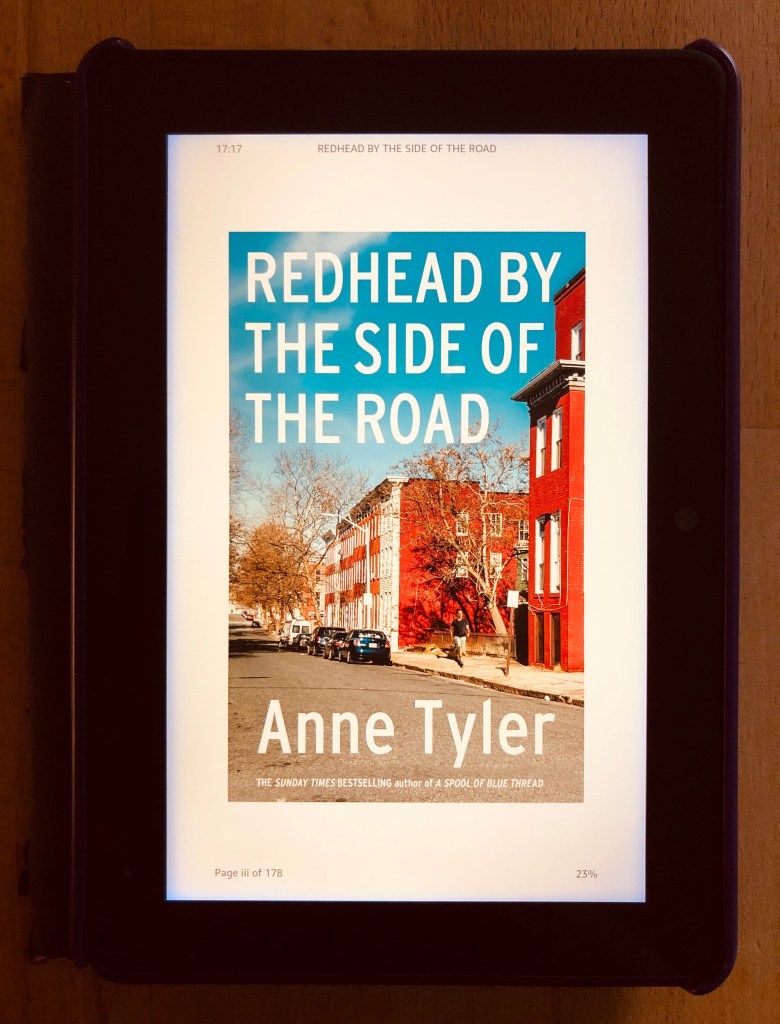
This week I have chosen to read Redhead by the Side of the Road by Anne Tyler from the Booker Prize Longlist 2020. It is the story of Micah Mortimer, an average forty-something who works as a self-employed tech support, ‘Tech Hermit’, a ‘super’ for his apartment block in Baltimore, ‘sweeping, shaking out the mat or conferring with a plumber’.

The second person narration in the opening line, ‘You have to wonder what goes through the mind of a man like Micah Mortimer’ has the feel of a chatty busybody whispering in your ear, almost asking if we should care about Micah. The narrative continues in the third person providing a distanced view of Micah and his current girlfriend Cassia Slade, ‘He has a girlfriend, but they seem to lead fairly separate lives.’ Similarly, his former girlfriend, Lorna Bartell is described as ‘so very, very sure of her principles’ again suggesting the space between them.

Micah is the story. There are no big plot twists or crashing conflicts. Rather, Micah’s life is quietly laid bare, with subtle storytelling that equals the balance he strives for in his life and is exemplified in the description of his daily routine, ‘At seven fifteen every morning you see him set out on his run. At about ten or ten thirty he slaps the magnetic TECH HERMIT sign on the roof of his Kia.’ The narration continues to follow his every step, including systematic spotless cleaning, as he keeps his life in perfect order, even keeping faithful to the ‘Traffic God’, pretending to adhere to an ‘all-seeing surveillance system’ when he drives.

The meaning of Micah’s life, and life in general, is addressed in the opening ‘Does he ever stop to consider his life? The meaning of it, the point?’ leading the reader to wonder if he will ‘spend the next thirty to forty years this way’, a state of paralysis and in somewhat of a minor existential crisis.

Interspersed between Micah’s routine are descriptions that languish in the fullness of building character and setting. Micah is described as ‘a tall, bony man in his early forties with not-so-good-posture – head lunging slightly forward, shoulders slightly hunched’. His client, Yolanda Palmer, ‘a dramatic-looking woman in maybe her early fifties with a flaring mane of dark hair and a mournful, sagging face.’ Equally, scene descriptions vividly portray the family life of his sisters in ‘the general impression, as always, was a tumult: noisy, unkempt people wearing wild colours, fog barking, baby crying, TV blaring, bowls of chips and dips already savaged.’ This depiction is in direct contrast to Micah’s ordered life. However, there is a certain degree of closeness between the siblings despite Micah being the youngest and his older sisters’ teasing him for being ‘finicky’ and asking if it is ‘vacuuming day’ or ‘dusting day’ or ‘scrub-the-baseboards-with-a-Q-tip day’.

Enter Brink Bartell Adams, ‘a young man in a tan corduroy blazer’. Brink is described as a ‘rich kid’, ‘handsome’, ‘a boy, really perhaps not out of his teens’. As a catalyst, Brink creates disarray in Micah’s life by claiming to be his son. Micah is forced to confront not only his past in the form a prior relationship with Lorna, but his current relationship with Cassia.

As his routines unravel, Micah struggles to understand his family and girlfriends. Although eccentric, he is a loveable character. Will his world fall apart, remain static or will he be able to propel himself out of paralysis and take action? Redhead by the Side of the Road is a love story that is delicately written, compellingly ordinary and easily identifiable in its realistic depictions as well as disrupted routines, with which we can all identify.

Themes: love, friendship, habits, routines, second chances, misunderstandings, hope, family, sadness, loneliness.


All pictures and writing are my own unless otherwise credited. Permission must be obtained before any image reproduction and credit must be issued in any image reproduction or quotations. 


Blog, Creative Shorts, New Writing

Waste Land

IMG_0643 b

In the hazy summer, the light dazzling jewels, a thousand angels dance in the afternoon. The concrete, a galaxy paved on the ground, extends as far as the eye can see. Glossy stones glimmer in the sun, a sea of refracted light, searing bare feet. Heat waves rise up creating puddles stretched out like silk ribbons just beyond reach, mirages wavering and disappearing when you blink, a game of lost reality.

Almost monochrome, rainbow colours are bleached white and silver. Unrelenting, each wave of heat makes you wish you could turn it off as simply as a flipping a light switch, allowing night to fall, a security curtain, to close the day’s play. The city transforms, time slows to a veiled performance, a slow red bull.

A ball is kicked.

It bounces, crossing the concrete, a lone explorer in a sea of stone. It was time.

I turn away from the ball and head towards the gap between Cannon and Walbrook Street. It was time to leave the mad dogs to the mid-day sun and meet Fletch. When we get back to school in September and you get that inevitable question, what did you do during your summer? Fletch and I would have answers. No exotic holidays abroad, or second homes or climbing mountains. But real, hard evidence of the subterranean secret under our feet.

My face feels red and my freckles would have multiplied in the short time in the sun. I pull my hair up and tied it in a large top knot that wobbles as I walk. My feet sweat in the knee length wellies and the rubber knocks the bare skin of my legs. I look out of place wearing shorts and a t-shirt, a large rucksack on my back and a hoodie in hand.

Fletch is already at the entrance. He is taller than the wooden door and seems to have grown since yesterday, his arms and legs longer, his body wiry. I push my top knot a bit higher to give me extra height.

The secret rivers of London are actually no secret. They, the officials, have tried to excavate some of them, and others have been turned into sewers. Treasures have been found: coins, tools, shoes and even jewellery. But we aren’t after lost treasures of the Roman Empire or bones of long forgotten smugglers.

The air is cooler in the alleyway and we open the entrance and the damp air rises up is actually cold and clashes with the summer heat. I pull my sweatshirt over my head and place my head torch over my top knot like a crown and switch it on. We leave the streets of London behind and descend the ladder until we reach the bottom. The water pools around our ankles.

We are travellers looking for an ancient bronze door in the tunnels, perhaps a splintered landmark. The bronze door of London. A lesson taught for fun in history of the strange and mysterious of London. We go deeper than the tube lines. Deeper than the secret rivers. Deeper than the catacombs. Some say it leads to hell. Others, paradise.

I reach out and run my hand along the mossy wall as we descend; the tunnel is desolate. I thought of how empty spaces can frighten and when you are engulfed in emptiness, you can become hollow. A blank, devoid of meaning and purpose. You become nothing encompassed in nothing.

I shake my head and the head torch flicks from side to side illuminating the tunnel in bursts. These are dangerous thoughts and the waste land tunnel is playing tricks on me already.


All pictures and writing are my own unless otherwise credited. Permission must be obtained before any image reproduction and credit must be issued in any image reproduction or quotations. 


Bedside Table Reads, Blog

Shortlist Read: A Good Girl’s Guide to Murder

IMG_7088

Hello!

This week I have read A Good Girl’s Guide to Murder by Holly Jackson from the YA Book Prize 2020 Shortlist. It is a page turning, crime thriller where, Pippa Fitz-Amboi, tries to uncover a cold case murder in her small town of Little Kilton.

For her EPQ (Extended Project Qualification), as part of her A-Levels, Pippa’s research is based on the ‘2012 missing persons investigation of Andie Bell’ as well as the ‘implications of the press in their presentations of Sal Singh and his alleged guilt’, both of whom attended her school. The EPQ forms the basis of her investigation.

The narrative is presented through the Pip’s first-person production reports for her EPQ, ‘my production log will have to be a little different: I’m going to record all the research I do here, both relevant and irrelevant’. Transcripts of Pip’s interviews are also included and written in interview format:

‘Pip: Do you mind if I record this interview so I can type it up later to use in my project?

Angela: Yes, that’s fine. I ‘m sorry I’ve only got about ten minutes to give you. So what do you want to know about missing persons?

Pip: Well, I was wondering if you could talk me through what happens when someone is reported missing?’

In addition, the story is interspersed with third person narration such as how Pip behaves when she gets nervous: ‘Oh god, this is what happened when she was nervous or backed into a corner; she started spewing useless facts dressed up as bad jokes. And the other thing: nervous Pip turned four strokes more posh’. The transitions between points of view are seamless and provides the reader access to Pip’s thought process as well as omniscient knowledge of the other characters and events.

The fictional town of Little Kilton, based on Great Missenden, and the murder mystery is exemplified through a map, detailing: Sal’s house, Andie Bell’s house, the location of Andie’s car, the school and the woods. All locations that feel as though they could be real, creating a layer of authenticity to the narrative and an unnerving sense of the factual buried within the fiction.

The atmosphere of mystery is established from the outset with the Singh house described as ‘their home was like the town’s own haunted house’ with children ‘daring one another to run up and touch the front gate’. This image is reminiscent of the mystery surrounding the Radley house in Harper Lee’s To Kill a Mocking Bird where ‘Jem wouldn’t get any farther than the Radley gate’.

Pip has a Type A personality. She is smart, ambitious and highly organised. In the midst of her EPQ investigation, she tries to complete her application to Cambridge, prepare for a ‘pre-interview ELAT exam’, finish the ‘admission essay’ and take the entrance exam. However, the deeper Pip digs, her investigation has to potential to derail her future. Pip’s strength and intelligence as an investigator has hints of Riverdale’s Betty and Veronica Mars, unafraid and fact based, strong female protagonist role models.

Pip’s family is a reflection of contemporary families. Her ‘real’ father ‘died in a car accident’ when she was a toddler and she describes Victor (her step-father) and her brother Joshua, not as ‘just three-eighths hers, not just forty percent family, they were fully hers’. As a family unit they come in and out of the narrative, providing a support network and positive encouragement. Their closeness is demonstrated as Victor addresses Pip endearingly as ‘Pickle’. Victor adds moments of light relief in the narrative and is described ‘buoyant’. His actions are humorous as he ‘dramatically, gripping the banister reaching for the departing teenagers, like the house was a sinking ship and he the heroic captain going down with it’ while saying, ‘Fare thee well’.

As Pip works with Ravi, Sal’s older brother, they develop an ever-growing list of ‘Persons of Interest’ uncovering unlikely associations, lies and motives. With the detective skills of Agatha Christie’s Poirot and Miss Marple, in conjunction with the technology of contemporary society, Pip uses everything at her disposal: computers, mobile phones, photographs and police reports, in an attempt to unravel the mystery of missing Andie Bell, the supposed guilt of Sal Singh and uncover the secrets of a small town that hides a murderer.

Themes: murder, lies, secrets, deceit, truth, drugs, date rape, deceit, power, money, bullying, friendship, loyalty, belief, honesty, family


All pictures and writing are my own unless otherwise credited. Permission must be obtained before any image reproduction and credit must be issued in any image reproduction or quotations. 


Blog, Creative Shorts, New Writing

The Railway


IMG_0040

From the railway carriage I caught glimpses – a road here and a house there.  Fields. Hedgerows. Stonewalls. Colours blurred. Greys, greens and browns stretched like motorway trail lights. I rested my forehead against the glass; it burned cold. My reflection laced with the hills as the train charged along the track like a soldier in the heat of engagement. As the sun descended, little pieces of my reflection merged with the meadows and drifted away in the wake of the train. Swift like spirits, the carriages cut through the countryside and eventually came to a shrill halt at the village platform of Benson.

Commuters rushed off the train and buzzed away on scooters and bikes or walked briskly flat faced, oblivious to their surroundings and most importantly, unaware that I had loitered.

I walked along the platform towards the setting sun. Glowing white in the centre, surrounded by pale yellows and oranges, it slipped towards the tracks, its golden glory siphoning away any remaining warmth.

The ticket collector emerged from the station shop. I turned and watched as he crammed a large baguette into his mouth. He smiled with his mouth full before disappearing behind the security coded door.

Did he know?

‘You dawdle. Why do you always dawdle?’ Not Mama or Mother. Always Bria. Bria never shouted. Not really. Everything was always said on a soft breath with a harsh undertone leaving an edge that grew, taking control of my mind and heart, creating fissures where none had ever existed before.

The next train would not be long. Twenty, thirty minutes at most. My window of opportunity was closing, and I wished the sun would set faster before Bria knew I was late coming home from school. The electronic sign above the platform flashed yellow letters ‘Next Train: 22 min’.

The damp evening air made the skin of my face feel clammy. I knew it would happen if I stood still. Still like I had been petrified in stone millions of years old. Grandma never lied although Bria always said that she was, in no uncertain terms, off her rocker. But I trusted Grandma more than Bria and was sure they would show. One day. Today? Tomorrow? I know.

For when the sun meets the horizon, and the air numbs your nose, with the rising of the moon, out of their sleep they will stir soon, in a shower of Earthly dust, look to the skies you must, for the Faeries will be on the rise, with shimmering wings they soar like little spies, over houses and over walls, ready to answer your calls.

It’s easy to miss. People look but don’t see.

There, in the distance, along the tracks, glinting and glistening and flickering, closer and closer. Rising from between the railway sleepers, just a minute more for the shimmering to take form.

And the station master’s door slammed shut. I flinched. I blinked. And in that moment the sun had set, and night settled on the railway station.


All pictures and writing are my own unless otherwise credited. Permission must be obtained before any image reproduction and credit must be issued in any image reproduction or quotations. 


Bedside Table Reads, Blog

Longlist Read: Who They Was


IMG_7053b

Hello!

This week I have chosen to read Who They Was by Gabriel Krauze from the 2020 Booker Prize Longlist. A work of autofiction about growing up in South Kilburn, London, Krauze explores his young life of violence, drugs, murder, revenge and reputation but also of family, respect and education. The London Krauze inhabits juxtaposes images of London as a business as well as a tourist capital of the world and conveys a relentless, seething war that lies beneath.

Written in the first person, present tense, Krauze begins in medias res, ‘And jump out the whip and I’m hitting the pavement’ propelling the reader into his world and shockingly, into the mugging he is about to commit describing ‘And I’m creeping up fast to get behind her’. This is contrasted with the narration of when he is closer to the woman ‘I can smell shampoo and softness and then expensive perfume.’ This olfactory sensory impression lingers with the sibilance and walks a fine line between beauty and predatory. The violence of the scene when he ‘clocks she’s got a big diamond ring on her wedding finger’ is simply stated, ‘So I snap her finger back…it’s like folding paper’.

Written in a stream of consciousness, Krauze’s sentences vary from run on passages of action and imagery ‘and I’m running after the whip, inhaling the morning, glass needles of sunlight piercing through the sky and falling all around me…’ to sharp and simple, ‘I go to Uncle T’s.’ The brutal meets the beautiful as the language oscillates between slang, ‘I bell my boy Flipz like you brudda and I just got rushed by a whole bag of man in Grove’ and lyrical illustrations of ‘Grey clouds like heavy sponges tug on the sky’s skin and the sun hides its face from the city’ and sharp metaphors, ‘Two women in suits with bitter lemon-rind faces’.

Running parallel to the violence, jail and drugs, is Krauze’s experience as an undergraduate: ‘I’m doing an English degree at Queen Mary University’ as well as philosophical explorations, ‘one of the points that Nietzsche makes is that the morality is just a rule of behaviour relative to the level of danger in which individuals live.’ The oppositions of violence and education, different as night and day, often literally, as night of violence is followed immediately by a day of university lectures and seminars.

Krauze reflects on writing about prison as ‘feeling dead like I’m giving it something it doesn’t deserve.’ He furthers this portrayal using simple sentences and repetition that contrast with the long descriptions of violence, ‘Days without breath. Nights without silence. Dreams without sleep.’

In opposition to Krauze’s depiction of jail, his relationship with his family is poignantly reflected in how he missed Easter Sunday, ‘I’ve missed painting of the eggs with Tata’. This is a rare break in the armour and a realisation, ‘I don’t know what it is but I feel like somewhere out there I have lost part of myself.’ He further considers ‘time’ as ‘a strange land to walk through.’ This is particularly powerful, representing the transient nature of human life and that ‘this moment is just a whisper in the dark’.

In Who They Was, Krauze’s London explosively reveals modern life and its ghosts. It is a life that sits next to you on the tube, bus or university lecture. It is a life that walks the same streets and breathes the same air but oscillates on a parallel plane occasionally intersecting at tangents. However, amidst the despair, revenge and violence is an exploration of hope and what it means to be human.

Themes: despair, revenge, loss, death, betrayal, prison, education, family, love, hope, friendship


All pictures and writing are my own unless otherwise credited. Permission must be obtained before any image reproduction and credit must be issued in any image reproduction or quotations. 



Blog, Creative Shorts, New Writing

The Eye of Laertes


IMG_3390

I approach the Eye of Laertes. With a clear turquoise sea, you’d imagine sirens rising up to lure you to a destiny underwater. Well, it’s not like that and there is no ethereal music either. The light emanating from the Eye of Laertes, according to legend, is so strong it burns to death anyone who enters. The overhanging rock is low forming an overhang to the entrance. I turn the boat away from the archway. It’s a small motorboat, but not small enough to fit through the Eye. I rev the engine and the bow lifts off of the water and jumps up and down as I pull away.  Looking over the starboard side, the water near the rocks is a deeper turquoise. I hold the boat steady, then circle and turn it to face the Eye again. I cut the engine. There is a small anchor. I throw it overboard and wait.

I tend not to give much credence to legend. The facts are facts. That’s what they teach us in science anyway. Focus on the question. Research it. Form a hypothesis. Conduct an experiment. Observe. And form conclusions. Pac and I have been conducting experiments all summer. Now, it’s time to debunk the Eye of Laertes.

I hear Pac before I see him. The motor of his boat is clunky and old.

“Got everything!” He shouts. “Hey Mont! You ready?”

As Pac slows, I pull his boat close and use the rope to tie it to mine. It is full of wet suits and snorkeling equipment borrowed – stolen –  from his Dad’s surf shop. Pac’s Dad doesn’t like me. Says I’m a bad influence. We should be doing real work. Not pretend science. We should be getting ready for exams, and not messing about with the boat. But my logbook says otherwise. We’re going to make a great discovery one day. Before we’re sixteen. And be the youngest to submit papers to Scientific Today. I can feel it.

The rocks around the Eye of Laertes form a large circle and the only way in is through the Eye. Or to send a drone up. But pictures from drones that I’ve seen are never clear.

“Definitely ready. Let’s debunk!”

I take out my phone and open the logbook in Notes.

Research Question: Does the light from Eye of Laertes burn a swimmer to death

Hypothesis: Propose light source is strong, therefore blinding and confusing and disorientating a swimmer, thereby resulting in their death by drowning.

Experiment: Anchor outside the Eye of Laertes. Using snorkelling gear and sun reflecting scuba mask, enter water, swim through archway. Explore inner circle of sea and caves. Return to boats and write up findings.

I put my phone in my bag and slide it under the seat. Putting a wetsuit on in a small boat is difficult. I remember to note this for future explorations. We slip on the fins, they’re open heal fins, but should work just fine. We cover our eyes with the mask, fit the snorkel and tip overboard into the sea from either side of the boats. The water is cold, even in the wetsuit.

I adjust my breathing. Steady. Slow. Even. I give a thumbs up to Pac. He returns a thumbs up. I point towards the archway. We start to swim towards the Eye of Laertes. The light is strong, and I can feel the sea warming up as we swim through the stream of light.

When we pass under the overhanging rock, something changes. The light intensifies. It becomes more than swimming in a stream of light. I look over to Pac. He’s pointing forward and indicates for me to go first.

I take the lead. Things to note: light intensifies, water warmer, rock formation around arch reflects blue of the water. No hell fire burning.

Entering the Eye of Laertes, the light obscures the other side. I can’t see the rocks or the sea or the sky and then it hits me. The heat.


All pictures and writing are my own unless otherwise credited. Permission must be obtained before any image reproduction and credit must be issued in any image reproduction or quotations.