
Bedside Table Reads, Blog

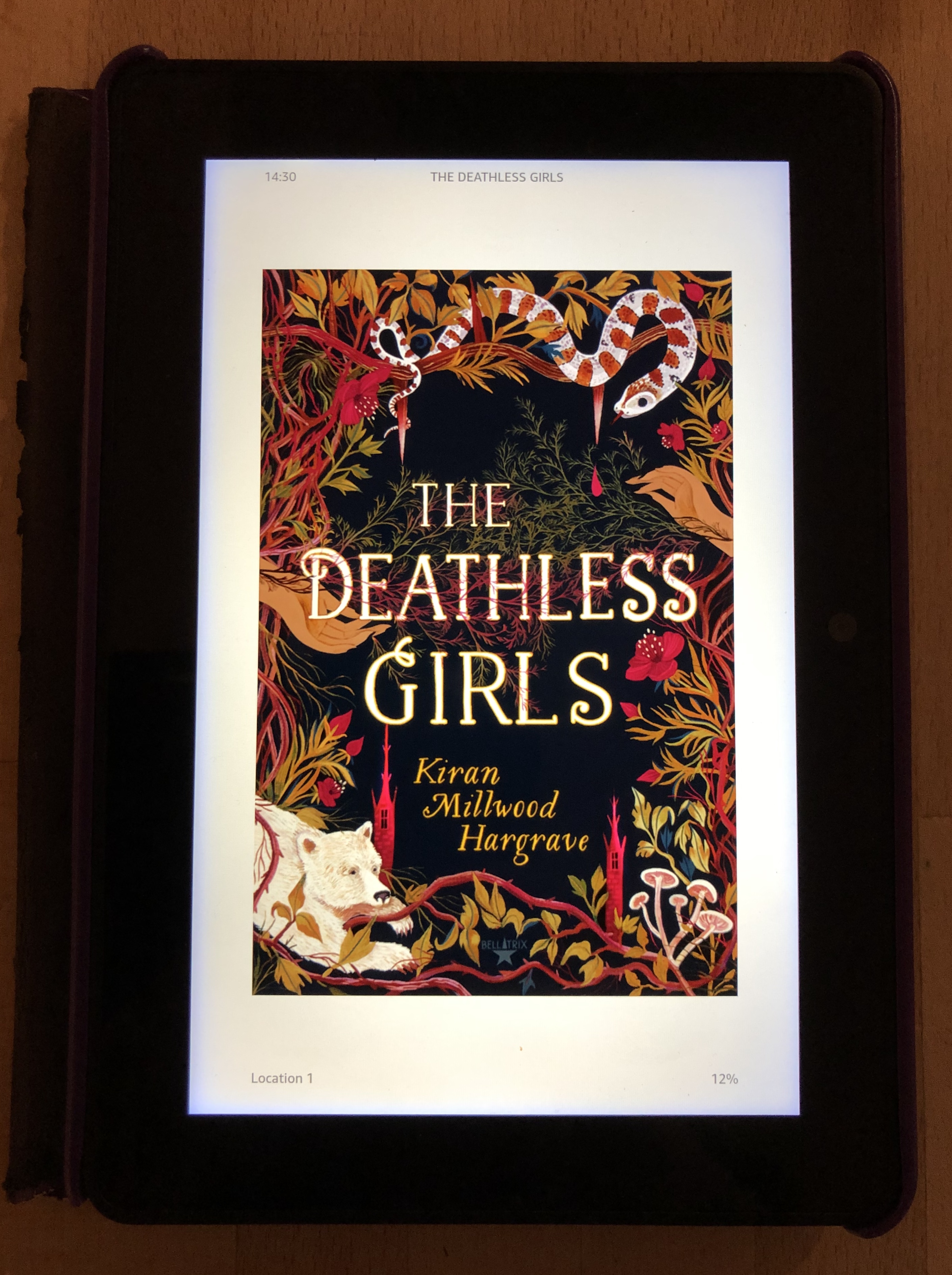
Shortlist Read: The Deathless Girls

Hello! Happy Halloween!

This week, in keeping with the Halloween spirit, I have read the suitably spooky gothic novel The Deathless Girls by Kiran Millwood Hargrave from the YA Book Prize Shortlist 2020. The Deathless Girls is from the Bellatrix (female warrior) series and aims to give voice to female characters in literature that have historically been consigned to the shadows, and in this case – the brides of Dracula.

Hargrave opens with two quotes, Catherynne M. Valente’s ‘that’s how you get deathless’ and Bram Stoker’s ‘She shall not go into that unknow and terrible land alone’. Both quotes set an ominous atmosphere of mystery and suspense with the references to ‘deathless’, ‘unknown’ and ‘terrible land’. The addition of a glossary adds a supernatural quality with the vocabulary ‘Demoni (Demons)’, ‘Iele (Forest spirits)’ and ‘Strigoi (Undead)’. These two pages successfully set the scene for the story of twin sisters Kizzy (Kisaiya) and Lil (Lillai) – Travellers – to unfold. Written in the first person from Lil’s point of view, Hargrave begins the narration with an ‘Aftermath’ where the arrival of the soldiers was the beginning of the end. The combination of the quotes, the glossary and the ‘Aftermath’ establish the gothic nature of the novel with an unnerving darkness that resonates throughout.

The inciting incident of the soldier’s attack opens the main narrative and occurs just before Kizzy and Lil turned seventeen, the day before their ‘divining day’ where they would receive the prophesy of their future. This attack is brutal and described as ‘the circle of blazing wagons was crawling with black-clothed men in crimson sashes, wielding long, glinting sticks’. Kizzy and Lil are enslaved and taken to their fully gothic destination – a castle described as ‘ridiculous and looming’ and ‘its turrets pierced the sky, black needles against the clouds, sharp as bared teeth set in grey gums’. Upon arriving at the castle Lil describes how their friend, Fen, was sold ‘I felt nausea rock my stomach. They were bargaining over Fen and the others like they were livestock’. The link to antebellum slavery runs throughout and speaks to the loss of identity, freedom and choice that the characters experience with some invasive descriptions such as ‘she peered into my mouth, ran her finger along my teeth’ where Lil ‘felt as though I was floating above my body’.

In addition, conflict is established between the ‘Travellers’ and the ‘Settled’ the with the ‘reasons that the Settled hated us [Travellers] were man and stupid: because we had brown skin, because we lived in wagons, because we called no land our own’ further linking to the theme of divisions and a sense of power.

The supernatural features throughout adding layers of tension as the ‘Settled think all Travellers are gifted, or at worst, sorcerers’.  Additionally, the ‘monster’ lurks throughout in the form of the ‘Dragon’ who ‘razes whole villages that disobey his commend. He is an evil man, with a black heart. Some say he’s worse than a man, has no heart at all’ implying his vampire nature. By defocusing on Dracula and the vampires, Kizzy and Lil are successfully brought to the foreground. However, as the gothic horror genre is a firm favourite, I would have liked the vampires to have appeared earlier in the novel fully harnessing the gothic and allowing greater scope to explore the decisions Kizzy and Lil will have to make.

Aside from the strong connection between twins Kizzy and Lil, the relationships between Kizzy and Fen as well as Lil and Mira skim the novel. Because the main focus is on the bond between the twins, Fen and Mira and their connection with Kizzy and Lil could have been explored in greater depth further supporting the main characters and allow the reader to invest more heavily in them. However, the strength of Kizzy and Fen’s feelings are expressed when Fen shouts, ‘Leave her!’ when one of the enslavers ‘placed one of his own foot on one of Kizzy’s wrists’. The deep connection between Kizzy and Fen is alluded to throughout and unfortunately for Kizzy, not supported by the divining prophesy which successfully creates suspense and leads us to wonder if they will ever be together. Lil and Mira’s relationship develops quickly and as the potential third bride of Dracula, Mira’s character and her connection with Lil is significant; the three are described as ‘the three sisters – two dark, one fair […] the beautiful damned […] the deathless girls’.

If you did not pick up on the Dracula narrative undertones, you would be surprised at the turn of events towards the end of the novel. The story of enslavement, liberty and choice ultimately allow for an exploration of the characters’ lives prior to becoming the brides of Dracula. In contrast to the lengthy exploration of Kizzy and Lil’s lives up to this point, the exposition of girls’ decision making is quick; such an important decision could have had greater contemplation and discussion within their dialogue. Despite the fact that the vampires do not make an appearance until nearly the end of the novel, the sisterhood and the bond between twins is successfully conveyed with gothic elements replete with dark castles, mystery, suspense, supernatural, weather, dreams and nightmares. And who doesn’t love a good gothic horror?

Themes: sisterhood, relationships, female love, enslavement, gothic, mythology, magic, travellers, vampires, choice, immorality, superstition, dreams, nightmares, darkness, folklore, persecuted


All pictures and writing are my own unless otherwise credited. Permission must be obtained before any image reproduction and credit must be issued in any image reproduction or quotations. 


Blog, Creative Shorts, New Writing

Red Rock

All I actually remember of that day was that the morning was bright and clear, but by evening the storm had changed everything. What happened in between, I have pieced together from the disconnected threads of my memories, family stories defended at holidays and rumours whispered in the village shop, after church and at school.

We had not been at Red Rock long. A few months, at most. The island, contrary to its name, was not red. It was the lighthouse base that was built of red brick and rose out of the cliff edge like it had grown there as naturally as the trees and rocks that surrounded it. The base was a two-story fortress with a total of twenty small sea salted windows that would never be clean; the only way to really see out was to open them, exposing the room to the heavy damp. The tower was a similar red with the addition of white bricks; it marked the end of the island like fairground sweet. Inside the tower there was a spiral staircase that stretched from the basement to the lantern room where there were two galleries: the main lantern gallery and a watch gallery just below. We were never allowed on either gallery. No one except Pop was allowed to the very top. Pop couldn’t bare it if something had happened to us, after losing Mama and all. That’s what Margaret said. But Pop only pretended to listen to Margaret and when she went to the mainland for supplies, Clarise and I raced up the spiral stairs to the lantern room to watch out for ships until she came back and we were under our stepmother’s thumb again.

That morning, the sea was unusually calm and the sky a deep blue with only a few strands of white cloud that stretched across the from one side to the other like white rainbows. Clarise and I played around the foundation of the tower. It was only out of the corner of my eye that I would ever see him. A shadowy figure always disappearing. Pop said the island was filled with stories of lighthouse keepers past but they were nonsense. He didn’t believe in anything. Not after Mama. There was no God. Margaret was always quick to counter, saying that it’s important to have faith. She never said what to have faith in, but whatever it was, Pop was only interested in keeping the faith of the lantern – that’s what he was hired to do. But when you’re ten, you see everything. And I saw a shadowy figure. Clarise, a year younger, always listened to her older brother. It was a given and if I saw it, she saw it.

Someone had come to the door that day, a man in a suit, and had an argument with Pop. Their voices were raised and coarse as they stood in the doorway; Pop wouldn’t let him in. The man’s car was noisy and rattled as he drove away. Margaret baked a carrot cake – she had opened the window and the fruity sweet smell seeped out and mixed with the salty taste of the air.

Mrs Reynolds from the village shop said that Pop went after him. I don’t remember that. Pop closed door. Or was it the man’s car door that had closed? It’s hard to tell when the wind gets up and as they argued, the wind had grown stronger. I know because our ball rolled farther away. Or did it roll farther away because Clarise had given it a good whack because I wasn’t paying attention to her?

Clarise and I ran after the ball. We could see the road winding in and out of the trees as we approached it. And on the road, I saw the car, the man’s car appearing and disappearing through the trees. Mrs Thatcher, our schoolteacher, said it was Pop’s car. Both cars were dark blue, the man’s was rusted but could I see the rust from where I stood? I don’t remember Pop getting in his car, but the sky had darkened, and it had started to rain. Clarise wanted to go inside. She kept pulling my arm. I pushed her away and she fell in the mud. She cried. I told her I had to get the ball. I didn’t see her leave. I thought she’d wait for me. Margaret said she couldn’t find Clarise. But I was sure she could see us from the open window. When I returned, the window was closed. She said she couldn’t see us through the closed window – that’s what she told the police.

I walked back alone, shouting for Clarise as the rain grew heavy and my voice was lost in the growing storm. Father Vincent said he saw me sitting on the church wall. Did I stop to sit on the church wall in the storm? Did I walk that far? I remember the shadow that grew closer to me as I returned to the lighthouse. I remember hearing the crash. Everyone remembers hearing the crash. The fire rose from between the trees and even the storm did not dampen its intensity. Where was Clarise? Father Vincent said he helped me into the church. I do not remember being in the church. I remember holding the ball. The muddy ball. It was cold in my hands and my fingernails were caked in mud. I can still see my muddy fingernails. Was I chilled because I sat in the church? I remember shivering and the shadow grew so close to me that I could almost touch it.


All pictures and writing are my own unless otherwise credited. Permission must be obtained before any image reproduction and credit must be issued in any image reproduction or quotations. 


Bedside Table Reads, Blog

Longlist Read: Such a Fun Age

Hello!

This week I have read Such a Fun Age by Kiley Reid from the Booker Prize Longlist 2020. Set in Philadelphia and New York, this is the story of Emira Tucker, a Temple University graduate who is trying to find her path in life. It is also the story of Alix Chamberlain who is married with two children and has a career as an influencer. The relationship between Emira and Alix explores racial profiling, parenting, racism, inequality, class and privilege through stereotypical characters and humour.

Written in the third person, the narrative alternates between Emira and Alix. Opening with a racially profiled encounter, Emira (African American) is employed as a babysitter by Alix. On her night off, while at a party, Emira receives a call from Alix asking her to take three-year old (Briar) out as they deal with an incident at home. While taking Briar to Market Depot, Emira is challenged by the guard with ‘Is this your child?’ and ‘Any chance you’ve been drinking tonight, ma’am?’ as well as another customer ‘And I heard the little girl say that she’s not with her mom.’ The exchange is recorded by Kelley Copeland who befriends Emira and emails her the recording promising to delete it. Emira is rescued from the situation by Mr Chamberlain. The plot unfolds from this event and spirals as Emira explores her options without Alix and Alix connives ways to hold on to Emira. This underlying tension successfully pervades the novel.

Emira typifies young graduates today searching for a ‘grown up’ job with health insurance; she is against the clock because ‘by the end of 2015, Emira would be forced off her parents’ health coverage. She was almost twenty-six years old’. For Emira, her babysitting job is more than a job. She bonds with Briar in a way Alix does not. Like many graduates of the ‘slash generation’, Emira is highly identifiable, working additionally as a transcriber for the Green Party Philadelphia typing ‘125 words per minute’ as well as an ‘on-call transcriber’ for Temple University.

Alix, a New Yorker at heart, agrees to the move to Philadelphia, has two children and longs for her city friends: Jodi ‘a casting director’, Rachel ‘proudly Jewish and Japanese, managed a firm that designed book covers’ and Tamara, a ‘principle of a private school in Manhattan’. Alix pines for her New York life and submerses herself in social media, book deals and products while caring for her younger child, Catherine, ‘with her revamped blog, detailing the success of other letter-writing promotion-receiving getting-what-they-want women, had six thousand hits a day’. Many will identify with juggling work, children and a loss of identity. Alix’s relationship with Briar, is challenging and at times comical, but a sadness pervades the relationship. Briar’s voice is one that ‘consumed everything in its path’, ‘it was loud and hoarse and never stopped’ and the relief of Briar sleeping is described as ‘it was as if a fire alarm had finally been turned off’.

Reid sets the stage for the relationship between Alix and Emira to be linked by more than just an employer-employee association and the narrative takes an unexpected twist with Emira dating the pushy Kelley Copeland, who just happened to also have ‘ruined Alex Murphy’s senior year […] before she became Alix Chamberlain’. Kelley is described as ‘one of those white guys who not only goes out of his way to date black women but only wants to date black women’. This successfully establishes further underlying tensions between Emira, Alix and Kelley.

While Emira sees babysitting for the Chamberlain’s as a job, Alix becomes increasingly, and strangely, obsessed with Emira, her welfare and future. Invading Emira’s privacy, Alix checks her phone: ‘Alix felt betrayed by Emira’s cell phone. These were the first plans Emira had in the last month that Alix hadn’t known about before she pretended she didn’t’. Alix makes decisions on what she thinks will be best for Emira stating: ‘you might be too young to understand this right now, but we have always had your best interests at heart’ and emphasising her love for Emira ‘we love you’ as part of the family regardless of the fact that ‘they made her wear a uniform’. This ‘white saviour’ behaviour underscores Alix’s privilege and highlights the further distinctions between them.

The themes of Such a Fun Age speak to very relevant topics that do need discussing. Emira is a highly likeable and believable character. Alix, veers far in to the stereotypical at times and oversteps credibility with her actions, dialogue and obsession. Equally, Kelley’s questionable behaviour gives the impression of harbouring sinister strands. Such a Fun Age does intertwine deeply important explorations of race and privilege while questioning if there is a ‘fun age’ through humorous dialogues, encounters and relationships.

Themes: racial profiling, class, inequality, parenting, motherhood, privilege, white saviour, family relationships, friendships, love


All pictures and writing are my own unless otherwise credited. Permission must be obtained before any image reproduction and credit must be issued in any image reproduction or quotations. 


Blog, Creative Shorts, New Writing

The Phantom

It was an early morning in spring. But it could have easily been midwinter. The fields were covered in a thick frost and a gauzy fog hovered above the ground, stretched thin in long layers and blocked out the dawn. If I waited, the sun would eventually burn through the fog, however, there was no time to delay, she would have the paddle steamer fired up and ready to go. One thief alone – always caught, two thieves – disappear like ghosts.

The frost melted around my canvas trainers as I ran; it formed an undulating water mark of dark blue and my toes were cold even though I had started to sweat in the thick mac. The further I ran into the fog, the thicker it became and before long, it surrounded me. I stopped. It’s always best to stop when you are not sure. Take stock…you know, take a moment and think. If you panic, the answers become blurred. And when you need answers, you need to be clear headed. That was one of my strongest qualities. The ability to think clearly when everyone else is lost in hysteria.

Standing still made my feet feel even colder and wetter. The fog cut close to my face and as I breathed it in, the damp hung in my lungs, seized its membranes, and forced me to take suffocating short, quick breaths. Cold induced asthma took hold, but I stuffed my hand into my coat pocket and pulled out my inhaler. I sucked in two quick puffs and closed my eyes waiting for the drug to work. Slowly, my chest eased, my lungs were released from the freezing fog. I replaced the lid and pushed it back into my pocket and grabbed hold of the silver compass. It was attached to a silver chain, but I had refused to wear it, it was Mother’s and wearing it somehow seemed wrong. I pulled it out. It was cold, the kind of cold where you couldn’t tell if the silver was burning or freezing in the palm of your hand. I rubbed the compass with both hands to get it started; the sapphire set in the centre of the radiating sun rays glowed. I clicked the catch at the bottom, the lid popped open. I watched the arrow spin and then headed due south.

I was slightly off course, but not too far. As I neared the river, my shoulder ached with the weight of the satchel and the leather cut into my collar bone. I had slung it over my head and diagonally across my body so it wouldn’t fall off. I could never carry the school satchel on one shoulder; the strap would always slide off my narrow shoulders. But now, it wasn’t filled with my computer, books, or a pencil case. I carried silver, and silver was heavy and necessary; it was the only chemical that could link the compass with its originator. The brown leather bulged and was held closed by only one of the straps. The other, flapped freely as I followed the compass.

I heard the chugging of the paddle steamer but saw nothing; it was a whispering ghost waiting for me. As I neared the river, the fog thinned, and I caught the glint of gold at the very tip of the bow. If you weren’t looking, you would miss it. The rest of the steamer was veiled in a ripple vacuum, but I knew the small red outline was there, with the paddle wheels at the stern and the smaller thin wheel on the port side. It was as if a small wooden train engine was set in the hull of the boat; it had a small deck at the front and stairs up to helm.

“Run!” Ornella allowed her voice to break through the vacuum.

I looked behind and could see dark shadows growing larger in the fog. There were at least three. I snapped the compass shut, held it tightly and ran towards her.

“Hurry sister!” she said.

Ornella was older than me at fifteen, but only slightly, by ten and a half months. However, that ten and a half months meant the difference between giving orders and receiving them. The compass pointed me directly to the small port side paddle wheel; I trusted in the compass completely and launched myself over the river. Ornella pulled me up onto the deck.

“Let’s go, Odinia!” She shouted as she jumped up to the helm and pushed the steamer into action; it rumbled underneath my feet and we were off.

The shadows had slowed. I knew they couldn’t see anything. I watched as they faded into the fog then joined Ornella at the helm. Dropping the satchel behind her, I sunk into the folding chair by the fire and slipped off the canvas trainers and hung my wet socks over the arm of the chair to dry. Ornella was strong and serious, when she turned and looked at me, she smiled but I knew as soon as her back was to me, her mouth would be drawn in a tight, thin line piloting The Phantom to our next heist.


All pictures and writing are my own unless otherwise credited. Permission must be obtained before any image reproduction and credit must be issued in any image reproduction or quotations. 

Bedside Table Reads, Blog

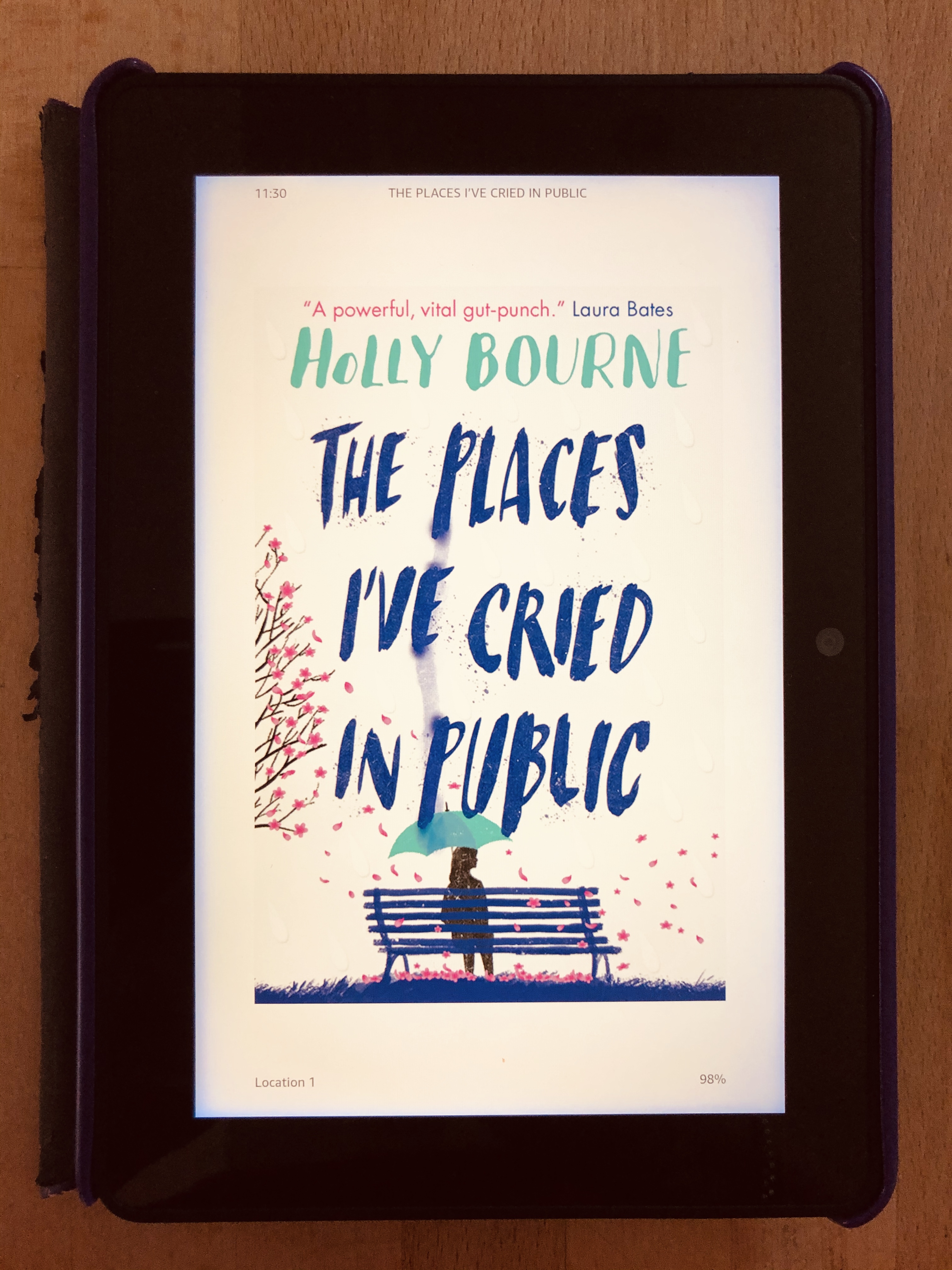
Shortlist Read: The Places I’ve Cried in Public

Hello!

This week I have chosen to read The Places I’ve Cried in Public by Holly Bourne from the YA Book Prize Shortlist 2020. This is a story of Amelie and the boy she loved first (Alfie) and the boy she loved second (Reese). It is the story of Amelie’s journey through the locations that she’s cried to discover why loving Reese was so painful, confusing and frightening and not at all like loving Alfie, who was safe, comforting and gentle.

The narrative is written in the first person and alternates between Amelie’s present and her past as she excavates her memories through flashbacks of where she has cried in public, to discover how she has ended up so hurt and confused. Amelie’s life changes when her family has to move from Sheffield to a town outside of London. She leaves the security of her boyfriend Alfie, her friends, and all that she loves about the North describing it as ‘It’s all duck and pet, and it’s lovely, really it is. You feel like everyone is a friend’.

Starting A-Levels in a new town, a new school and being a painfully shy singer/songwriter who suffers from a ‘shyness rash’ and has a ‘full-blown obsession with cardigans’, Bourne, establishes a vulnerability in Amelie and the ensuing obsessive love/hate relationship with Reese where she ‘fell hard for Reese’ and it ‘looked like love’ and ‘felt like love’ but is not sure if love is ‘supposed to hurt like this’.

Amelie begins her journey on ‘this bench’ which is ‘Dot Number One’, ‘the first place I ever cried in public’ and addresses Reese and his new girlfriend: ‘You’re smiling at her from under your trilby hat. You’re looking at her how you use to look at me. It hurts in such a profound way that there almost isn’t room for it in my body.’ The pain is so acute and so raw that as she contemplates ‘Why am I doing this to myself?’ the reader wonders if her parents, and new friends: Hannah, Liv and Jack, will be able to extract her from the toxic relationship with Reese before she self-destructs.

Reese, like a ‘radiating magnetic force field’ and ‘dressed – like an old-fashioned British dandy’ as ‘his hat matched his waistcoat’ is mesmerising. What starts innocently for Amelie, in hindsight is the beginning of Reese’s manipulation, and she addresses him ‘you were waiting outside my music lesson’ then flashes back to the scenario, ‘He tipped his hat again, leaning against the wall, one knee bent, looking so damn cool.’ Amelie describes the attraction of Reese as ‘J.R.R. Tolkien couldn’t even dream up a quest more enticing than going to the music block with Reese Davies.’

But the closer Amelie gets to Reese, the further away from her new friends and family she becomes, and understands less and less about love and relationships, where ‘even after the best night of my life, you still manage to make me cry’. Reese, like a drug, is described as a ‘giant sexy magnet’ and Amelie states that she felt ‘like I was wearing chainmail’.

Amelie’s journey, ‘the dots on the map where you made me cry’, is self-destructive at points as she believes that she is ‘sure it’s all my fault somehow’ and if ‘only I’d done things differently’ and ‘been…less me, then I wouldn’t have driven you away’. This confusion and misconstrued belief that Amelie is somehow at fault for the destructive relationship, is so powerful, sad and infuriating that as a reader, you want to reach into the book and help her to see that it is not her, but Reese and no one should ever be ‘…less me’.

We have all been there, crying alone in some public location: ‘train station waiting -rooms’, ‘dance floor of clubs’, ‘bus stops’, ‘at the back of lessons’, ‘on the pavement’ and ‘cold concrete’ and in ‘school bathrooms’ – one of the questions The Places I’ve Cried in Public raises is why no one stops to ask if you need help? Being privy to Amelie’s detailed descriptions of psychological abuse, this book is a call to humanity; we are not alone, and we need to help each other. It is a must read, as we all ‘have a voice’ and we all have ‘a song to sing’ and above all, we all need to be able to say, ‘I am safe’.

Trigger warnings: physical, emotional and mental abuse and manipulation

Themes: coming of age, love, first love, grief, abuse, trauma, forgiveness, toxic relationships, manipulation, therapy, mental health


All pictures and writing are my own unless otherwise credited. Permission must be obtained before any image reproduction and credit must be issued in any image reproduction or quotations. 


Blog, Creative Shorts, New Writing

The Witching Lake

It was our first summer at Lake Roake.

The white sands that surrounded half of the lake’s shore made you think you were in Hawaii rather than England; actually, it was probably somewhere near Lincoln. The lake, a giant crater, wide and deep, was surrounded by trees that kept its secrets from leaking beyond the wooded perimeter. The far side of the lake was so far it almost felt like an ocean when the sun set in the distance and obscured any hope of seeing the faint image of the wood opposite. Pinwheel roads that jutted out from the lake were mostly hidden by the trees, but when you reached the end of each road, the view opened and the white sands dared you to cross as the lake beckoned with glittering reflections, in the day – of sunlight, and in the night – of moonlight.

Mum had specifically avoided holidays near water after the time we rented a cottage with a tidal river at the end of the garden and no fencing. Nightmare, just a nightmare, was all she said for the whole two weeks, who would rent this house to a family with toddlers? I kept having to tell her to forget about it and that if we went now, the law about access to water with children around had probably changed anyway. The twins were now seven and knew how to swim, old enough according to Mum for a summer holiday by the lake. Mum spent the week before in a frenzy of list making – beach towels, beach chairs, goggles, swimming costumes, sunscreen, sun hats, picnic basket, floats – you name it, and Mum jammed it into the car.  

“A summer of bliss,” Mum said smiling as we finally drove east with the car piled high.

Dad was meeting us at the cabin after work. Mum said that he would be in and out all summer commuting to work; she felt we needed a car as well, justifying a two-car holiday for one family of five. For me, it meant that I was able to sit in the front, away from Isla and Lynn, and control the music from my phone. I was twice their age and the gap between us grew larger each year.

“Rosemary, turn that off now and read me the directions from the owner.” Mum handed me her phone. “Look in my mail – Ameila Waterbone.”

I scrolled and found the email and read: ‘It’s the largest lake in the area. Fresh water with the power to magically heal. It’s what remains from the formation of glaciers hundreds and thousands and thousands of years ago.’

“Rosemary, please, the directions? She said the post code doesn’t take you to the right place.”

I scrolled down and read: “For the southern approach – take the ring road counter-clockwise to the east exit to Hill Street. Pass Lake Roake Park, pass Madison’s Farm Shop and the boat launch and there…there it is.” I said pointing at our cabin. It was not so much of a cabin but a large house with a porch and a view with access to the lake.

Isla and Lynn jumped out and Mum screeched after them laying down the rules for the lake. “Don’t go off of the porch without an adult. Don’t go on the sand without an adult. And don’t for any reason, and I do mean any, go in the lake without an adult.”

I started hauling in our luggage. It was less altruistic and more selfish; I figured if I helped unpack, I’d get to choose the best room. I was right. Mum was pleased and I chose the room at the front of the house that looked out onto the lake; the best part was the balcony, something Isla and Lynn weren’t allowed to have – they might fall out, or jump, basically Mum found it a problem for them as they were just ‘so unpredictable’ in her eyes.

I took my journal out of my bag, opened the door and stepped outside to take in the view. My journal does not document my life or have any deep dark secrets, not really, just words or thoughts. And so far, this lakeside holiday was pretty good. I wrote:

Arrived at Lake Roake. Sunny and warm. Bedroom at front of house. Bed has a yellow and pink patchwork quilt. Balcony. View of white sand and lake. Imagining I’m somewhere exotic and far away. Feeling good. Not at all jittery. Only three lies so far today. But it is still early in the day.

I count my lies. There’s nothing to it. I just like counting them. Most people don’t even know when I’m lying and sometimes, I make a column for lies people recognise and a column for lies they don’t.

I opened my suitcase. I had decided to live out of my suitcase. At least to start. I didn’t want to waste a minute of the sunshine. It could change so quickly. I put on my bikini and a beach dress. I pulled my dark hair up and piled it on top my head as I slipped on my flip-flops. I slung a blue and white stripped beach bag over my shoulder. I had already packed it with sunscreen and a towel. I grabbed my phone and water bottle and headed out to the sands. Isla and Lynn were already parked in front of the iPad and didn’t see me leave. I closed the front door quietly and felt the freedom of the lake calling me.

The trail was easy and led directly from the house to the sands. To the left and to the right, not a single soul could be seen. Maybe tourist season hadn’t started yet, I thought. Mum had said that the lake was one of the less visited, hence why we could get such a good location at late notice.

As I walked, I let the pure white grains sift over the top of my feet; they looked like strange sand creatures from a science fiction movie. The water at the edge of the lake was a deep blue almost as pure as the sand. I videoed my feet, the sand and the water. The edge of the lake seemed shallow, and there was no tide, it just seemed to heave or pulsate towards the centre. I put my phone and water bottle into my beach bag and let the bag drop to my feet, then I slipped off my dress and left it on top of the bag. Security. Someone would have to move my dress before they stole my phone. An effort.

It was only three steps to the lake; I approached slowly. No, I approached cautiously. As I stepped into the water, allowing the coldness to flow over my toes, a boy’s voice screeched at me, “NO! GET OUT!”

I jumped back and dislodged the white sand sending it flying as I fell backwards.

“What are you doing?” he demanded.

“Hey. What’s the big idea?” I said brushing the sand off of the palms of my hands. “Has there been a chemical spill or something?”

“No. Don’t you know? They’re supposed to tell everyone.” The boy said.

“You’re crazy.” I said standing up and headed towards the lake.

“You can’t go in the lake.” He said and moved to block my way.

“Back off.” I said stepping around him. But he moved again. His blond hair fell in his eyes as he formed a barrier between me and the lake.

“As I said…” He spoke very slowly and calmly and pushed his hair off of his face. His dark eyes were wide and serious. “You can’t go in the lake.”

I pushed him out of my way and as he fell, I quickly walked around him. Before he could stop me, I marched into the lake up to my knees but jumped backwards almost immediately. The water was icy – icy like a snowy mid-winter day. The blood in my veins ran cold and it gripped my heart. But it was not the cold or the pain that tightened in my chest, it was what I saw in the middle of the lake. She was there, in a small boat, just for a moment.

“Are you okay?” He knelt next to me. “Look, I told you not to go into the lake. I saw…I saw you arrive with your Mum. Why don’t I help you back to your cabin? They should have really told you.”

I blinked. There was nothing there. On the lake. No lady. No boat. I let the boy help me to my feet. It made no sense.

“What’s out there? On the lake?” I asked him as I picked up my dress and threw it over my head.

“Nothing’s out there on the lake. It’s what underneath.”

I hitched my bag over my shoulder, I said, “What’s underneath?”

“Look. No one goes in the lake.”

“That’s stupid. We’ve come here for the summer and can’t go in the lake? We’re going to roast in our cabin. No pool. No lake. Nothing.”

“The risk is huge if you swim in the lake.” He said. “Look. It all began a long time ago. But you know what happens if I tell you a story and then you tell it to someone else. It changes a little bit with each retelling, however, even if the details have changed over the centuries, it’s still about love and death, you know. There was a lady, in a time before all of this, who was in love. And as you’d imagine, it was a tragedy; she lost her love. But the anger that followed, well, was unlike any anger anyone had known, and festers will all of the bodies that lie at the bottom of the lake.”

“That’s crazy.” I said but even as the words came out of my mouth, I wasn’t so sure.

“Look, hundreds of people have drowned here. And all I’m saying is don’t be a statistic for this summer. There’s a pool in town.” He said holding out his hand. “Evan. Maybe we could go together?”

“Rosemary.” I said taking his hand, shaking it tentatively and vaguely agreeing. “Alright.”

The pool would be warmer at least, I thought. Evan ran off before we reached the end of the path to the cabin.

I pushed the door open and Mum was talking to someone in the kitchen.

“Hey.” I said as I entered. “I met this kid called Evan and we’re going to check out the pool later in the town. Is that okay?”

The lady stopped mid-sentence and Mum said, “Rosemary. That’s not funny. Who told you to say that?” She turned to the woman in the kitchen. “Violet, I am so sorry. I don’t know what to do with her sometimes. Since the accident, well, the lies are just continuous.”

“I’m not lying. A boy called Evan told me not to go into the lake.” I insisted.

Violet stood up. “I think I’d better go.” She said as she shook her head at me.

“Rosemary, this summer is a chance for a new start.” Mum said as Violet left.  “I thought you said that you would try?”

“I am trying.” I insisted.

“Then set the table and stop lying.” She said as she handed me two plates.


All pictures and writing are my own unless otherwise credited. Permission must be obtained before any image reproduction and credit must be issued in any image reproduction or quotations. 

Bedside Table Reads, Blog

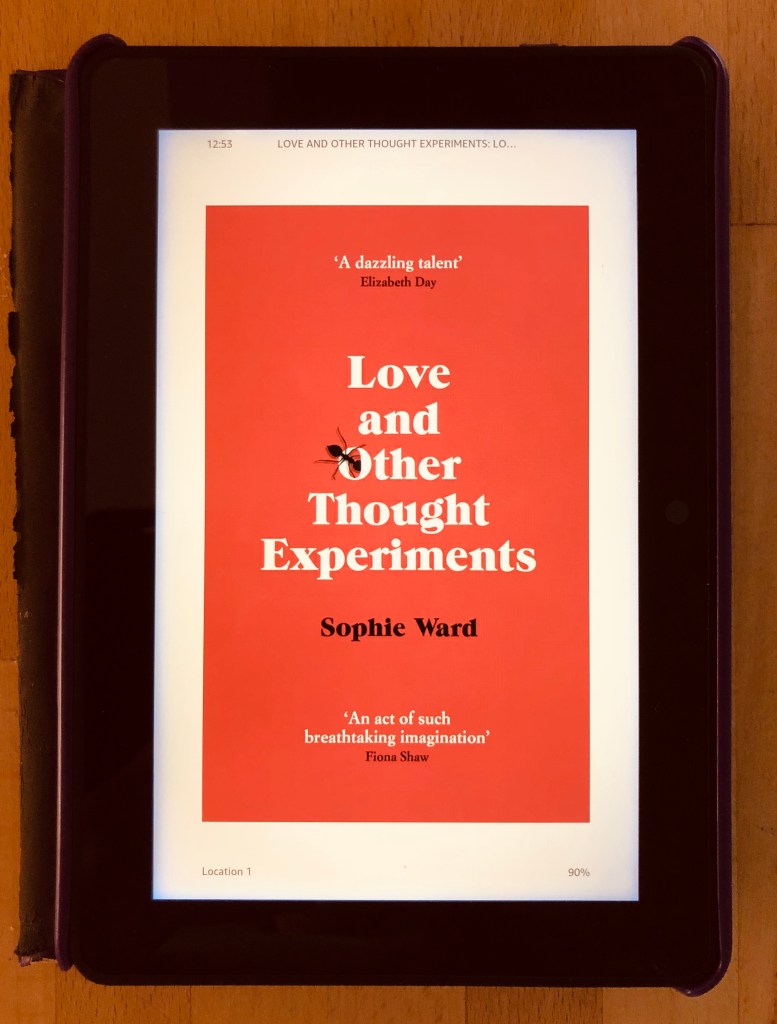
Longlist Read: Love and Other Thought Experiments

Hello!

This week I have read Love and Other Thought Experiments by Sophie Ward from The Booker Prize Longlist 2020. At the heart of the narrative is the relationship between Rachel and Eliza, their son Arthur, and Hal (Arthur’s biological father). These characters and their relationships form the springboard for a series of explorations of amorphous realities, what it means to be human and to love.

Each of the ten interlinked chapters begins with a thought experiment: Pascal’s Wager; The Prisoner’s Dilemma; To Be a Bat; Philosophical Zombies; What Mary Knew; The Chinese Room; Twin Earths; The Ship of Theseus; Descartes’ Demon and Gilbert Harman’s Brain in a Vat. The reader, almost as a psychologist, examines the characters within each experiment and must expect the unexpected with changes in point of view, time and space.

In Kafkaesque style, the narrative opens with Rachel who believes that an ant has crawled into her eye while she slept, ‘Something bit me…In my dream…it bit me…it’s gone into my eye.’ Eliza doubting her responds, ‘Nothing there…do you want some antiseptic?’ This singular event brings their very relationship into question with Eliza contemplating ‘in their four years together she had often felt like this, there and not there, connected, yet keeping a part of herself separate’. Regardless, they conceive Arthur on ‘Friday 24th October 2003’, time speeds ahead, Arthur is born – years pass, and Rachel is diagnosed with a brain tumour all within a few pages. It is only with hindsight that the shift to artificial intelligence and science fiction becomes clear and that initial references such as: ‘program’, ‘Helloworld’, ‘uses crt’ and ‘(*Here the main program block starts*)’ begin to make sense.

Once traditional narrative understandings are suspended, Ali, a new character, is introduced in the second chapter, whose memory of swimming out to sea to get a ball where ‘He couldn’t swim hard enough with the ball in his arms but he didn’t want to let go of it’ initially seems to have little connection with the characters in the first chapter. Ali’s story transitions throughout – a different time and location, the Mediterranean or London? It is only in the third chapter that Ali is linked to Elizabeth (Rachel’s mother) in their youth, again a different time and location – Brazil.

The most unnerving chapters are those written from the ant’s (fourth chapter) and the perspectives of Artificial Intelligence – AI (ninth chapter). The ant’s perspective, in the fourth chapter is voyeuristic where the ant ‘watch the sleeping human forms…the rise and fall of their bodies’ to the dangerous where it watches ‘the human women dream and feel the impulse to be closer.’ The violation of Rachel by the ant ‘the first touch of skin’ and the ‘walk over the face’ to find ‘the smallest openings, along the pink ridge of the eye’ is more than unsettling. Similarly, the exploration of Rachel’s brain and tumour is unnervingly described as ‘the soft flesh of the tumour is embedded in the back of the woman’s brain’. Equally, the revelation of Zeus, as the ‘operating system’ reveals the ‘moment in human history when technology advanced enough to allow machine intelligence to connect and learn and from that point become autonomous’ puts the seemingly divergent narratives into perspective. Again, the narration bends time and space. Arthur, an astronaut, exists because of artificial intelligence. Artificial Intelligence (AI) describes this as ‘we need each other, Arthur, and it is this version of you that has the greatest chance of success’. Time shifts to ‘the fourteenth day of May 2041, human years’. Narratives shift, Rachel has not died of a brain tumour. There is ‘this world’ and the ‘other world’. There is ‘this Rachel’ and the ‘other Rachel’.

The story of Arthur and his family, traversed realities and times, bringing the reader to a future world of artificial intelligence. Beyond A Brave New World of Big Brother, Sophie Ward transports us to a time in the not too distant future where Arthur wants to ‘tear the implant from his head’ and ‘let the wires fry’ but Zeus, reading his mind, his body and his vitals placates him. Arthur is ‘a lab rat and the lab was in his head’. Love and Other Thought Experiments is a premonition, nay warning, in true science fiction fashion, of humanities fast track to a brave new dystopian society, inhabited by a part-human, a part-artificial intelligence species.

Themes: relationships, love, death, humanity, human behaviour, artificial intelligence, parenting, family, destiny, fate, reality, truth, philosophy, psychology, time, science fiction, thought experiments, utopia, dystopia.


All pictures and writing are my own unless otherwise credited. Permission must be obtained before any image reproduction and credit must be issued in any image reproduction or quotations. 


Blog, Creative Shorts, New Writing

Ys of Brittany

When the gates of Ys were opened,

and the city consumed by the sea,

its beauty, a secret, lies in wait,

for the first to hear the church bells ring

and there to rise as king.

The journey to Brittany had been uneventful. We arrived at the port early, queued, had the buffet breakfast with hot chocolate and then spent the rest of the journey in our cabin watching movies as the engine drummed the ferry through the low waves. As usual, there was some who didn’t know how to lock their car without the alarm and as the ferry rocked, car alarms sounded, and as usual, Mum cursed the owners, asking how hard was it to look up a video on the internet, but with earphones in, I could hardly hear them.

The drive from Saint-Malo hadn’t changed over the year. The towns and coast were familiar and comforting like an old, warn sweater. Our house was not really a house, but rather an ancient grey stone villa with turrets and a tower, set high on a cliff top in much need of renovation. Jaded, Mum had said, preloved. But the thick dust on surfaces that we had not covered with old sheets at the end of last summer told another story. Each year, I discovered something new about the house, like it was waiting for me to be old enough to know its real secrets. The house was far too big for just Mum and me, but it was an investment, she insisted, for us girls. An investment that would take decades to realise, if ever, as she insisted on doing the work herself over the summers.

You’re going to love it, she’d say, when it’s done! And when would that be? I’d reply.

Every summer it was the same. Every summer she discovered something new that needed to be fixed and added it to the list because over the winter, the house would give into its age like a degenerative disease so that in the summer when we took one step forward, the house had already taken two steps back.

I couldn’t argue about the view. Sunsets, when it wasn’t raining, were spectacular. But that wasn’t very often. Mist, fog and rain were as staple as milk, bread and cheese. If anyone approached by boat in the fog, they were doomed to crash into the rocky base of the cliff; I was sure that numerous boats sank just below with the crews sacrificed to the grindylows who would drag them under with their elongated, sinewy fingers to become sea ghosts. On clear days, you could easily see the boats coming.  There was no hope that they’d be able to dock at the cliff base and would have to sail along the coast to the village.

Being a teenager this year, I was sure things would be different. And they were. I had to do more work. Mum said that my first task was to clean out the room at the end of the long hallway on the left and she would start in the first room on the left. There were twelve rooms in total. Five on either side of the hallway and two at the top of the house. Eventually we’d meet and clean the middle room together. It was a cute idea, but when I opened the door of the last room, I realised the huge task ahead. This would take most of the summer.

The room was damp, even in the July heat, with four rickety single beds in dormitory style and motheaten bedspreads that did not match – patchwork quilts of reds, oranges and yellows jarred with the blue-green wallpaper of flowers and birds. The wallpaper was torn at its joins and in some places, pieces were completely gone revealing the plaster work beneath. Mum had given me a bag containing: cloths, polish, window cleaner, bin bags, adaptors as well as a mop and bucket and a hoover. She had packed two in the car this year and I thought she was crazy, but perhaps she did not underestimate the job at hand.

Under the windows, which spanned the length of the wall, were three low, long bookcases. That was the best part of the room. I took one of the adaptors out of the bag attached it to the hoover and plugged it in to a dodgy socket; the hoover roared to life. I detached the arm and sucked up the dust on the books with the end of the hose. When I’d just about reached the end of the row, an envelope flapped out from between the books and jammed against the hose, the hoover struggled to suck it down and the flat of the envelop puffed in and out like lungs expanding and contracting.

I slammed the off button with my foot and silence returned to the room. The envelop fell to the ground with the loss of suction and lay partially open at my feet. I rested the arm of the hoover on the wood floor and picked up the envelop. It was yellowed and the edges were disintegrating, like the rest of the villa. I removed the letter; it was three pages and began: Dearest Daughter and was dated: 1820. I shivered and suddenly felt like an intruder in someone else’s life. The writing was hard to read, and I moved closer to the window for better light. The letters were small, and the cursive writing in italics was a mix of English and French. My French reading was very bad, so I tried to make out the words I could: regret, obliged, reluctant and weeks. On the second page, there seemed to be a warning: beware, below the sea, flooded, dam. The more I looked at the words, the clearer they became, and on the final page it seemed less like a warning but more of an invitation: paradise, beautiful, secret, waterfall, lake, ancient, regenerate. It was signed: Your Loving Mother with a postscript in bold capital letters that I could easily read: Find the keys, trust your heart, follow your feet and seek the eternal: Ys.


All pictures and writing are my own unless otherwise credited. Permission must be obtained before any image reproduction and credit must be issued in any image reproduction or quotations. 

Bedside Table Reads, Blog

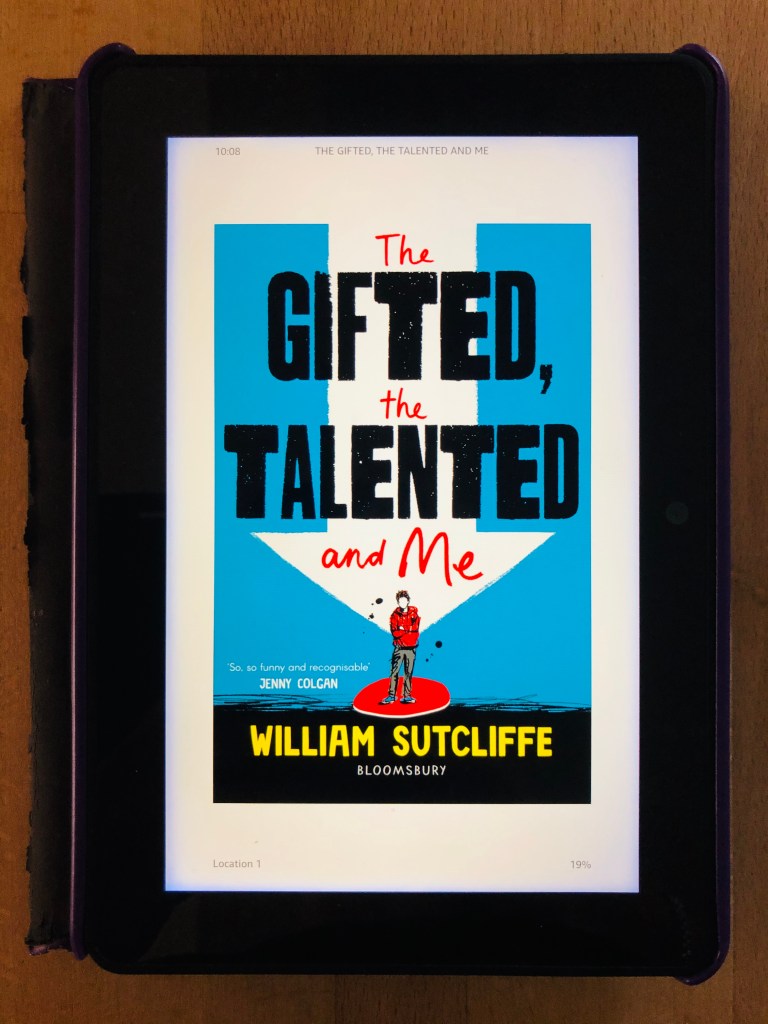
Shortlist Read: The Gifted, the Talented and Me

Hello!

This week I have chosen to read ‘The Gifted, the Talented and Me’ by William Sutcliffe from the YA Book Prize Shortlist 2020. Sam is fifteen, happy with his life in Stevenage and happy being ordinary. All this is about to change as Sam’s parents call a family meeting.

Sam, his older brother Ethan (seventeen) and younger sister, Freya (seven) assemble to what they think is the announcement of their parent’s divorce, only to discover their Dad sold his company. As a result, they are rich. Not only are they rich, but his Mum has quit her job and they are moving to London. This inciting incident jettisons the family to Hampstead and Sam and his siblings into the North London Academy for the Gifted and Talented.

Written in the first person, we are privy to Sam’s confusion, angst and search for himself in all its humour, sadness and easily relatable teenage experiences. His initial reaction, ‘Hang on…what do you mean goodbye, Stevenage?’ sets the scene for Sam’s difficult transition to life in Hampstead. Sam’s Mum believes that ‘mainstream education is restrictive and conformist and obsessed with pointless targets and stats.’ By sending them to the North London Academy for the Gifted and Talented, she explains she ‘is going to set you free to find out who you really are!’ While Ethan is musical, and Freya, artistic and draws a ‘puppy, a unicorn and a kitten sitting on a cloud under a double rainbow’, the decision is described ‘like getting out of jail halfway through your sentence’, Sam wants to know why they are ‘sending me to a school for weirdos?’

To further complicate Sam’s life, his Mum is on her own journey of self-discovery. Her workshop shed at the back of their Hampstead house is for throwing pottery and she starts a blog on the theme of ‘motherhood and creative rebirth’ much to Sam’s horror as she describes her children as ‘F__, seven and already a burgeoning artist; E__, seventeen, a highly talented musician; and S__, fifteen, a little stranded between the twin states of childhood and adolescence…’ and further writes ‘For S__, things are not so easy. He’s a very straightforward boy, and the unstructured approach is a great challenge to his rigid male brain.’  The public revelations of their personal family life set the scene for further conflict between Sam and his Mum.

Equally horrifying, Sam discovers at school that ‘Kicking is a violent act.’ and ‘Ball games are fine, up to a point, as long as they’re not competitive, but football is out.’ Talentless, friendless, and ‘feeling…a bit weird’, Sam feels ‘doomed’. But then he meets Jennifer, ‘the ringleader’ of the ‘I’m-beautiful-and-I-know it’ group who was ‘so stunning she didn’t even need to try’ and Sam’s school experience begins to take a turn for the better. He also meets Marina, from the fashion set, ‘the only person who ever greeted me or seemed to actually notice my existence’ who was wearing a ‘reconfigured bath mat’ when they met. The scene is set for Sam to find navigate his way to fitting in and getting a girlfriend.

The internal monologues are highly relatable, realistic and humourous:

‘OPTIMISTIC BRAIN: We have to audition for the school play. That is exactly what Ethan said we should do.

PESSIMISTIC BRAIN: You’re only saying that to get closer to Jennifer, even though you know she’s a snobby, up-herself princess who thinks you’re a total geek. We should stay away from her.’

It is the school production of ‘The Tempest’ where Sam is launched into an unexpected world as he auditions for the part of Caliban and takes his revenge on bully, Felipe (Jennifer’s boyfriend). In a hilarious scene where Sam is paired with Filipe, they are tasked with mirroring the other person in real time. Sam imitates a monkey and begins to ‘pick fleas out of my fur and eat them’ and then begins to ‘groom him, messing up is complicatedly gelled hair, picking imaginary insects off his head and putting them in my mouth.’ Sam realises that ‘onstage, I could be as ridiculous as possible’.

‘The Gifted, the Talented and Me’ is an exploration in finding out who you are. While that sounds serious and philosophical, Sutcliffe skilfully navigates the ups and downs of trying to fit in and remain true to yourself with scenes that are as painful and cringeworthy as they are funny. Will Sam fit in, find his talent and ultimately will Sam find himself?

Themes: coming of age, identity, sexual identity, family, teen years, fitting in, being average, friendship, first love, being yourself


All pictures and writing are my own unless otherwise credited. Permission must be obtained before any image reproduction and credit must be issued in any image reproduction or quotations. 


Blog, Creative Shorts, New Writing

The Hills

I didn’t want to visit the old man. Every summer, at the end of August we drove from South London to Oxfordshire. The Chiltern Hills! – my mother would exclaim every time as we transitioned from city to country living. Like the hills were something new and majestic rising up out of the earth, a surprise every summer. Just look at those rolling hills – it’s really something, she would say nodding at me to acknowledge the awe of the countryside. Under her breath, she would whisper, breath-taking, just breath-taking. And, like every year, I’d nod, draw my knees up to my chest, rest my flip-flops on the leather seat of the car and put my nose in my phone. My friends would post about holidays abroad: Barbados, South Africa, Madagascar. Me. Some lousy hills outside of London with the old man.

The house sat in acres of land and was always cold and damp, even in summer. It had been raining and the old man greeted us in his wellies and mac. He wore a coat, even in the heat of the summer. It wasn’t a farm but there was more land than you could ever imagine living in South London.

“Come in. Come in.” The old man said. “Tea is ready. Carrot cake from ‘The Tea Cosy’ too. Best in the village.” He hadn’t changed. His salt and pepper beard tidy but with a hint of scruff.

“Dad. You know we talked about this.” Mum said.

I looked from Mum to the old man. Some secret pact had occurred. She knew I wouldn’t come if I knew I’d be on my own with the old man. She took my suitcase out of the car and put it on the gravel.

“I’ll be back next week.” She said giving the old man a hug.

“Mum!” I whispered through gritted teeth as the old man took my suitcase into the house.

“I have to work this week. It’s only a week. It will go quickly and before you know it, I’ll be back, and we’ll have the whole next week together.”

A week alone with the old man. A week where I could be lying on a sun lounger, drinking mocktails, swimming in pools, getting my nails done, or a hundred other things. Mum’s car sped off and I was left alone with the old man.

“You’ve come at just the right time. We’ll have the tea when we get back.”

“Mmmm.”

“The blackberries are calling.”

“Mmmm.”

“Here, you can’t go over the hills in those.” He said pointing at my flip-flops and handed me some wellies. They must have belonged to the old lady. I zipped open my case and pulled out some socks. The wellies were a bit tight; the old lady must have been small. Smaller than a fourteen-year old. I caught sight of myself in the mirror. Shorts and wellies.

“Let’s go.” He said shutting the door.

“Aren’t you going to lock it?” I asked.

“Who’s going to steal anything way out here? Anyways, I haven’t got much to steal.”

Well, I had, I thought. I had my computer, my iPad, my jewellery and clothes all neatly packed in my case ready to steal.

“Please can we lock the door?”

Reluctantly, he took a skeleton key off of a hook by the door and tried to turn the lock. It was stiff but eventually he shifted the catch and the door locked. He slipped the key into his shirt pocket and picked up two large tin pails and pointed at the other two for me. I carried both in one hand and my phone in the other. Reception came and went, and eventually I gave up and pushed the phone in the back pocket of my shorts and carried one pail in each hand.

We walked for what seemed like hours. Along tracks and through fields. The damp remnants of the rain evaporated into the afternoon sky and I wished I’d brought my water bottle. Fresh air, he kept saying, nothing like it, does a world of good. It was hot and my feet sweated in the wellies.

“Watch out for the fairies.” He said as we approached a small bridge over a stream. I laughed. He thought I was five.

“Sure thing. I’ll watch out for the fairies.” I said laughing.

He talked a lot about fighting in the war. Flying spitfires. He was an ace, he said. He talked of his sweetheart. Before the old lady. The love of his life. She was a spy, he said, the best there was. Infiltrated the enemy and helped win the war. Killed in action, sadly, sadly, he would mutter shaking his head. I guessed the old lady wouldn’t have been so happy to hear that his ‘sweetheart’ was the love of his life. The more we walked, the more he talked about the war, getting shot down in enemy territory and being a prisoner.

He stopped. There were briars as far as you could see. In between the prickly shrubs, blackberries hung heavily. He picked several and filled his mouth. The black juice stained his fingers and lips with blood wine stains. He reached out and started filling the first tin pail.

I stepped closer to the briars. Nettles scratched my ankles and I was glad for the old lady’s wellies. I pulled one of the thick blobs off and popped it into my mouth. The sweet juice exploded. I picked another and another. My fingers grew mottled and sticky. The old man hummed as he picked. He must have been hot in his mac. I wished I had put on sunscreen and in between picking, eating and filling the pail, I paused in the small shade of the bushes. I filled one tin quickly, ignoring the thorns that pricked the skin of my arms, my blood mingling with the purple blood of the blackberries.

The old man stopped humming. I turned just as he tilted over, still holding the pail, like he was suddenly shot, blackberry juice dripping from the side of this mouth. He landed with a thud in the nettles and brambles.

I dropped my pail. The blackberries spilled out onto the weeds and grass.

“Grandpa!” I shouted. His eyes were wide and his face stiff. I shook him but there was no response. I ripped my phone out of my back pocket. There was no reception.

“Help!” I shouted. “No! No!”

We were in the middle of nowhere. I pulled the skeleton key out of his shirt pocket. I started to run, key in one hand, phone in the other. The wellies slapped against my calves. Through the fields and tracks and as I reached the fairy bridge, my wellie jammed between the planks of wood and I tripped. I held tight to the key, but my phone landed in the stream. Leaning over, I pulled it out and let the water drip off as I continued running.

The greens of the hills blurred until the house came into view. I shoved the key into the door. It stuck. I couldn’t shift the catch.

“Open, damn it.” I said and wished I hadn’t made him lock the door. The latch shifted. As I called an ambulance, I caught sight of the tea on the table, the carrot cake from ‘The Tea Cosy’, three place settings, the water in the kettle, waiting to boil like a still life painting. Hurry, I said as much as to the emergency operator as to myself. I closed the door, and left the key on the hook and the door unlocked.

It felt like I was gone a long time. It couldn’t have been that long. But the sun had shifted and when I returned, Grandpa and the spilled blackberries were withering in the sun. The flesh of the once plump blackberries, broken, spread out in the grass rotting. The sweetness seeping into the ground, the remains, sour. And Grandpa, lying still, as if part of the earth already.

Inspired by: Blackberry-Picking by Seamus Heaney


All pictures and writing are my own unless otherwise credited. Permission must be obtained before any image reproduction and credit must be issued in any image reproduction or quotations.