
Bedside Table Reads, Blog

Shortlist Read: Furious Thing

Hello!

This week, I have read Furious Thing by Jenny Downham, from the YA Book Prize Shortlist 2020. Downham explores both the destructive and constructive natures of power and love in her novel.  It is about emotional abuse, teenage angst, the power to protect and being able to ‘open the Forbidden Door.’

The novel is divided by three fairy-tale style chapters, ‘A Tale of Love and Death, Another Tale of Love and Death and a Third Tale of Love and Death’, written in the third person reflecting Lex’s own narrative: It opens with, ‘Once there was a girl who grew up wicked. She slammed things and swore.’ These two opening lines, especially the reference to ‘wicked’ set the scene for the link between Lex’s world and fairy-tales reminiscent of the wicked stepmother in Cinderella, the wolf in Little Red Riding Hood and The White Witch in Narnia. References to fairy tales run throughout ‘like a fairy-tale daughter’, a ‘fairy-tale wedding’ and ‘it’s the thing fairy-tales teach us’ contrasting the ideal that is expected of Lex with the reality of her disappointments and struggles.

The main story is written in the first person. Protagonist, Lex (Alexandra), is fifteen and furious, she articulates clearly: ‘I felt pure rage’. Her anger seethes, simmers and explodes; we are privy to her confusion, reasoning, actions and reactions. She explains that, ‘Anger was something to believe in when the world let you down. And I roared with it.’

Fuelled by her mother’s fiancé, John, who taunts her continually with ‘Why do bad things always happen when you’re around, Alexandra?’, Lex rages against her home, school and the people close to her, as well as herself. The events all play against the backdrop to the run up to the wedding of Lex’s mum and John and Lex’s GCSEs.

Lex experiences see-saw emotions, particularly in relation to John, who tries to supress, control and manipulate her. She describes trying to control herself: ‘His anger rippled in me. I felt it in my chest, live a wave. Don’t get angry, I thought. Be nice…’ and ‘I took a breath and swallowed my anger.’ Lex’s rage, however, manifests itself as ‘a bolt of steel running through me’ and ‘the reddest, hottest feeling’ as she physically throws a chair through a window at school and the ‘glass exploded’. Lex’s actions are a representation of her frustration, anger and confusion. These actions are misinterpreted, manipulated and overpowered by John, to his own end.

Lex’s relationship with her stepbrother Kass fluctuates between brother-sisterly love and romantic love. Their innocent friendship growing up depicts a childhood ideal where they ‘scrambled up trees and hid under beds’. For Lex, and to a certain extent, Kass, this becomes an attraction even after he has left for university. This is a reflection of her mother’s relationship with John, while supportive also has the capacity to be destructive.

Lex’s connection with her half-sister, Iris, expands as the novel progresses and it is shocking for Lex when Iris asks her to ‘Do your furious thing.’ and ‘Do your monster.’ These descriptions of her actions, as seen from a six-year-olds point of view, reveal Iris’s understanding of how Lex’s outbursts are to try and control a situation that is out of her control. The reference to Lex as a ‘monster’, links back to the theme of fairy-tales and the idea of ‘wicked’.

Lex’s Grandad was her refuge as a child. Scarred by her last day with him, she carries the weight of his death and remembers how he taught her ‘about knots and how to climb trees and everything I know about nature.’ She channels her deceased Grandad throughout and is connected to him physically through a ruby necklace where she often ‘asks a favour from the dead’ and prays, ‘Grandad…help me nail this.’ We hope, that somehow, Lex’s Grandad can reach out from the beyond grave and influence her situation.

As her mother’s wedding to John approaches, John’s power, control and abuse extends to her mother and Iris. Lex desperately reaches out for help and turning to: her stepbrother Kass, her mother’s friend Meryam and her son Ben, her stepbrother’s ex-girlfriend Cerys, John’s ex-wife Sophie and even Monika (the other woman from his office). You would hope that one person in Lex’s life could see past her rage to the real emotional abuse at play.

Lex is strong, courageous, wild and smart. Her journey is a rollercoaster where she tries to face her fears, ‘being groped by drunk old men or threatened with doctors or being told over and over there was something wrong with you.’ We hope, despite the setbacks, Lex will triumph as a heroine.

Themes: abuse, emotional abuse, bullying, manipulation, power, control, strict parenting, love, friendship, family, relationships


All pictures and writing are my own unless otherwise credited. Permission must be obtained before any image reproduction and credit must be issued in any image reproduction or quotations. 

Bedside Table Reads, Blog

Longlist Read: Redhead by the Side of the Road

Hello!

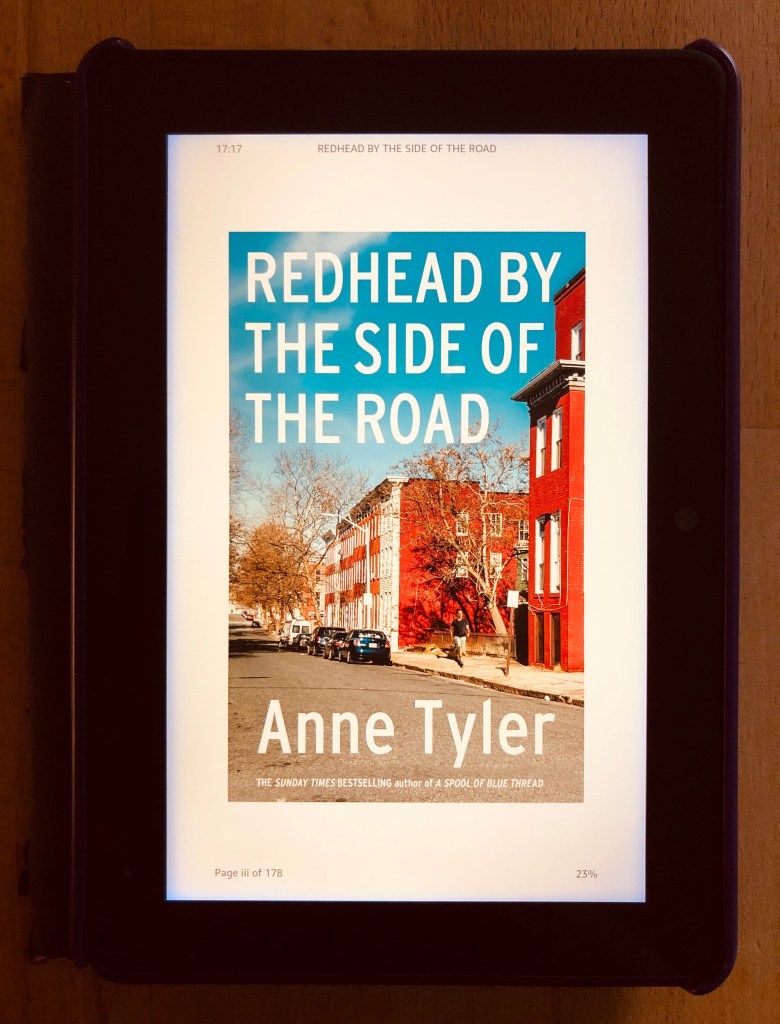
This week I have chosen to read Redhead by the Side of the Road by Anne Tyler from the Booker Prize Longlist 2020. It is the story of Micah Mortimer, an average forty-something who works as a self-employed tech support, ‘Tech Hermit’, a ‘super’ for his apartment block in Baltimore, ‘sweeping, shaking out the mat or conferring with a plumber’.

The second person narration in the opening line, ‘You have to wonder what goes through the mind of a man like Micah Mortimer’ has the feel of a chatty busybody whispering in your ear, almost asking if we should care about Micah. The narrative continues in the third person providing a distanced view of Micah and his current girlfriend Cassia Slade, ‘He has a girlfriend, but they seem to lead fairly separate lives.’ Similarly, his former girlfriend, Lorna Bartell is described as ‘so very, very sure of her principles’ again suggesting the space between them.

Micah is the story. There are no big plot twists or crashing conflicts. Rather, Micah’s life is quietly laid bare, with subtle storytelling that equals the balance he strives for in his life and is exemplified in the description of his daily routine, ‘At seven fifteen every morning you see him set out on his run. At about ten or ten thirty he slaps the magnetic TECH HERMIT sign on the roof of his Kia.’ The narration continues to follow his every step, including systematic spotless cleaning, as he keeps his life in perfect order, even keeping faithful to the ‘Traffic God’, pretending to adhere to an ‘all-seeing surveillance system’ when he drives.

The meaning of Micah’s life, and life in general, is addressed in the opening ‘Does he ever stop to consider his life? The meaning of it, the point?’ leading the reader to wonder if he will ‘spend the next thirty to forty years this way’, a state of paralysis and in somewhat of a minor existential crisis.

Interspersed between Micah’s routine are descriptions that languish in the fullness of building character and setting. Micah is described as ‘a tall, bony man in his early forties with not-so-good-posture – head lunging slightly forward, shoulders slightly hunched’. His client, Yolanda Palmer, ‘a dramatic-looking woman in maybe her early fifties with a flaring mane of dark hair and a mournful, sagging face.’ Equally, scene descriptions vividly portray the family life of his sisters in ‘the general impression, as always, was a tumult: noisy, unkempt people wearing wild colours, fog barking, baby crying, TV blaring, bowls of chips and dips already savaged.’ This depiction is in direct contrast to Micah’s ordered life. However, there is a certain degree of closeness between the siblings despite Micah being the youngest and his older sisters’ teasing him for being ‘finicky’ and asking if it is ‘vacuuming day’ or ‘dusting day’ or ‘scrub-the-baseboards-with-a-Q-tip day’.

Enter Brink Bartell Adams, ‘a young man in a tan corduroy blazer’. Brink is described as a ‘rich kid’, ‘handsome’, ‘a boy, really perhaps not out of his teens’. As a catalyst, Brink creates disarray in Micah’s life by claiming to be his son. Micah is forced to confront not only his past in the form a prior relationship with Lorna, but his current relationship with Cassia.

As his routines unravel, Micah struggles to understand his family and girlfriends. Although eccentric, he is a loveable character. Will his world fall apart, remain static or will he be able to propel himself out of paralysis and take action? Redhead by the Side of the Road is a love story that is delicately written, compellingly ordinary and easily identifiable in its realistic depictions as well as disrupted routines, with which we can all identify.

Themes: love, friendship, habits, routines, second chances, misunderstandings, hope, family, sadness, loneliness.


All pictures and writing are my own unless otherwise credited. Permission must be obtained before any image reproduction and credit must be issued in any image reproduction or quotations. 


Bedside Table Reads, Blog

Shortlist Read: A Good Girl’s Guide to Murder

IMG_7088

Hello!

This week I have read A Good Girl’s Guide to Murder by Holly Jackson from the YA Book Prize 2020 Shortlist. It is a page turning, crime thriller where, Pippa Fitz-Amboi, tries to uncover a cold case murder in her small town of Little Kilton.

For her EPQ (Extended Project Qualification), as part of her A-Levels, Pippa’s research is based on the ‘2012 missing persons investigation of Andie Bell’ as well as the ‘implications of the press in their presentations of Sal Singh and his alleged guilt’, both of whom attended her school. The EPQ forms the basis of her investigation.

The narrative is presented through the Pip’s first-person production reports for her EPQ, ‘my production log will have to be a little different: I’m going to record all the research I do here, both relevant and irrelevant’. Transcripts of Pip’s interviews are also included and written in interview format:

‘Pip: Do you mind if I record this interview so I can type it up later to use in my project?

Angela: Yes, that’s fine. I ‘m sorry I’ve only got about ten minutes to give you. So what do you want to know about missing persons?

Pip: Well, I was wondering if you could talk me through what happens when someone is reported missing?’

In addition, the story is interspersed with third person narration such as how Pip behaves when she gets nervous: ‘Oh god, this is what happened when she was nervous or backed into a corner; she started spewing useless facts dressed up as bad jokes. And the other thing: nervous Pip turned four strokes more posh’. The transitions between points of view are seamless and provides the reader access to Pip’s thought process as well as omniscient knowledge of the other characters and events.

The fictional town of Little Kilton, based on Great Missenden, and the murder mystery is exemplified through a map, detailing: Sal’s house, Andie Bell’s house, the location of Andie’s car, the school and the woods. All locations that feel as though they could be real, creating a layer of authenticity to the narrative and an unnerving sense of the factual buried within the fiction.

The atmosphere of mystery is established from the outset with the Singh house described as ‘their home was like the town’s own haunted house’ with children ‘daring one another to run up and touch the front gate’. This image is reminiscent of the mystery surrounding the Radley house in Harper Lee’s To Kill a Mocking Bird where ‘Jem wouldn’t get any farther than the Radley gate’.

Pip has a Type A personality. She is smart, ambitious and highly organised. In the midst of her EPQ investigation, she tries to complete her application to Cambridge, prepare for a ‘pre-interview ELAT exam’, finish the ‘admission essay’ and take the entrance exam. However, the deeper Pip digs, her investigation has to potential to derail her future. Pip’s strength and intelligence as an investigator has hints of Riverdale’s Betty and Veronica Mars, unafraid and fact based, strong female protagonist role models.

Pip’s family is a reflection of contemporary families. Her ‘real’ father ‘died in a car accident’ when she was a toddler and she describes Victor (her step-father) and her brother Joshua, not as ‘just three-eighths hers, not just forty percent family, they were fully hers’. As a family unit they come in and out of the narrative, providing a support network and positive encouragement. Their closeness is demonstrated as Victor addresses Pip endearingly as ‘Pickle’. Victor adds moments of light relief in the narrative and is described ‘buoyant’. His actions are humorous as he ‘dramatically, gripping the banister reaching for the departing teenagers, like the house was a sinking ship and he the heroic captain going down with it’ while saying, ‘Fare thee well’.

As Pip works with Ravi, Sal’s older brother, they develop an ever-growing list of ‘Persons of Interest’ uncovering unlikely associations, lies and motives. With the detective skills of Agatha Christie’s Poirot and Miss Marple, in conjunction with the technology of contemporary society, Pip uses everything at her disposal: computers, mobile phones, photographs and police reports, in an attempt to unravel the mystery of missing Andie Bell, the supposed guilt of Sal Singh and uncover the secrets of a small town that hides a murderer.

Themes: murder, lies, secrets, deceit, truth, drugs, date rape, deceit, power, money, bullying, friendship, loyalty, belief, honesty, family


All pictures and writing are my own unless otherwise credited. Permission must be obtained before any image reproduction and credit must be issued in any image reproduction or quotations. 


Bedside Table Reads, Blog

Longlist Read: Who They Was


IMG_7053b

Hello!

This week I have chosen to read Who They Was by Gabriel Krauze from the 2020 Booker Prize Longlist. A work of autofiction about growing up in South Kilburn, London, Krauze explores his young life of violence, drugs, murder, revenge and reputation but also of family, respect and education. The London Krauze inhabits juxtaposes images of London as a business as well as a tourist capital of the world and conveys a relentless, seething war that lies beneath.

Written in the first person, present tense, Krauze begins in medias res, ‘And jump out the whip and I’m hitting the pavement’ propelling the reader into his world and shockingly, into the mugging he is about to commit describing ‘And I’m creeping up fast to get behind her’. This is contrasted with the narration of when he is closer to the woman ‘I can smell shampoo and softness and then expensive perfume.’ This olfactory sensory impression lingers with the sibilance and walks a fine line between beauty and predatory. The violence of the scene when he ‘clocks she’s got a big diamond ring on her wedding finger’ is simply stated, ‘So I snap her finger back…it’s like folding paper’.

Written in a stream of consciousness, Krauze’s sentences vary from run on passages of action and imagery ‘and I’m running after the whip, inhaling the morning, glass needles of sunlight piercing through the sky and falling all around me…’ to sharp and simple, ‘I go to Uncle T’s.’ The brutal meets the beautiful as the language oscillates between slang, ‘I bell my boy Flipz like you brudda and I just got rushed by a whole bag of man in Grove’ and lyrical illustrations of ‘Grey clouds like heavy sponges tug on the sky’s skin and the sun hides its face from the city’ and sharp metaphors, ‘Two women in suits with bitter lemon-rind faces’.

Running parallel to the violence, jail and drugs, is Krauze’s experience as an undergraduate: ‘I’m doing an English degree at Queen Mary University’ as well as philosophical explorations, ‘one of the points that Nietzsche makes is that the morality is just a rule of behaviour relative to the level of danger in which individuals live.’ The oppositions of violence and education, different as night and day, often literally, as night of violence is followed immediately by a day of university lectures and seminars.

Krauze reflects on writing about prison as ‘feeling dead like I’m giving it something it doesn’t deserve.’ He furthers this portrayal using simple sentences and repetition that contrast with the long descriptions of violence, ‘Days without breath. Nights without silence. Dreams without sleep.’

In opposition to Krauze’s depiction of jail, his relationship with his family is poignantly reflected in how he missed Easter Sunday, ‘I’ve missed painting of the eggs with Tata’. This is a rare break in the armour and a realisation, ‘I don’t know what it is but I feel like somewhere out there I have lost part of myself.’ He further considers ‘time’ as ‘a strange land to walk through.’ This is particularly powerful, representing the transient nature of human life and that ‘this moment is just a whisper in the dark’.

In Who They Was, Krauze’s London explosively reveals modern life and its ghosts. It is a life that sits next to you on the tube, bus or university lecture. It is a life that walks the same streets and breathes the same air but oscillates on a parallel plane occasionally intersecting at tangents. However, amidst the despair, revenge and violence is an exploration of hope and what it means to be human.

Themes: despair, revenge, loss, death, betrayal, prison, education, family, love, hope, friendship


All pictures and writing are my own unless otherwise credited. Permission must be obtained before any image reproduction and credit must be issued in any image reproduction or quotations. 


Bedside Table Reads, Blog

Shortlist Read: All Quiet at the End of The World


IMG_7035

Hello!

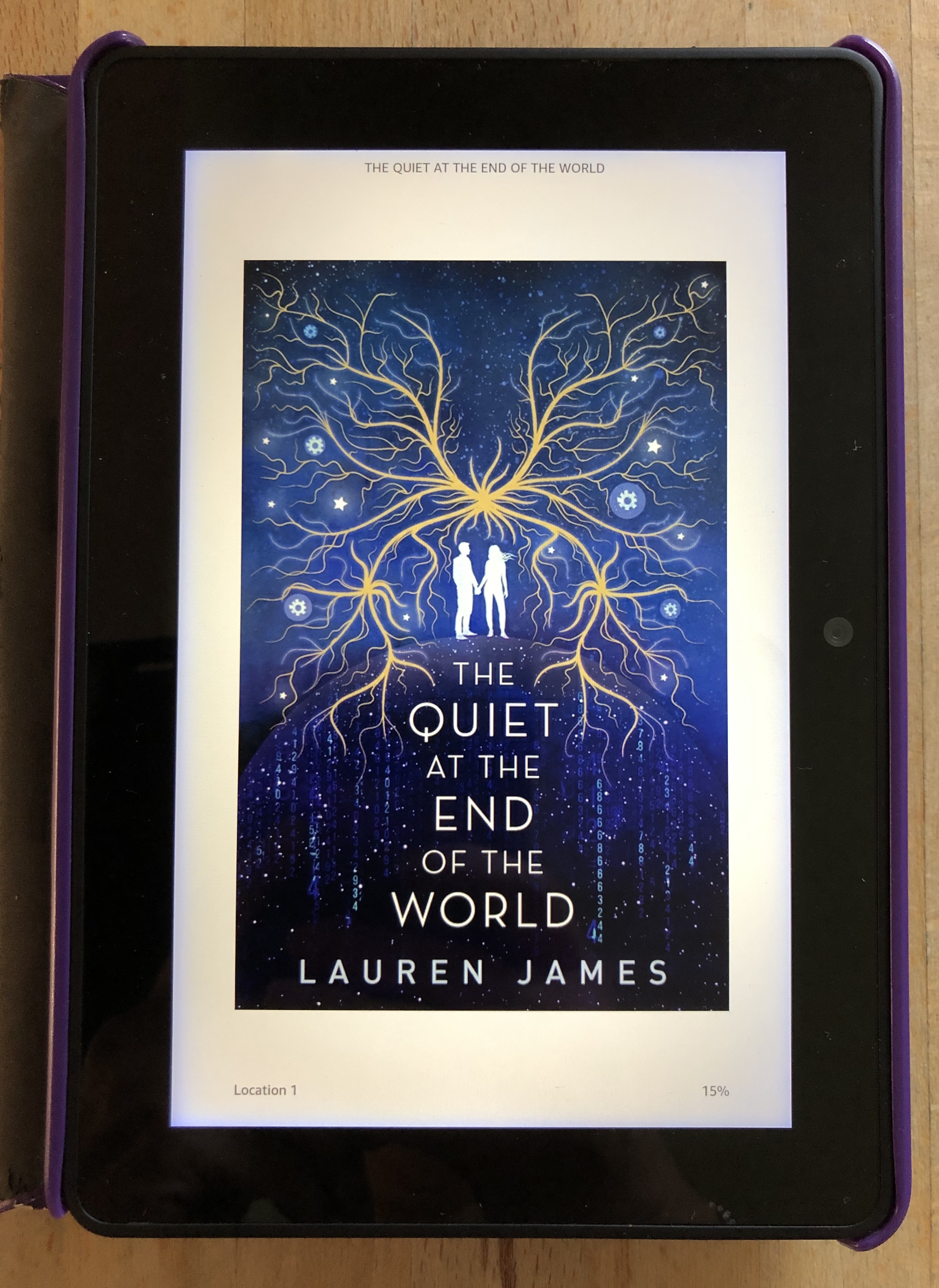
This week I have chosen All Quiet at the End of the World by Lauren James, from the YA Book Prize Shortlist 2020. This is a dystopian fiction set in the future that explores not only the existential crisis of humanity, but the very nature of what it means to be human.

Inspired by Carlo Rovelli’s Seven Brief Lessons on Physics, who states that ‘I believe that our species will not last long’. All Quiet at the End of the World runs with Rovelli’s thread that ‘we belong to a short-lived genus of species’ and that ‘the brutal climate and environmental changes which we have triggered are unlikely to spare us’.

These themes could make for heavy reading combined with the premise of a virus that stops fertility in humans. However, the narrative, set in London, is firmly about Lowrie (16 years old) and Shen (17 years old), their relationship with each other, their parents and their responsibility to world as the youngest remaining humans. Born from frozen eggs seventy years after the virus, in the time of sterility, they are waiting for scientists to find a cure. Themes of environmental action, a previously unknown virus, quarantine, waiting for a cure are never more pressing than in the current Covid-19 environment for not only a YA, but for an adult audience.

The narrative takes the form of a dual storyline and opens in the past when the virus first emerged with a call log for Maya Waverley to the emergency services. The narrative skips eighty-five years and is written in the first person from Lowrie’s point of view, as she and Shen explore the London underground with her Dad (a horticulturist). Lowrie finds Maya’s purse in an abandoned tube ‘the purse flops open, revealing rows of plastic cards’ and thus the scene is set for the link between the two narratives.

Lowrie and Shen are teenage explorers, detectives and scientists who try to unravel what has happened over the decades since the virus. Shen (from China, deaf in one ear and afraid of rats) is presented as being ‘the best at intellectual things’ but for Lowrie, ‘fixing stuff is my speciality’. Through their mudlarking they find and document pieces that are buried in the Thames and anywhere they can explore and is shown in a log at the beginning of each chapter. Their parents work together to teach them all they will need to know to survive in this new world.

Their futuristic world is defined with reference to bots who ‘keep things safe’ specifically ‘Mitch’ who befriends Lowrie and Shen and is describes as having ‘spindly metal legs’ that ‘have sprouted out of the robots rusted spherical body’.

Maya’s story is told through Lowrie’s research from what is left of Maya’s social media feeds where Maya revealing her feelings: ‘So much for feeling calmer! Today I can’t stop showering and showering, trying to get the virus off me’ and identifying a post virus world: ‘that was my first day of our new normal’ as well as her fears ‘I’m still having nightmares about the virus’. Maya attaches new items in her feed: ‘NEWSBREAKING.com: Doctors report Drop in Women Conceiving’, providing an external eye on the changing situation due to the virus.

The conflicting feelings of being a teenager are explored as Lowrie questions her sexuality, ‘I might be maybe probably definitely bisexual’ as well as and her attraction to Shen, ‘I find myself eyeing his forearms again’. The need to get away from her parents and experience independence also raises conflicting feelings, ‘now that we’re finally independent, I just miss him terribly’.

All Quiet at the End of the World questions evolution and what it means to be human. The extinction of humanity, climate change, the restoration of eco systems, prejudice and the ethics of assisted suicide are all seen through the love story of Lowrie and Shen. It is told in simple language, ‘I fill my utility belt with the essentials – a penknife, screwdriver, chisel and spanner’ that affirm Lowrie’s voice and power.

Themes: love, death, climate change, pandemic, nature of humans, existence, existential crisis, independence, parent-child relationships, bullying, prejudice, sacrifice.


All pictures and writing are my own unless otherwise credited. Permission must be obtained before any image reproduction and credit must be issued in any image reproduction or quotations. 


Bedside Table Reads, Blog

Longlist Read: How Much of These Hills is Gold


IMG_7018

Hello!

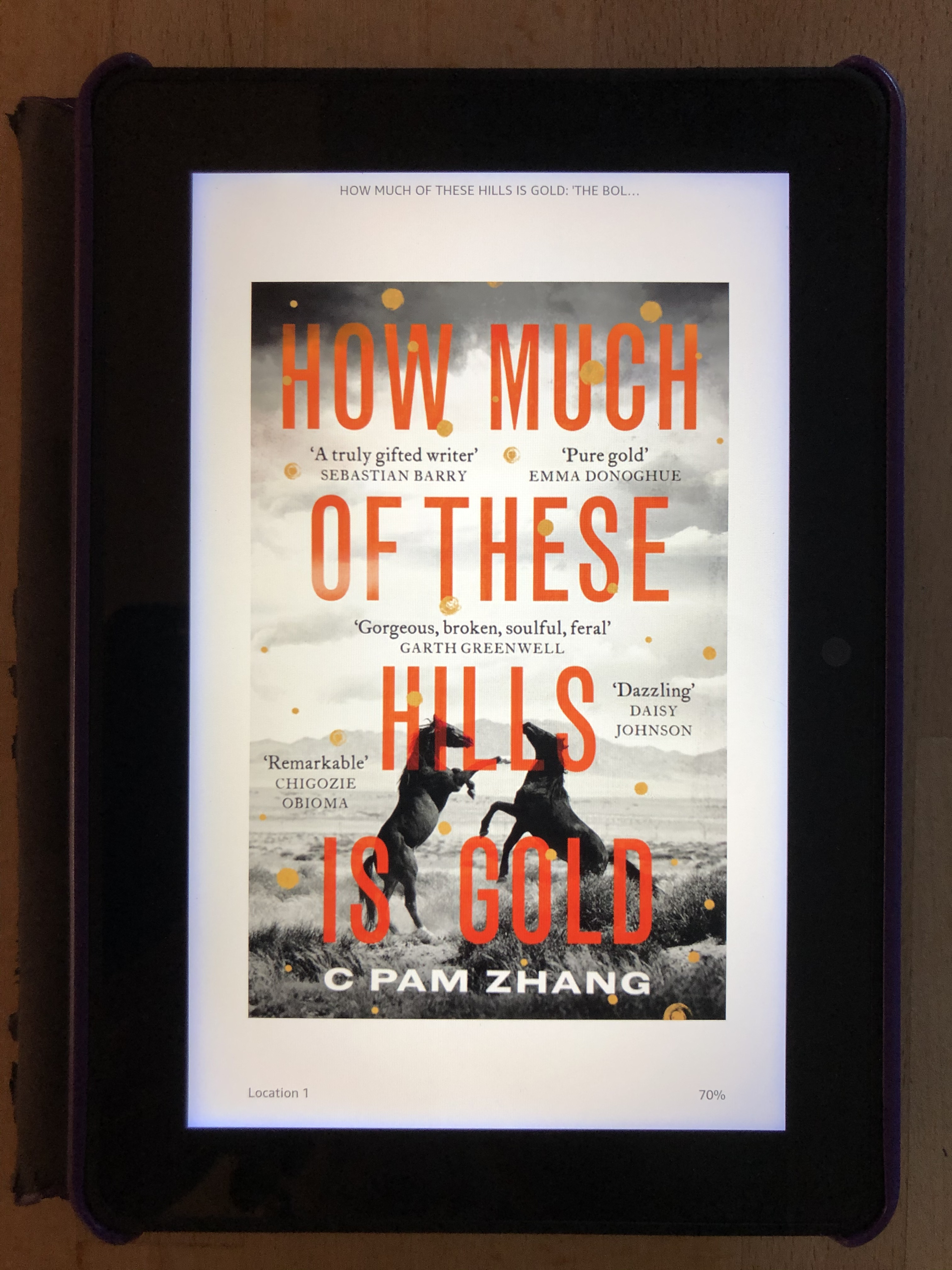
How Much of These Hills is Gold by C Pam Zhang, from the Booker Prize Longlist 2020, is my book choice this week. It is a story of two orphaned native-born Chinese sisters, Lucy (12) and Sam (11), set in the wake of the California gold rush and their journey to bury their deceased father and search for home.

The narrative is written in the present tense immersing the reader into the action and creating a sense that we are living it along with Lucy and Sam. Using simple prose, it is divided into four parts. Parts One and Two are written in the third person and opens when ‘Ba dies in the night, prompting them to seek two silver dollars.’ And a few pages later we learn they are alone as ‘And long gone, Ma.’ The death of Ba sets the sisters on a journey to bury him.

The backdrop of the wild west in the 1800’s subverts expectations of white cowboy protagonists. The writing feels YA initially: with both parents removed from the narrative through death in the first few pages of the story, the sisters are propelled on their adventure. However, knitted in the simple prose and initial YA feel, is the image of the two children trailing the corpse of their dead father in a crate through the desert. This morbid image contrasts a sense of black humour, where bits of the corpse fall off as it decays in the heat of arid plains, described by Lucy who realises that ‘the hand has not one but two missing fingers.’ This is furthered when she decides to preserve the body in salt, like a piece of meat, to rid it of maggots and flies: ‘Sprinkled over Ba’s body, the salt looks like ash.’

With a thematic feel of Steinbeck’s Of Mice and Men’s the American Dream, where George describes ‘a little house and a couple of acres’ and Lennie’s desire to ‘live off the fatta the lan’, Lucy and Sam are fully aware of Ba’s dream: ‘I’ve got my eye on a piece of land eight miles toward the ocean. Between two hills, forty acres.’

Layered within the narrative, Chinese tradition appears throughout, where the sisters search for two silver dollars to place over their father’s eyes ‘sending the soul to its final good sleep’. A sense of family and responsibility drives the sisters on their journey as Ba says, ‘Family comes first.’ Animal and insect imagery add texture to the layers with reference to: snakes, buffalos, horses, tigers, flies and maggots. The buffalo descriptions are particularly striking: ‘the skeleton rises from the earth. Like a great white island…they’ve seen buffalo bone in pieces along the wagon trail, but never whole.’

The narrative also explores a search for identity and home. Sam, androgynous, becomes the boy Ba never had and is ‘prized by a father who wanted a son’. As Lucy searches for ‘What makes a home a home?’ she also seeks an understanding of identity through appearance, location and language with realisations such as: ‘For the first time Lucy understands that the language Ma shared with them in bits and pieces, was only a child’s game’.

The narrative cleverly shifts to the first person in Part Three where Ba’s perspective reveals an adult version of past events and then switches back to the third person in Part Four, fast forwarding five years. The relationship between gold, salt, earth and the elements interplay and are linked with plums, blood and skull imagery. The Parts are identified with dates (XX62, XX59, XX42/XX62, XX67) indicating the actual year (1862, 1869, 1842/1862, 1867) but also potentially representing any year creating a sense of timelessness to the narrative.

This coming of age story of Lucy and Sam takes the reader on a meandering journey through savage events, vast sorrow and parched deserts but it also through personal sacrifice, belonging, family and hope. How Much of These Hills is Gold sets out a new vision of the immigrant experience in forming the history of the American West.

Themes: coming of age, American Dream, heritage, tradition, death, loneliness, family, parent-child relationships, sibling relationships, gender, identity, sacrifice, loss, hope


All pictures and writing are my own unless otherwise credited. Permission must be obtained before any image reproduction and credit must be issued in any image reproduction or quotations. 


Bedside Table Reads, Blog

First Shortlist Read

Hello!

IMG_9638

The YA Book Prize 2020 Shortlist and The 2020 Booker Prize Longlist have been announced and it’s that time of year to get reading. My bedside table and Kindle are stacked up and ready to go!

My first read, Meat Market by Juno Dawson, is from the YA Book Prize 2020 Short List about the fashion industry, its attraction and iniquitous underbelly.

Meat Market follows the journey of sixteen-year-old Jana Novak (an average teenager from an estate in London) through the treacherous world of modelling. Scouted at Thorpe Park for her androgynous looks and height, Jana is propelled into a whirlwind of fashion shoots, travelling and worldwide fashion weeks. Forced to choose between the lure of money through modelling and sixth form college, Jana opts for the former and embarks on a journey that takes her further and further away from her family, friends and herself. Her friends Sabah, Laurel and boyfriend Ferdy (Kai Ferdinand) oscillate in and out of Jana’s life initially keeping her grounded in reality, but as the novel progresses the distance between them grows as does Jana’s dependence on anti-anxiety medication and sleeping tablets.

Dawson systematically cuts away the glamour of the fashion industry and life of the models exposing raw truths: long hours, grotty accommodation, jet lag, eating disorders, drug abuse, sexual abuse and the dehumanising effect of the industry.

You would expect the novel to follow an arc of doom and gloom with our protagonist, Jana, self-destructing. However, the journey Dawson takes us on is one of hope, with Jana finding courage, strength, friendship and most importantly, herself, as well as exposing the fashion industry’s darkest secrets.

Written from the first-person point of view, we have an intimate knowledge of Jana’s life, her loneliness and confusion. This is enhanced by alternating the first-person narrative of past events with short interviews in the present. The opening interview of the book:

‘ – What am I supposed to say?’

‘ – Well, why did you want to make this film?’

‘ – It’s time, I think.’

sets the scene for the first-person narrative to catch up to this moment. The narration is interspersed with texts, newspaper articles and a celebrity review providing the reader a momentary opportunity to observe events from an outside perspective creating a concrete link to the real world. Our world. This makes the events feel not only tangible but frighteningly realistic. Reference to specific magazines, locations in London and around the world anchor the story in reality. Jana’s voice is clear, distinct and entirely relatable with Dawson capturing the essence of a London teenager through both dialogue and internal monologue. Jana’s opening thought, ‘Why are men such trash?’ is simple and brutal establishing the foundation on which Dawson builds her story.

Dawson’s gaze on the modelling industry in Meat Market is a call for greater regulation to safeguard the health and safety of models around the world.

Meat Market is a great read to kick start the nominations. The rest of the YA Book Prize Shortlist 2020 has a lot to live up to – very much looking forward to reading another from the list!

Key themes: identity, mental health, abuse, power, ethics, drugs, money, vulnerability, glamour, loneliness, courage, friendship and love.


All pictures and writing are my own unless otherwise credited. Permission must be obtained before any image reproduction and credit must be issued in any image reproduction or quotations.