
Bedside Table Reads, Blog

Shortlist Read: Deeplight

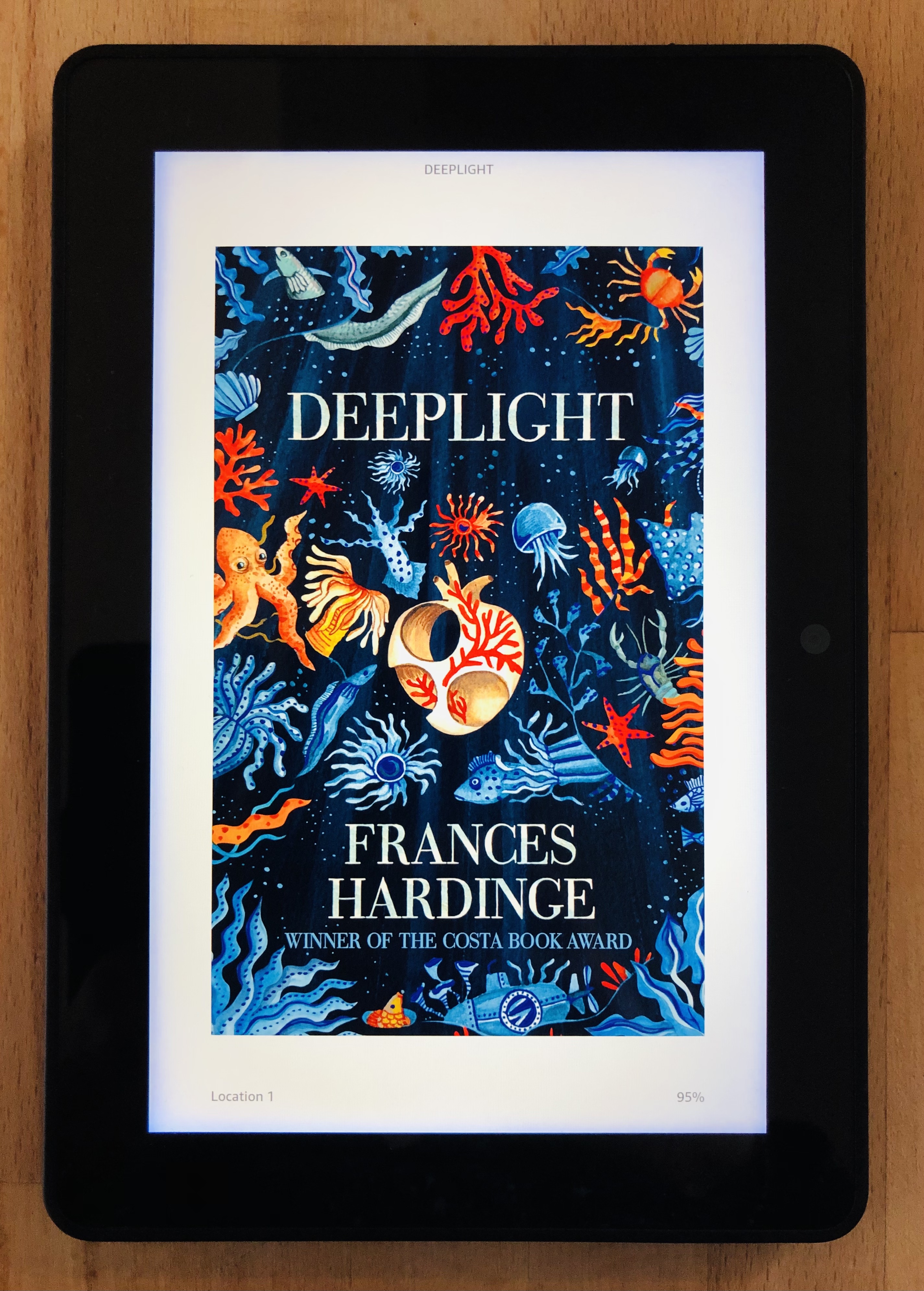
This week I have had the great pleasure of reading Deeplight by Frances Hardinge from the YA Book Prize Shortlist 2020. A fantasy set on the imaginary islands of Myriad where the Undersea gods were ‘as real as the coastlines and currents, and as merciless as the winds and whirlpools’. It is here, where the gods destroyed each other in the event known as the ‘Cataclysm’ and subsequently, the fear of the gods has dissipated. The narrative follows fourteen-year-old Hark, orphaned with his best friend Jelt, as they scavenge an existence together on the island of Lady’s Crave.

The narrative is written in the third person and Hark is presented as a storyteller. His skill in spinning a yarn gets him out of more than one sticky situation. His way with verbal language is juxtaposed with the fact that he cannot read. Two years younger than Jelt, Hark is constantly caught up in Jelt’s schemes and is described always being ‘neck deep in Jelt’s latest plan. It was as though he’d signed up for it in his sleep’. The devotion to their ‘friendship’ and seeing Jelt as ‘family’ drives his commitment to Jelt’s schemes but deep down, Hark questions Jelt, his decisions and escapades. This internal friction for Hark is crucial and drives his conflicted decision making throughout the narrative. However, there are certain points where Hark’s unflinching loyalty to Jelt, in the face of emotional manipulation, is so very frustrating.

Hark and Jelt’s relationship is established from the outset where Hark is ‘the follower’ and Jelt ‘the leader’. While Hark protests ‘You never ask, Jelt.’ and ‘You did have time to tell me.’ Jelt contrives an answer that makes it seem like he is attempting to help Hark, ‘I’m trying to show Rigg what you can do, Hark!’ ‘I brought you in because we’re friends.’ The fact that Hark was ‘mollified’ by this compliment indicates the long road he has to be out from under Jelt’s manipulative control. This is furthered by Jelt’s harsh insistence ‘Oh, grow a spine, Hark! Before I start wishing I’d left you out of this. This is a promotion.’ Will Hark ‘grow a spine’? This question lingers throughout leaving the reader to will him to make the ultimate decision to break with Jelt and go his own way. However, even in the face of a dangerous and suspenseful scheme to climb a cliff edge to put out a lantern in the beacon tower, Hark is bogged down by his conscious ‘But I couldn’t leave Jelt in the lurch, could I? He’d be dead without me.’

From the outset, the beacon scheme is somewhat doomed with Hark caught ‘Appraised and sold’ as a slave, highlighting the inequalities within the Myriad society. While ‘slavery was forbidden within the Myriad’ if you committed a crime and were found guilty, you could be sold as an ‘indentured servant’. Hark’s gift of the gab allows him to combine his lies with ‘fragments of truth’ appealing to his audience of purchasers where he is ultimately bought by Dr Vyne. Hark is transported to the Myriad island of Nest ‘a wild, lonely island…almost ghostly’ where he begins a new life in servitude at the Sanctuary. It is a place where ‘young acolytes’ trained to become priests in the past. Hark explains that these priests are ‘The old, crazy ones whose minds broke when the gods died!’ It is also where Hark makes unlikely alliances providing the reader with some rays of hope.

It is as an ‘indentured servant’ where Dr Vyne sees Hark’s potential stating that ‘some schooling would make you more useful to me…I’ll have someone start teaching you your letters’. Even without Jelt, this was conflicting for Hark who was excited to learn to read but replays Jelt’s words: ‘Reading makes your brain soft.’ ‘You live in the world, or you live in a book. You can’t do both.’ trying to understand Jelt’s idea that ‘illiteracy was a badge of honour.’ The reader is buoyed by Hark’s change of situation away from Jelt, albeit, an enslaved situation. Hopeful that after three months on Nest, Jelt was well and truly out of the picture, however, like a boomerang, Jelt returns with one more scheme. It is this savaging foray that sets off a series of events compromising Hark and forever changing Jelt. This nail biting turn of events leaves the reader on edge and slightly seasick.

Hardinge’s successful world building conveys the Myriad islands and the gods as if they have always existed enabling the reader to suspend any notion of reality slipping into the fantasy world of the Undersea, gods, godware, smugglers and priests with ease. The prose is cleverly crafted and rich with original similes, ‘The sun was as pale as a poached egg’ and ‘Nest’s harbour was a little more than a bare bay, curving like an empty melon rind’. Hardinge expands new notions, such as ‘godware’, which if obtained, means not only having a piece of a god, but for Hark and Jelt, having the heart of a god signifies money, freedom, renewed life and potential death with nail biting consequences.

Hardinge introduces the ‘sea-kissed’ who experience hearing loss due to extensive diving or being in submarines and explains that ‘sea-kissed deafness was the mark of a seasoned aquanaut, and therefore generally respected’. Sign language features throughout and is generally understood by most to greater or lesser extents. ‘Sea-kissed’ Selphin, Rigg’s daughter, is a voice of reason for Hark when her mother wants the godware to heal her deafness. Selphin represents the ‘good’ in contrast to Jelt’s ‘bad’ and she tries to warn Hark of the dangerous changes the god-heart can make, signing angrily ‘So what are you going to do? Change my thoughts? Make me want something I don’t want? If you do that – if you even try – I’ll kill you.’ Selphin also sees Hark as ‘spineless’ exemplified in her ‘one swift, fluid sign. It was the expressive sign for a jellyfish, pulsing its way forward, fingers trailing las tentacles.’ This aquatic imagery transcends the water with readers constantly hoping that Hark will not be further dragged under by Jelt.

The journey through Hardinge’s fantasy world of Myriad, the Undersea, gods, battles between gods and god-killers and the toxic relationship between Hark and Jelt is rich in detail, immersive and believable. It is through Hark’s relationship with Selphin and the old dying priest, Quest who is ‘shrewd and lucid’ with many secrets, that Hardinge drips elements of brightness for Hark. Can Hark escape the manipulative clutches of the monstrous Jelt? Will learning to read and write free Hark from his past? And ultimately, will Hark ‘grow a spine’, become a ‘god-killer’ and have a future of freedom and hope? I wholeheartedly recommend Deeplight – it is easily one of my favourite YA books I have read from the 2020 shortlist.

Themes: friendship, loyalty, enslavement, lies, truth, stories, freedom, manipulation, isolation, loneliness, fear, bravery, literacy, obsession, power, greed, change, old age


All pictures and writing are my own unless otherwise credited. Permission must be obtained before any image reproduction and credit must be issued in any image reproduction or quotations. 


Bedside Table Reads, Blog

Shortlist Read: Shuggie Bain

Hello! I’ve had a little rest from posting in January, but I am back and ready to go. I am continuing my goal of reading all the longlist Booker Prize nominated books from 2020 and to kick off 2021 I’ve started with the winning book, ‘Shuggie Bain’ by Douglas Stuart. It is story of toxic relationships, abuse, addiction, neglect and poverty set in 1980s Glasgow. While the narrative is about Shuggie, his love for his mother and growing up gay, it is as much, if not more, about his mother Agnes and her spiralling alcoholism. The effect on her children: Catherine, Alexander (Leek), and Shuggie is a truly raw exploration of the pain and paralysis of alcoholism and poverty. If you think you’ve read about these themes before, think again – Stuart’s rollercoaster of a novel will leave you gasping for breath, closing your eyes and wondering when the rollercoaster will come off the rails.

Shuggie, fifteen, is introduced in the first part, ‘1992 – The South Side’, where he lives alone in a boarding house. The opening line sets the scene of bleak oppression, ‘The day was flat.’ This simple sentence is followed by a semantic field of negativity – ‘abandoned’, ‘listlessly’ and ‘vacant-eyed’. Shuggie’s out of body experience with his ‘soul floating’ initially leads to the possibility of hope with a new day at the end of the paragraph where he ‘thought only of tomorrow’. With a dream of going to hairdressing college, Shuggie runs the deli counter to support his ‘digs’ and counts himself lucky to have the room. Within the boarding house where ‘he could smell the musty overcoat of the yellow-toothed man who ate only what smelled like buttered popcorn or creamed fish’ Shuggie searches for his identity staring in the mirror as ‘he tried to find something masculine to admire in himself.’ It is hard to see how the desperate ingrained despair of the past can lead to a new life for Shuggie.

The narrative shifts to the past, 1981 – Sighthill, where Agnes Bain, proud and beautiful, is described as ‘To be thirty-nine and have her husband and her three children, two of them nearly grown, all crammed together in her mammy’s (Lizzie) flat, gave her a feeling of failure.’ This failure extends to the men who are described as ‘rotting into the settee for want of decent work’. The deprivation is furthered in that ‘it would take an eternity to pay off a pair of children’s school trousers or a set of bathroom towels’. Agnes’ second husband, Big Shug, a Protestant taxi driver, is loose with money and ‘a selfish animal’; he dissolves any hope Agnes may have, fuels inevitable gritty conflicts and Agnes’ alcoholism that are shocking and sad to read.

The narrative progresses in time from 1981 to 1982 – Pithead and 1989 – The East End, coming full circle at the end in 1992 – The South Side. There are many scenes that haunt the reader long after completing the novel, such as the abuse Agnes endures from Big Shug in her alcoholic state ‘the hardened hairspray cracked like chicken bones as he wound his fingers into the strands. With a tug hard enough to rip handfuls out by the roots, he started up the stairs, dragging her behind him.’ While the novel is at times overwhelmed with similes, such as the ‘chicken bones’ above and the description of Anges ‘abandoned behind the door like a ragged draught excluder’, it is these comparisons that linger. These volatile vignettes result in Agnes’ attempt to escape, no more than when she ‘held out a glowing cigarette to the curtains’ while holding Shuggie close to her in an attempted suicide. The juxtaposition in the description of this scene with the ‘grey smoke’, the ‘orange flame’ and the ‘greedy fire’ with her ‘complete calm’ is chilling. The fire is beautiful with ‘dancing shadows on the walls and the paisley wallpaper came alive’ while Agnes and Shuggie waited for death in the ‘new beautiful silence’. It is abundantly clear that Shuggie loves and trusts his mother completely and is fearless in the face of the fire. It is this love that is so heart breaking as Anges’ deepening alcoholism grinds away any potential hope.

Equally, seventeen year-old Catherine is attacked when trying to find Leek at the pallet factory by ‘many hands [that] moved on to her body, roaming and searching’ threatening her with a ‘silver fishing knife’ that would leave her with a ‘Glasgow smile, a scar from ear to ear’ or even raped. The description intensifies as the ‘gutting knife rattled against her teeth’. The scene is desperate, made worse by her realisation that ‘the men standing around her were only boys, younger than her and probably younger than Leek’. The ingrained abuse of women from such a young age further emphasises the hopelessness of the narrative and it is unsurprising when, early on, Catherine marries young and moves to South Africa without looking back. Leaving her brothers to cope with Agnes is an act survival for Catherine; it creates a sense of hope that the cycle of paralysis can be broken.

However, leaving Leek and Shuggie with Agnes is bleak. Agnes oscillates between alcoholic oblivion and times of vague coherency in the all too vivid description when ‘She lowered her head into the cavernous bag and tilted it slightly to her face. The children watched the muscles in her throat pulse as she took several long slugs from the can of warm lager she had hidden there.’ Is there any hope for Shuggie? He regularly misses school to care for his mother, heartbreakingly described: ‘With a practiced finger he reached inside her mouth and hooked out the bronchial fluid and bile. He wiped her mouth clean and lowered her head safely back on to her left shoulder.’  Equally is his struggle with his identity in a masculine world and wonders: ‘Was this the moment that would make him normal?’ While most of the novel follows Agnes’ story, it is Shuggie’s absence in the narrative that is so telling of his neglect.

With the dialogue written mostly in dialect, the inclusion of slang and simple hard-hitting prose, the novel paints a detailed picture of Shuggie’s life growing up in Glasglow. I would highly recommend ‘Shuggie Bain’, but be prepared for the no holds barred exploration of Agnes, Shuggie, Catherine and Leek, their relationships, poverty, abuse and alcoholism, and persist to the end to see if they are able to realise their hopes and break free from the paralysis that consumes their lives.

Themes: family, dysfunctional family, abuse, addiction, coming of age, poverty, neglect, religion, violence, masculinity, bullying, unemployment, prostitution, gambling, loneliness, hopelessness, redemption, hope, mother-son relationship, sexuality, identity, class, status, aspiration


All pictures and writing are my own unless otherwise credited. Permission must be obtained before any image reproduction and credit must be issued in any image reproduction or quotations. 


Bedside Table Reads, Blog

Shortlist Read: The Black Flamingo

This week, I have read The Black Flamingo, by Dean Atta, from the YA Book Prize Shortlist 2020. I was so excited to read this novel of verse, and I was not disappointed. A highly relatable and moving coming of age story about Michael, as he explores his identity as a half Jamaican and half Greek-Cypriot gay teen and ultimately, his drag debut.

Written in the first person, the pages are filled with verse and illustrations (by Anshika Khullar) that propels the reader through Michael’s life in London from six years old to university. Interspersed, Atta includes text messages and notes, all presented with an economy of words that juxtaposes the deeper introspection providing an intimidate glimpse into Michael’s heart, mind and soul.

The novel opens with a Prologue, and as expected, it reveals the narrative journey: ‘The black flamingo is me trying to find myself’ to ultimately ‘I am the fairy finding my own magic’. These short phrases sum up the introspective nature of the verse that culminates with Michael’s revelation at a drag artist, ‘I stand triumphant in a leotard and heels, a full face of make-up and a beard’ which is both exhilarating and hopeful.

However, within the first few pages, Michael reflects that ‘I often feel like a bad egg that was not meant to be’. This is a dark and despairing phrase; you have to hope that ‘the magic’ referred to in the Prologue provides Michael with enough agency not only to overcome this negativity and embrace all of himself. This darkness is represented in the episode where his father shouted at his mother, ‘You’re useless!’ while ‘throwing his plate down, turkey stuck to the kitchen floor’. The verbal abuse combined with the violent action is just one example of Michael’s hurdles.

The narrative fast forwards to Michael’s ‘sixth birthday’ where all he wanted was a ‘Barbie’ but instead was given ‘Teenage Mutant Ninja Turtles’. However, later that year, his Mother gave him a Barbie described as: ‘No wrapping paper, just / a pink bow on the box. / Mummy has bought me / a Barbie! / But she got it wrong. / It’s not the Goddess / but I hug her anyway.’ Atta highlights ‘a Barbie!’, the short phrase separated by line breaks signifying the importance of the gift as well as the developing relationship between Michael and his mother.

In Michael’s continued search for identity, on his seventh birthday, he no longer wants a Barbie, but rather he describes: ‘I tell Mummy I want to change my last name. I tell her I want to match her. I want to change my surname from his Brown to her Angeli.’ The repetition of ‘I tell’ demonstrates the forcefulness of his desire to not to have ‘his name /dragging behind me like a dead dog on a lead’. The repetition is furthered by the simile as well as the alliteration of the words ‘dragging’, ‘dead’ and ‘dog’. Atta emphatically concludes his relationship with his father by relinquishing his association with his name with further similes: ‘like a toilet roll on the sole of my new Kickers boots, / like a shedded snakeskin / like a second shadow’. These comparisons are economically phrased hard hitting as Michael soars with his new name ‘Michael Angeli’ where he ‘can really fly’.

There are many evocative, sad and joyous examples of narrative verse throughout The Black Flamingo. One that particularly hit home was ‘Don’t let anyone tell you / that you are half anything’ and ‘you are a full human / being.’ Exploring, as many of us do, our composite identities, and for Michael what it means ‘to be British, Cypriot and Jamaican’ is highly relatable and affirms that there are many parts that can make up the whole.

The narrative verse takes us through Michael’s teenage years, two schools and his relationships his friends: Emily, Callum, Daisy, Rowan, Grace, Destiny and Faith as well as his Uncle B and sister Anna. It is Michael’s ‘coming out’ letter to Rowan that is so moving and exposes his vulnerableness when he writes ‘I’ve liked you for so long / I like your ginger hair, your freckles / will you go out with me?’ and the heartbreak we feel with him when Rowan responds: ‘Oh, right,’ he says. ‘This is awkward.’

While Michael navigates secondary school, it is in university where he seeks to solidify his identity ultimately trying out the Drag Society where his journey ends and begins simultaneously with his first performance as Black Flamingo ‘I call myself black. / I call myself queer. / I call myself beautiful. / I call myself eternal. / I call myself iconic. / I call myself futuristic.’ The simple sentences, making use of anaphora, ‘I call’ with all end-stopped lines emphasise Michael’s certainty of who he is as he subsequently says, ‘You can call me The Black Flamingo’. The verse is indeed a celebration of individuality. It is also a warning, not to be defined by labels.

Presented as notes, Atta includes: ‘How to Do Drag’, ‘What’s it like to be a Black Drag Artist (for those of you who aren’t)’ and ‘How to Come Out as Gay’. The lines from these ‘How to…’ notes that linger are: ‘Remember you have the right to be proud. / Remember you have the right to be you.’ Through the repetition of ‘remember’ and ‘right’ the lines form an uplifting message of hope.

The Black Flamingo explores many dichotomies throughout – gay and straight, female and male, Black and White but ultimately it is a testimony that nothing is better than being yourself. The Black Flamingo is easily one of the best novels of verse fiction and one that everyone should read.

Themes: identity, belonging, sexuality, race, gender, coming of age, relationships, family, acceptance, mother-son relationships, self-discovery, inner truth, hope


All pictures and writing are my own unless otherwise credited. Permission must be obtained before any image reproduction and credit must be issued in any image reproduction or quotations. 


Bedside Table Reads, Blog

Shortlist Read: The New Wilderness

This week I have read The New Wilderness by Diane Cook from the Booker Prize Shortlist 2020, a dystopian fiction of environmental destruction and survival. Volunteering for an experiment in leaving ‘no trace’, the characters in the ‘Wilderness State’ exist as a collective ‘Community’ of nomadic hunter-gatherers. The narrative is centred on the mother-daughter relationship between Beatrice, who agrees to enter the experiment with the promise of better health for her daughter, Agnes, who is dying from poison ‘City’ air.

The New Wilderness presents the impending doom of environmental destruction, not as an anticipated event, but one that has already occurred. Written in five parts: ‘The Ballad of Beatrice; In the Beginning; The Big Walk; The Ballad of Agnes and Friend or Foe’, the third person narration is able to effectively shift perspectives from Beatrice to Agnes, exploring the depth and divisions of their relationship. The shift to Agnes’ narrative works particularly well as an exploration a younger generation’s collective responsibility of a respectful existence in the wake of the older generation’s individualistic greed and disregard for the natural world. Small revelations alongside Agnes’ maturation allow her an insight into Beatrice, although Agnes herself has forged an almost animalistic bond with the land and thereby establishing a greater divide between herself and her mother.

The social commentary on the ever-decreasing natural resources pervades the novel. The rich description of the natural world where the landscape is described as ‘grasslands that smelled of nutmeg after a rain’ is juxtaposed with images of the ‘City’ with poison air and the ‘streets were crowded, filthy, where rows of high-rises sprawled to the horizon and beyond.’ While these two environments seemingly co-exist, it raises the question of whether the filth and sprawl of the ‘City’ is unstoppable and if the ‘Wilderness State’, last vestige of the natural world, is doomed. David Attenborough addresses this very idea in the documentary ‘A Life on Our Planet’, and while our destruction is irrefutable, he does give a sense that we can still, collectively, enact change, whereas The New Wilderness leaves us wondering if only a few are actually destined to survive – a rather hopeless thought.  

The twenty original members of the ‘Wilderness State Community’ were not scientists, naturalists or environmentalists; they were twenty volunteers who gave up everything because this experiment was their last option. They quickly lose most of the technological trappings of modern society, keeping time by the seasons and flowers with the effect that their existence seems to be in sync with the ‘wild world’. This is echoed in the ‘Manual’ which dictates the rules including the ‘bags of their garbage they carried with them to be weighed and disposed of by the Rangers at Post’. The drive towards ‘no trace’ is seemingly impossible as the group complete ‘micro trash sweeps’ to completely encourage ‘re-wilding’. Additionally, the role of the Rangers is not clearly defined as they seem to function solely to deliver post and provide the group with the next set of instructions. The fact that the ‘Community’ makes use of rope, bedding, cookware and steals processed food from the Post seems to contradict the notion that the ‘Community’ should be living off of the land as primitive hunter-gathers and makes one question the nature of the experiment.

The group continually evaluate what is necessary, carrying the ‘forty-pound cast-iron pot’ through the Wilderness and the ‘Book Bag’ which once contained ‘the Book of Fables’ but ‘had been lost to a flash flood’. Both seem almost farcical as the group ‘were limited to seven days in one place’ and carrying the cast-iron pot across the ‘Wilderness State’ is nothing short of madness. With Agnes growing up with little memory of the ‘City’, her skills of survival are finely tuned over the years and her instincts lead her to ‘follow the animals’ to find water and declares herself ‘I’m a leader’ when having to negotiate with the Rangers. While some of the older members of the ‘Community’ struggle to adapt to the de-evolved existence, those young enough or born in the Wilderness State are almost wild animals themselves.

The shift in relationships between the remaining original twenty of the ‘Community’ is not unexpected and Beatrice, a natural leader, vies with Carl, ‘the true hunter of the Community’, with Glen and Agnes sidelined. As with any dystopian survival story, it is survival of the fittest, and Glen lingers as a weak link throughout although he ‘was the one who knew about the study’ and was key in securing their place in the experiment. The result is that Beatrice’s relationships are volatile, and you wonder how long Beatrice, Glen and Carl can survive the three-way relationship in the pressure cooker of survival.

When Agnes reaches thirteen years old, The New Wilderness sets her up for the expected teenage conflicts with Beatrice, on their journey to nowhere in the nature reserve. Circling the ‘Wilderness State’, from ‘Post to Post’, with self-taught survival skills, it is unbelievable when Beatrice, on discovery that her own mother had died in the City, is overcome with guilt and remorse in leaving her, dramatically departs to see to ‘Nana’s affairs’ without even a good-bye. Prompted by ‘a loud bellowing horn’ Beatrice ‘smoothed down her hair ‘and announced, ‘I have to go’ and moved ‘mechanically’ towards the tanker truck. Beatrice is described as ‘in this moment she would do anything to leave this place’. Beatrice’s whole reasoning for bringing Agnes into the ‘Wilderness State’ was to save her, a supreme act of motherly love, it is therefore, confounding when she abruptly leaves Agnes and Glen. This lays the foundations for further conflicts between Agnes and Beatrice, propelling Agnes into her first real relationship with Jake, a newcomer to the Wilderness, who unfortunately seems to remain in the background.

While The New Wilderness is less clear on how the ‘Community’ made the shift from average urban unskilled city dwellers to skilled nomadic hunter-gathers with only a ‘Manual’ for guidance, the relationship between Beatrice and Agnes successfully drives the narrative. As a dystopian novel, it harnesses the expected tropes of the perfect place in the elusive ‘Private Lands’, societal control of the microcosm of the ‘Wilderness State’ with a battle between individualism and the collective as well as the ever-present threat to survival of both the ‘Community’ and the natural world. Dystopian fiction is one of my favourite genres, however, the characters here seem anaesthetised to some of the more truly tragic events of the narrative. This may indeed reflect the survival of the fittest mentality needed to exist in the ‘Wilderness State’ but I would have liked the members of the ‘Community’ to have conveyed a greater sense of compassion for each other, especially given the length of time they were together, and in turn cultivated greater sympathy on the part of the reader. The journey through The New Wilderness begs us to reflect on our own imprint on our natural world and take action before it is too late.

Themes: mother-daughter relationships, environment, climate change, pollution, nature preservation, survival, choice, miscarriage, parenting, individualism, collectivism.


All pictures and writing are my own unless otherwise credited. Permission must be obtained before any image reproduction and credit must be issued in any image reproduction or quotations. 

Bedside Table Reads, Blog

Shortlist Read: The Deathless Girls

Hello! Happy Halloween!

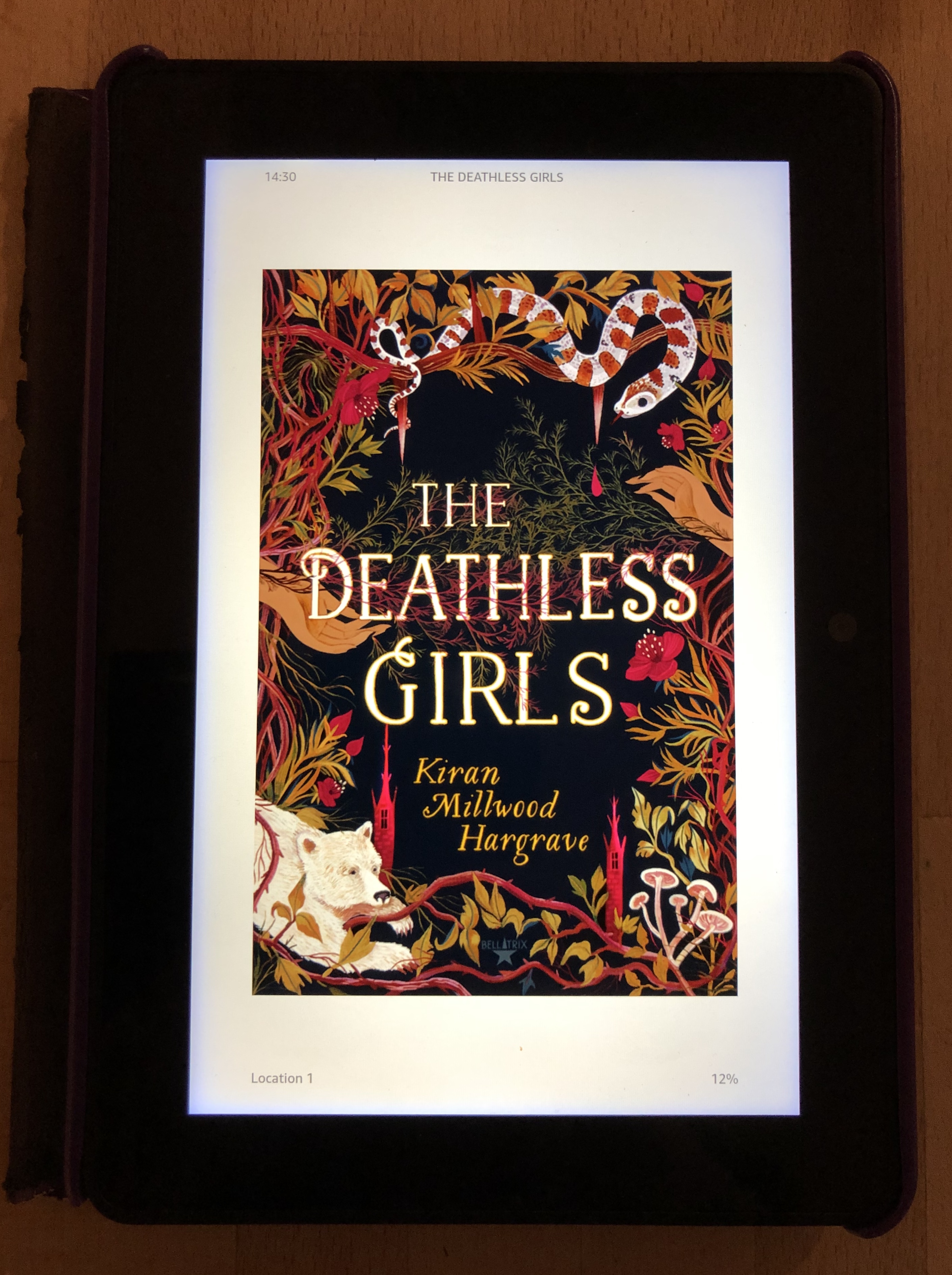
This week, in keeping with the Halloween spirit, I have read the suitably spooky gothic novel The Deathless Girls by Kiran Millwood Hargrave from the YA Book Prize Shortlist 2020. The Deathless Girls is from the Bellatrix (female warrior) series and aims to give voice to female characters in literature that have historically been consigned to the shadows, and in this case – the brides of Dracula.

Hargrave opens with two quotes, Catherynne M. Valente’s ‘that’s how you get deathless’ and Bram Stoker’s ‘She shall not go into that unknow and terrible land alone’. Both quotes set an ominous atmosphere of mystery and suspense with the references to ‘deathless’, ‘unknown’ and ‘terrible land’. The addition of a glossary adds a supernatural quality with the vocabulary ‘Demoni (Demons)’, ‘Iele (Forest spirits)’ and ‘Strigoi (Undead)’. These two pages successfully set the scene for the story of twin sisters Kizzy (Kisaiya) and Lil (Lillai) – Travellers – to unfold. Written in the first person from Lil’s point of view, Hargrave begins the narration with an ‘Aftermath’ where the arrival of the soldiers was the beginning of the end. The combination of the quotes, the glossary and the ‘Aftermath’ establish the gothic nature of the novel with an unnerving darkness that resonates throughout.

The inciting incident of the soldier’s attack opens the main narrative and occurs just before Kizzy and Lil turned seventeen, the day before their ‘divining day’ where they would receive the prophesy of their future. This attack is brutal and described as ‘the circle of blazing wagons was crawling with black-clothed men in crimson sashes, wielding long, glinting sticks’. Kizzy and Lil are enslaved and taken to their fully gothic destination – a castle described as ‘ridiculous and looming’ and ‘its turrets pierced the sky, black needles against the clouds, sharp as bared teeth set in grey gums’. Upon arriving at the castle Lil describes how their friend, Fen, was sold ‘I felt nausea rock my stomach. They were bargaining over Fen and the others like they were livestock’. The link to antebellum slavery runs throughout and speaks to the loss of identity, freedom and choice that the characters experience with some invasive descriptions such as ‘she peered into my mouth, ran her finger along my teeth’ where Lil ‘felt as though I was floating above my body’.

In addition, conflict is established between the ‘Travellers’ and the ‘Settled’ the with the ‘reasons that the Settled hated us [Travellers] were man and stupid: because we had brown skin, because we lived in wagons, because we called no land our own’ further linking to the theme of divisions and a sense of power.

The supernatural features throughout adding layers of tension as the ‘Settled think all Travellers are gifted, or at worst, sorcerers’.  Additionally, the ‘monster’ lurks throughout in the form of the ‘Dragon’ who ‘razes whole villages that disobey his commend. He is an evil man, with a black heart. Some say he’s worse than a man, has no heart at all’ implying his vampire nature. By defocusing on Dracula and the vampires, Kizzy and Lil are successfully brought to the foreground. However, as the gothic horror genre is a firm favourite, I would have liked the vampires to have appeared earlier in the novel fully harnessing the gothic and allowing greater scope to explore the decisions Kizzy and Lil will have to make.

Aside from the strong connection between twins Kizzy and Lil, the relationships between Kizzy and Fen as well as Lil and Mira skim the novel. Because the main focus is on the bond between the twins, Fen and Mira and their connection with Kizzy and Lil could have been explored in greater depth further supporting the main characters and allow the reader to invest more heavily in them. However, the strength of Kizzy and Fen’s feelings are expressed when Fen shouts, ‘Leave her!’ when one of the enslavers ‘placed one of his own foot on one of Kizzy’s wrists’. The deep connection between Kizzy and Fen is alluded to throughout and unfortunately for Kizzy, not supported by the divining prophesy which successfully creates suspense and leads us to wonder if they will ever be together. Lil and Mira’s relationship develops quickly and as the potential third bride of Dracula, Mira’s character and her connection with Lil is significant; the three are described as ‘the three sisters – two dark, one fair […] the beautiful damned […] the deathless girls’.

If you did not pick up on the Dracula narrative undertones, you would be surprised at the turn of events towards the end of the novel. The story of enslavement, liberty and choice ultimately allow for an exploration of the characters’ lives prior to becoming the brides of Dracula. In contrast to the lengthy exploration of Kizzy and Lil’s lives up to this point, the exposition of girls’ decision making is quick; such an important decision could have had greater contemplation and discussion within their dialogue. Despite the fact that the vampires do not make an appearance until nearly the end of the novel, the sisterhood and the bond between twins is successfully conveyed with gothic elements replete with dark castles, mystery, suspense, supernatural, weather, dreams and nightmares. And who doesn’t love a good gothic horror?

Themes: sisterhood, relationships, female love, enslavement, gothic, mythology, magic, travellers, vampires, choice, immorality, superstition, dreams, nightmares, darkness, folklore, persecuted


All pictures and writing are my own unless otherwise credited. Permission must be obtained before any image reproduction and credit must be issued in any image reproduction or quotations. 


Bedside Table Reads, Blog

Longlist Read: Such a Fun Age

Hello!

This week I have read Such a Fun Age by Kiley Reid from the Booker Prize Longlist 2020. Set in Philadelphia and New York, this is the story of Emira Tucker, a Temple University graduate who is trying to find her path in life. It is also the story of Alix Chamberlain who is married with two children and has a career as an influencer. The relationship between Emira and Alix explores racial profiling, parenting, racism, inequality, class and privilege through stereotypical characters and humour.

Written in the third person, the narrative alternates between Emira and Alix. Opening with a racially profiled encounter, Emira (African American) is employed as a babysitter by Alix. On her night off, while at a party, Emira receives a call from Alix asking her to take three-year old (Briar) out as they deal with an incident at home. While taking Briar to Market Depot, Emira is challenged by the guard with ‘Is this your child?’ and ‘Any chance you’ve been drinking tonight, ma’am?’ as well as another customer ‘And I heard the little girl say that she’s not with her mom.’ The exchange is recorded by Kelley Copeland who befriends Emira and emails her the recording promising to delete it. Emira is rescued from the situation by Mr Chamberlain. The plot unfolds from this event and spirals as Emira explores her options without Alix and Alix connives ways to hold on to Emira. This underlying tension successfully pervades the novel.

Emira typifies young graduates today searching for a ‘grown up’ job with health insurance; she is against the clock because ‘by the end of 2015, Emira would be forced off her parents’ health coverage. She was almost twenty-six years old’. For Emira, her babysitting job is more than a job. She bonds with Briar in a way Alix does not. Like many graduates of the ‘slash generation’, Emira is highly identifiable, working additionally as a transcriber for the Green Party Philadelphia typing ‘125 words per minute’ as well as an ‘on-call transcriber’ for Temple University.

Alix, a New Yorker at heart, agrees to the move to Philadelphia, has two children and longs for her city friends: Jodi ‘a casting director’, Rachel ‘proudly Jewish and Japanese, managed a firm that designed book covers’ and Tamara, a ‘principle of a private school in Manhattan’. Alix pines for her New York life and submerses herself in social media, book deals and products while caring for her younger child, Catherine, ‘with her revamped blog, detailing the success of other letter-writing promotion-receiving getting-what-they-want women, had six thousand hits a day’. Many will identify with juggling work, children and a loss of identity. Alix’s relationship with Briar, is challenging and at times comical, but a sadness pervades the relationship. Briar’s voice is one that ‘consumed everything in its path’, ‘it was loud and hoarse and never stopped’ and the relief of Briar sleeping is described as ‘it was as if a fire alarm had finally been turned off’.

Reid sets the stage for the relationship between Alix and Emira to be linked by more than just an employer-employee association and the narrative takes an unexpected twist with Emira dating the pushy Kelley Copeland, who just happened to also have ‘ruined Alex Murphy’s senior year […] before she became Alix Chamberlain’. Kelley is described as ‘one of those white guys who not only goes out of his way to date black women but only wants to date black women’. This successfully establishes further underlying tensions between Emira, Alix and Kelley.

While Emira sees babysitting for the Chamberlain’s as a job, Alix becomes increasingly, and strangely, obsessed with Emira, her welfare and future. Invading Emira’s privacy, Alix checks her phone: ‘Alix felt betrayed by Emira’s cell phone. These were the first plans Emira had in the last month that Alix hadn’t known about before she pretended she didn’t’. Alix makes decisions on what she thinks will be best for Emira stating: ‘you might be too young to understand this right now, but we have always had your best interests at heart’ and emphasising her love for Emira ‘we love you’ as part of the family regardless of the fact that ‘they made her wear a uniform’. This ‘white saviour’ behaviour underscores Alix’s privilege and highlights the further distinctions between them.

The themes of Such a Fun Age speak to very relevant topics that do need discussing. Emira is a highly likeable and believable character. Alix, veers far in to the stereotypical at times and oversteps credibility with her actions, dialogue and obsession. Equally, Kelley’s questionable behaviour gives the impression of harbouring sinister strands. Such a Fun Age does intertwine deeply important explorations of race and privilege while questioning if there is a ‘fun age’ through humorous dialogues, encounters and relationships.

Themes: racial profiling, class, inequality, parenting, motherhood, privilege, white saviour, family relationships, friendships, love


All pictures and writing are my own unless otherwise credited. Permission must be obtained before any image reproduction and credit must be issued in any image reproduction or quotations. 

Bedside Table Reads, Blog

Shortlist Read: The Places I’ve Cried in Public

Hello!

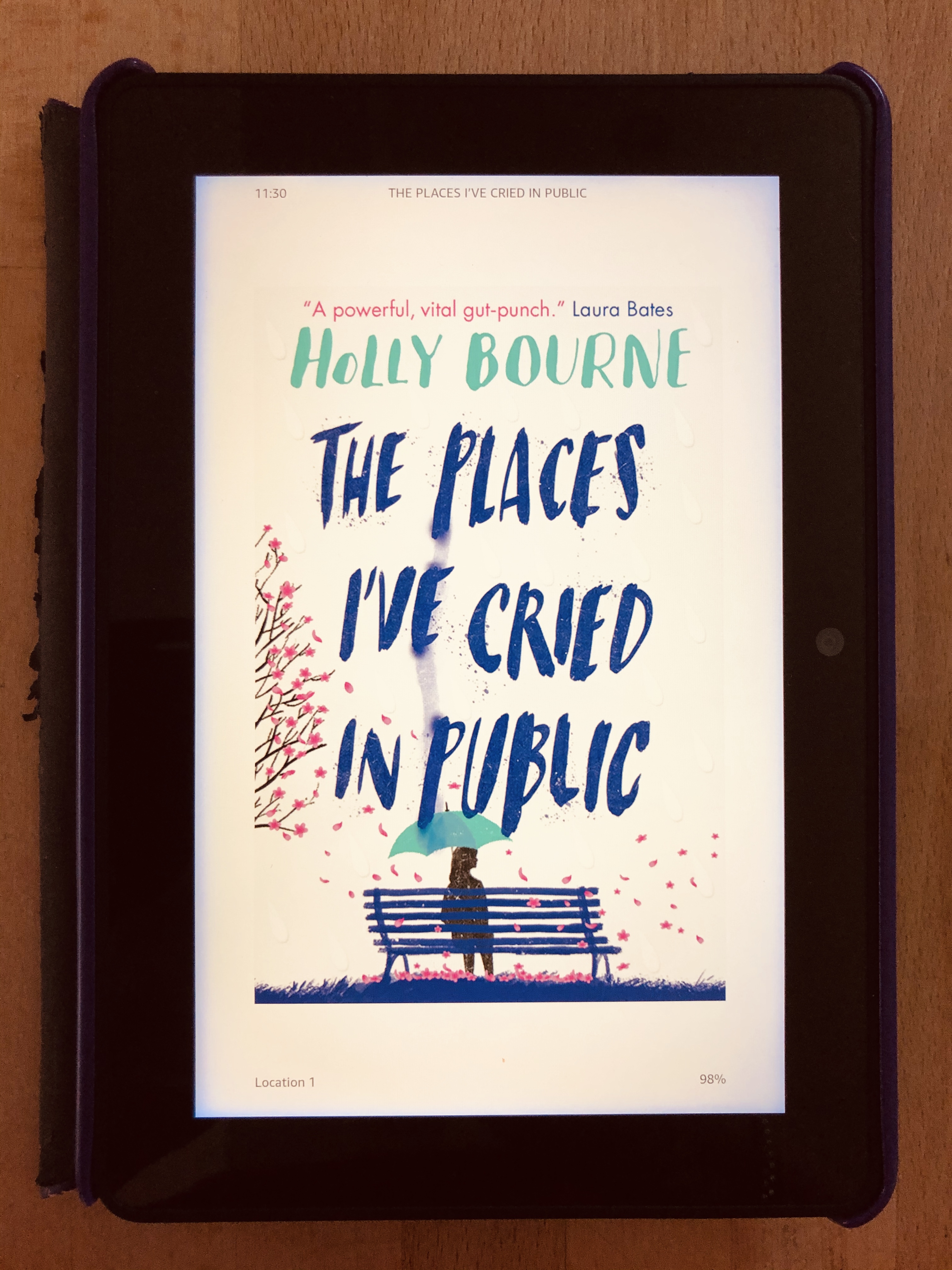
This week I have chosen to read The Places I’ve Cried in Public by Holly Bourne from the YA Book Prize Shortlist 2020. This is a story of Amelie and the boy she loved first (Alfie) and the boy she loved second (Reese). It is the story of Amelie’s journey through the locations that she’s cried to discover why loving Reese was so painful, confusing and frightening and not at all like loving Alfie, who was safe, comforting and gentle.

The narrative is written in the first person and alternates between Amelie’s present and her past as she excavates her memories through flashbacks of where she has cried in public, to discover how she has ended up so hurt and confused. Amelie’s life changes when her family has to move from Sheffield to a town outside of London. She leaves the security of her boyfriend Alfie, her friends, and all that she loves about the North describing it as ‘It’s all duck and pet, and it’s lovely, really it is. You feel like everyone is a friend’.

Starting A-Levels in a new town, a new school and being a painfully shy singer/songwriter who suffers from a ‘shyness rash’ and has a ‘full-blown obsession with cardigans’, Bourne, establishes a vulnerability in Amelie and the ensuing obsessive love/hate relationship with Reese where she ‘fell hard for Reese’ and it ‘looked like love’ and ‘felt like love’ but is not sure if love is ‘supposed to hurt like this’.

Amelie begins her journey on ‘this bench’ which is ‘Dot Number One’, ‘the first place I ever cried in public’ and addresses Reese and his new girlfriend: ‘You’re smiling at her from under your trilby hat. You’re looking at her how you use to look at me. It hurts in such a profound way that there almost isn’t room for it in my body.’ The pain is so acute and so raw that as she contemplates ‘Why am I doing this to myself?’ the reader wonders if her parents, and new friends: Hannah, Liv and Jack, will be able to extract her from the toxic relationship with Reese before she self-destructs.

Reese, like a ‘radiating magnetic force field’ and ‘dressed – like an old-fashioned British dandy’ as ‘his hat matched his waistcoat’ is mesmerising. What starts innocently for Amelie, in hindsight is the beginning of Reese’s manipulation, and she addresses him ‘you were waiting outside my music lesson’ then flashes back to the scenario, ‘He tipped his hat again, leaning against the wall, one knee bent, looking so damn cool.’ Amelie describes the attraction of Reese as ‘J.R.R. Tolkien couldn’t even dream up a quest more enticing than going to the music block with Reese Davies.’

But the closer Amelie gets to Reese, the further away from her new friends and family she becomes, and understands less and less about love and relationships, where ‘even after the best night of my life, you still manage to make me cry’. Reese, like a drug, is described as a ‘giant sexy magnet’ and Amelie states that she felt ‘like I was wearing chainmail’.

Amelie’s journey, ‘the dots on the map where you made me cry’, is self-destructive at points as she believes that she is ‘sure it’s all my fault somehow’ and if ‘only I’d done things differently’ and ‘been…less me, then I wouldn’t have driven you away’. This confusion and misconstrued belief that Amelie is somehow at fault for the destructive relationship, is so powerful, sad and infuriating that as a reader, you want to reach into the book and help her to see that it is not her, but Reese and no one should ever be ‘…less me’.

We have all been there, crying alone in some public location: ‘train station waiting -rooms’, ‘dance floor of clubs’, ‘bus stops’, ‘at the back of lessons’, ‘on the pavement’ and ‘cold concrete’ and in ‘school bathrooms’ – one of the questions The Places I’ve Cried in Public raises is why no one stops to ask if you need help? Being privy to Amelie’s detailed descriptions of psychological abuse, this book is a call to humanity; we are not alone, and we need to help each other. It is a must read, as we all ‘have a voice’ and we all have ‘a song to sing’ and above all, we all need to be able to say, ‘I am safe’.

Trigger warnings: physical, emotional and mental abuse and manipulation

Themes: coming of age, love, first love, grief, abuse, trauma, forgiveness, toxic relationships, manipulation, therapy, mental health


All pictures and writing are my own unless otherwise credited. Permission must be obtained before any image reproduction and credit must be issued in any image reproduction or quotations. 

Bedside Table Reads, Blog

Longlist Read: Love and Other Thought Experiments

Hello!

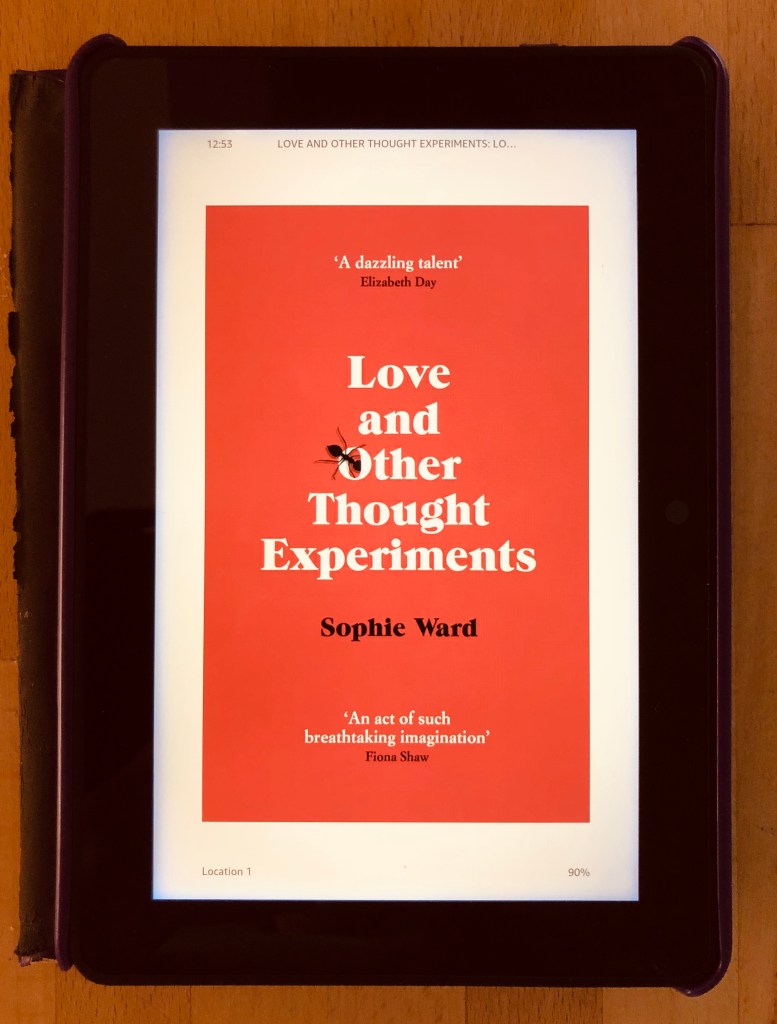
This week I have read Love and Other Thought Experiments by Sophie Ward from The Booker Prize Longlist 2020. At the heart of the narrative is the relationship between Rachel and Eliza, their son Arthur, and Hal (Arthur’s biological father). These characters and their relationships form the springboard for a series of explorations of amorphous realities, what it means to be human and to love.

Each of the ten interlinked chapters begins with a thought experiment: Pascal’s Wager; The Prisoner’s Dilemma; To Be a Bat; Philosophical Zombies; What Mary Knew; The Chinese Room; Twin Earths; The Ship of Theseus; Descartes’ Demon and Gilbert Harman’s Brain in a Vat. The reader, almost as a psychologist, examines the characters within each experiment and must expect the unexpected with changes in point of view, time and space.

In Kafkaesque style, the narrative opens with Rachel who believes that an ant has crawled into her eye while she slept, ‘Something bit me…In my dream…it bit me…it’s gone into my eye.’ Eliza doubting her responds, ‘Nothing there…do you want some antiseptic?’ This singular event brings their very relationship into question with Eliza contemplating ‘in their four years together she had often felt like this, there and not there, connected, yet keeping a part of herself separate’. Regardless, they conceive Arthur on ‘Friday 24th October 2003’, time speeds ahead, Arthur is born – years pass, and Rachel is diagnosed with a brain tumour all within a few pages. It is only with hindsight that the shift to artificial intelligence and science fiction becomes clear and that initial references such as: ‘program’, ‘Helloworld’, ‘uses crt’ and ‘(*Here the main program block starts*)’ begin to make sense.

Once traditional narrative understandings are suspended, Ali, a new character, is introduced in the second chapter, whose memory of swimming out to sea to get a ball where ‘He couldn’t swim hard enough with the ball in his arms but he didn’t want to let go of it’ initially seems to have little connection with the characters in the first chapter. Ali’s story transitions throughout – a different time and location, the Mediterranean or London? It is only in the third chapter that Ali is linked to Elizabeth (Rachel’s mother) in their youth, again a different time and location – Brazil.

The most unnerving chapters are those written from the ant’s (fourth chapter) and the perspectives of Artificial Intelligence – AI (ninth chapter). The ant’s perspective, in the fourth chapter is voyeuristic where the ant ‘watch the sleeping human forms…the rise and fall of their bodies’ to the dangerous where it watches ‘the human women dream and feel the impulse to be closer.’ The violation of Rachel by the ant ‘the first touch of skin’ and the ‘walk over the face’ to find ‘the smallest openings, along the pink ridge of the eye’ is more than unsettling. Similarly, the exploration of Rachel’s brain and tumour is unnervingly described as ‘the soft flesh of the tumour is embedded in the back of the woman’s brain’. Equally, the revelation of Zeus, as the ‘operating system’ reveals the ‘moment in human history when technology advanced enough to allow machine intelligence to connect and learn and from that point become autonomous’ puts the seemingly divergent narratives into perspective. Again, the narration bends time and space. Arthur, an astronaut, exists because of artificial intelligence. Artificial Intelligence (AI) describes this as ‘we need each other, Arthur, and it is this version of you that has the greatest chance of success’. Time shifts to ‘the fourteenth day of May 2041, human years’. Narratives shift, Rachel has not died of a brain tumour. There is ‘this world’ and the ‘other world’. There is ‘this Rachel’ and the ‘other Rachel’.

The story of Arthur and his family, traversed realities and times, bringing the reader to a future world of artificial intelligence. Beyond A Brave New World of Big Brother, Sophie Ward transports us to a time in the not too distant future where Arthur wants to ‘tear the implant from his head’ and ‘let the wires fry’ but Zeus, reading his mind, his body and his vitals placates him. Arthur is ‘a lab rat and the lab was in his head’. Love and Other Thought Experiments is a premonition, nay warning, in true science fiction fashion, of humanities fast track to a brave new dystopian society, inhabited by a part-human, a part-artificial intelligence species.

Themes: relationships, love, death, humanity, human behaviour, artificial intelligence, parenting, family, destiny, fate, reality, truth, philosophy, psychology, time, science fiction, thought experiments, utopia, dystopia.


All pictures and writing are my own unless otherwise credited. Permission must be obtained before any image reproduction and credit must be issued in any image reproduction or quotations. 

Bedside Table Reads, Blog

Shortlist Read: The Gifted, the Talented and Me

Hello!

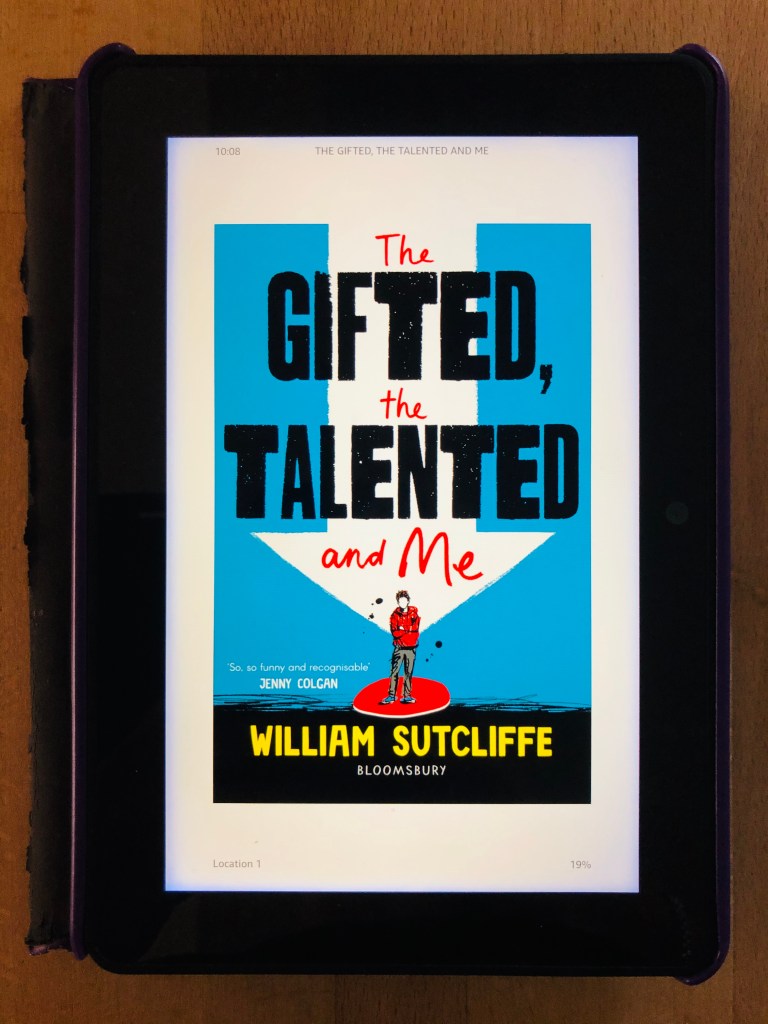
This week I have chosen to read ‘The Gifted, the Talented and Me’ by William Sutcliffe from the YA Book Prize Shortlist 2020. Sam is fifteen, happy with his life in Stevenage and happy being ordinary. All this is about to change as Sam’s parents call a family meeting.

Sam, his older brother Ethan (seventeen) and younger sister, Freya (seven) assemble to what they think is the announcement of their parent’s divorce, only to discover their Dad sold his company. As a result, they are rich. Not only are they rich, but his Mum has quit her job and they are moving to London. This inciting incident jettisons the family to Hampstead and Sam and his siblings into the North London Academy for the Gifted and Talented.

Written in the first person, we are privy to Sam’s confusion, angst and search for himself in all its humour, sadness and easily relatable teenage experiences. His initial reaction, ‘Hang on…what do you mean goodbye, Stevenage?’ sets the scene for Sam’s difficult transition to life in Hampstead. Sam’s Mum believes that ‘mainstream education is restrictive and conformist and obsessed with pointless targets and stats.’ By sending them to the North London Academy for the Gifted and Talented, she explains she ‘is going to set you free to find out who you really are!’ While Ethan is musical, and Freya, artistic and draws a ‘puppy, a unicorn and a kitten sitting on a cloud under a double rainbow’, the decision is described ‘like getting out of jail halfway through your sentence’, Sam wants to know why they are ‘sending me to a school for weirdos?’

To further complicate Sam’s life, his Mum is on her own journey of self-discovery. Her workshop shed at the back of their Hampstead house is for throwing pottery and she starts a blog on the theme of ‘motherhood and creative rebirth’ much to Sam’s horror as she describes her children as ‘F__, seven and already a burgeoning artist; E__, seventeen, a highly talented musician; and S__, fifteen, a little stranded between the twin states of childhood and adolescence…’ and further writes ‘For S__, things are not so easy. He’s a very straightforward boy, and the unstructured approach is a great challenge to his rigid male brain.’  The public revelations of their personal family life set the scene for further conflict between Sam and his Mum.

Equally horrifying, Sam discovers at school that ‘Kicking is a violent act.’ and ‘Ball games are fine, up to a point, as long as they’re not competitive, but football is out.’ Talentless, friendless, and ‘feeling…a bit weird’, Sam feels ‘doomed’. But then he meets Jennifer, ‘the ringleader’ of the ‘I’m-beautiful-and-I-know it’ group who was ‘so stunning she didn’t even need to try’ and Sam’s school experience begins to take a turn for the better. He also meets Marina, from the fashion set, ‘the only person who ever greeted me or seemed to actually notice my existence’ who was wearing a ‘reconfigured bath mat’ when they met. The scene is set for Sam to find navigate his way to fitting in and getting a girlfriend.

The internal monologues are highly relatable, realistic and humourous:

‘OPTIMISTIC BRAIN: We have to audition for the school play. That is exactly what Ethan said we should do.

PESSIMISTIC BRAIN: You’re only saying that to get closer to Jennifer, even though you know she’s a snobby, up-herself princess who thinks you’re a total geek. We should stay away from her.’

It is the school production of ‘The Tempest’ where Sam is launched into an unexpected world as he auditions for the part of Caliban and takes his revenge on bully, Felipe (Jennifer’s boyfriend). In a hilarious scene where Sam is paired with Filipe, they are tasked with mirroring the other person in real time. Sam imitates a monkey and begins to ‘pick fleas out of my fur and eat them’ and then begins to ‘groom him, messing up is complicatedly gelled hair, picking imaginary insects off his head and putting them in my mouth.’ Sam realises that ‘onstage, I could be as ridiculous as possible’.

‘The Gifted, the Talented and Me’ is an exploration in finding out who you are. While that sounds serious and philosophical, Sutcliffe skilfully navigates the ups and downs of trying to fit in and remain true to yourself with scenes that are as painful and cringeworthy as they are funny. Will Sam fit in, find his talent and ultimately will Sam find himself?

Themes: coming of age, identity, sexual identity, family, teen years, fitting in, being average, friendship, first love, being yourself


All pictures and writing are my own unless otherwise credited. Permission must be obtained before any image reproduction and credit must be issued in any image reproduction or quotations. 

Bedside Table Reads, Blog

Shortlist Read: Burnt Sugar

Hello!

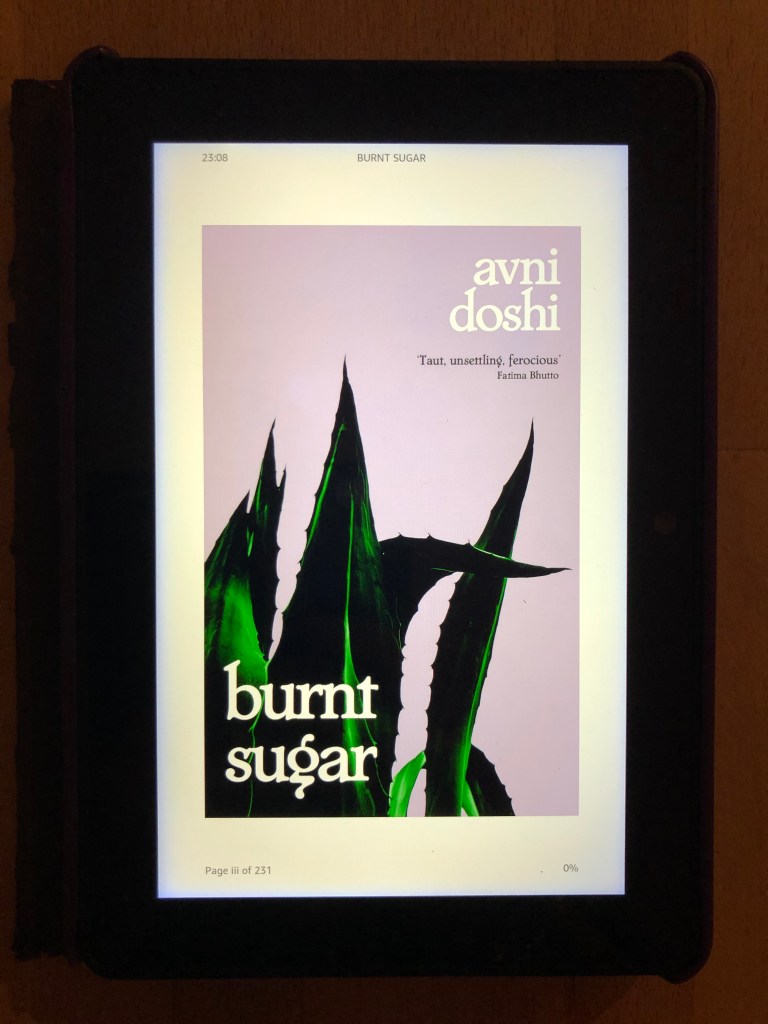
This week I have read Burnt Sugar by Avni Doshi. I am still working my way through the Booker Prize Longlist 2020, but the Shortlist has recently been announced, with Burnt Sugar being one of the six listed.

Burnt Sugar, written in the first person, is set in the Indian city of Pune. The narrative follows Antara’s present life and flashbacks to her childhood. The two narratives mingle with intertwining events as Antara tries to make sense of her relationship with her mother. Antara was named after her mother, Tara. She explains that this was ‘not because she [her mother] loved the name but because she [her mother] hated herself.’ The name, Antara, being opposite to Tara or ‘Un-Tara’.  Antara sees this not as a way of differentiating them, but rather that they were ‘pitted against each other’.

Throughout the narrative, Antara attempts to understand her past and her mother’s decision to leave her father and join an ashram (spiritual retreat). The past pushes through the narrative, influencing the present, challenging what Antara understands to be the truth or perceived truths.

Antara struggles with the present. Her mother seemingly suffers from early onset dementia, though her brain scans are normal. Antara seeks doctors and researches the disease stating, ‘I have read that the disease is caused by insulin resistance in the brain’ or ‘some studies…link cognitive health with problems of the intestines’. The absence of her father leaves Antara isolated in the care of her mother. Even her grandmother had ‘only one positive memory […] of her own child’.

The actions of Antara’s mother are unpredictable and at times dangerous. However, this unpredictability is echoed in Antara’s childhood, specifically when mother left her father, when they were beggars and when she was sent to boarding school and was ‘already in the car when they explained to me where we were going’.  

The anger Antara feels towards her mother simmers as she is forced into a position not only care for her but prove that that there is, in fact, something wrong with her. This complex relationship oscillates between resentment for her childhood and her duty as an adult. Recalling her year at boarding school, Antara describes how Sister Maria Theresa ‘without warning, stabbed the pencil in the back of my palm’ and how she had to hold her ‘soiled sheets above my head’ as her ‘classmates walked past […] giggling under their breath’.

Antara states that ‘my mother leaving my father, and my father letting us both go, has coloured my view of all relationships’. The theme of dysfunctional relationships extends to Antara’s own relationship with her husband, Dilip. She contemplates leaving him, even ‘packing a small handbag’ with her ‘passport and some jewellery’ only to return that evening with Dilip unaware of her actions.

This dysfunctional relationship between Antara and Tara is summarised by the narration ‘I understood how deeply connected we were, and how her destruction would irrevocably lead to my own.’ The fragility of the relationships is laid bare through the exploration of memory and ‘remaking memories’ into the ‘image of what other people remember’. The making and remaking of memories is a consistent theme throughout with Antara wondering ‘if a falsehood is enacted enough, does it begin to sound factual?’

The strain of the mother-daughter relationship is clear. Antara’s anger at having to care for her mother throughout her cognitive decline leads her contemplate if she is ‘becoming my mother’. She further wonders if she too, would see her own child as ‘a competitor or, rather an enemy’.

Through unravelling the past, secrets are uncovered, and the line between reality and falsehood blurs revealing two generations of women who struggle as mothers. Burnt Sugar is a soul-searching narrative of motherhood and the ‘striking sensation that life is short’. As the title suggests, there is a residue of bitterness that remains for Antara, the relationship with her mother and even for the reader.

Themes: memory, betrayal, mother and daughter relationships, betrayal, Alzheimer’s, love-hate relationship, parenthood, postpartum depression, dysfunctional relationships, motherhood, class inequality


All pictures and writing are my own unless otherwise credited. Permission must be obtained before any image reproduction and credit must be issued in any image reproduction or quotations.