
Blog, Creative Shorts, New Writing

The Footbridge

Mist rose from the white froth of the river as it rushed under the footbridge. To the right of the bridge was the weir – large iron gates shoulder to shoulder as the river poured over.  To the left of the footbridge, black angry whirlpools that were whisked downstream by the current. The spray from the water that crashed into the weir landed on the wooden footbridge in droplets and froze almost as quickly as it kissed the wood forming an icy sheath along the handrails and planks.

This was no place to be so early on a bitter December morning.

The footbridge was long. One of the longest in the kingdom. Crossing the river, even over the footbridge at this time of year was, needless to say, perilous. One slip, one rotten piece of wood and between the freezing river and the current, it would take a miracle to survive.

I tied the black woollen scarf more tightly around my neck and cursed myself for rushing, leaving my hat and gloves behind when I grabbed the oversized duffle coat. Numbness crept around my ears and I began to regret my half-hearted attempt at deception and wished I had not cropped my hair into such a short bob before setting out, but everyone knew my long, curly black hair. It was wild and even under a hat the curls would force their way loose. I would be seen. But what’s done, is done and my curls lay tied in an amputated ponytail under the floorboard in my bedroom. I needed to cross the bridge before the sun rose. I rubbed my bare hands together and prepared to traverse the icy planks to the field on the other side of the river where he would be waiting.

‘You have nine lives.’ I said out loud. ‘Remember Forest, you have nine lives.’

And as if walking a tightrope, I lifted my arms out from my sides and placed my foot on the first board, and the next and the next. Between the gaps in the planks, the river rushed dizzyingly underneath. The footbridge swayed with the white water to the right, the whirlpools to the left and the driving current below. I lost my balance and I wasn’t even halfway across. The icy air constricted my lungs arresting my breath and my vision clouded.

I reached out to the handrail and flinched as the icy surface burned my palm and retracted my hand. I closed my eyes and pushed my hands into my pockets to warm them. I felt the leather pouch of money. It weighed heavily in my coat and I remembered my purpose on this early December morning. I clutched the purse, opened my eyes and stared into the distance, along the footbridge to the other side. I ignored the weir, the whirlpools and the current beneath the footbridge and stepped solidly from one frozen board to the next. I breathed in through my nose and out through my mouth. Slowly. Deliberately. Evenly.

It was said that within my eyes, the whole of the kingdom could be seen. Even in one so young as myself. But what they did not know was that through my eyes, I could see the whole of the kingdom. Some secrets had to be kept.

I reached the bend in the footbridge and refocused my eyes towards the end – the lock. Hennery, the lock keeper, would not be up yet. He walked the streets of the town in the dead of night, ghostlike. Some say he was simply so old that he no longer slept at night. Others say he was cursed with an earthly purgatory of sleeplessness. I know he seeks what he has lost and can only hope to find under the cover of darkness.

As I neared the lock, I dared to look to my right, I had passed the weir and the white water had calmed to strong black current; I was able to keep my balance while glancing to either side of the footbridge. It was still early enough that not a soul stirred, not even a mallard. I continued to tread lightly, my shoes barely touching the footbridge. The last section I ran across on tiptoes until I reached the frozen earth of the bank. As expected, Hennery was nowhere to be seen.

I blew into my hands and rubbed them together as I peered both ways along the footpath. The sun was high enough to form long golden beams that accentuated the ethereal mist that rose from the river and rolled over the bank and settled in frozen fractal patterns on the saltmarsh-grasses, reeds and bulrushes. Before long, lovers would be out for early morning walks and Hennery would be summoned by boats needing passage through the lock.

How long was I to wait?

I moved off of the footpath into the cover of the horse chestnut trees of the bankside. I removed the purse and weighed it in my right hand. I scanned the bank, the river and the footbridge behind me. The scene was as empty as the soulless eyes of a dead man. My kingdom slept.

The grasses rustled and a frozen branch cracked. He was here. I laid the purse between two roots of the tree and stepped towards the footpath. Aiding and abetting a known fugitive. That is the crime I would be convicted of – penalty of death in my kingdom under the stars. My breathing became uneven again, the river scene swirled. The words aiding and abetting rebounded from one side of my mind to the other.

I caught sight of the horse chestnut tree. The pouch was gone. I had aided and abetted my father, a fugitive, for the last time. I ran back across the footbridge ignoring the ice, the weir and whirlpools. I ran along the empty Riverside Street. I ran up the hill to our house and stopped short of the path that led to the front door. The light was on in Mother’s room. The house was waking up. I untied my scarf and pulled it over my head, retied it under my chin and pulled the collar of the coat up to cover my neck.

I had lost one of my nine lives on the footbridge. I felt it drown in the river. But I would always land on my feet, Father had said, so I had to keep going. I turned away from the only home I had known and headed on the road out of town.


All pictures and writing are my own unless otherwise credited. Permission must be obtained before any image reproduction and credit must be issued in any image reproduction or quotations. 


Bedside Table Reads, Blog

Shortlist Read: The Black Flamingo

This week, I have read The Black Flamingo, by Dean Atta, from the YA Book Prize Shortlist 2020. I was so excited to read this novel of verse, and I was not disappointed. A highly relatable and moving coming of age story about Michael, as he explores his identity as a half Jamaican and half Greek-Cypriot gay teen and ultimately, his drag debut.

Written in the first person, the pages are filled with verse and illustrations (by Anshika Khullar) that propels the reader through Michael’s life in London from six years old to university. Interspersed, Atta includes text messages and notes, all presented with an economy of words that juxtaposes the deeper introspection providing an intimidate glimpse into Michael’s heart, mind and soul.

The novel opens with a Prologue, and as expected, it reveals the narrative journey: ‘The black flamingo is me trying to find myself’ to ultimately ‘I am the fairy finding my own magic’. These short phrases sum up the introspective nature of the verse that culminates with Michael’s revelation at a drag artist, ‘I stand triumphant in a leotard and heels, a full face of make-up and a beard’ which is both exhilarating and hopeful.

However, within the first few pages, Michael reflects that ‘I often feel like a bad egg that was not meant to be’. This is a dark and despairing phrase; you have to hope that ‘the magic’ referred to in the Prologue provides Michael with enough agency not only to overcome this negativity and embrace all of himself. This darkness is represented in the episode where his father shouted at his mother, ‘You’re useless!’ while ‘throwing his plate down, turkey stuck to the kitchen floor’. The verbal abuse combined with the violent action is just one example of Michael’s hurdles.

The narrative fast forwards to Michael’s ‘sixth birthday’ where all he wanted was a ‘Barbie’ but instead was given ‘Teenage Mutant Ninja Turtles’. However, later that year, his Mother gave him a Barbie described as: ‘No wrapping paper, just / a pink bow on the box. / Mummy has bought me / a Barbie! / But she got it wrong. / It’s not the Goddess / but I hug her anyway.’ Atta highlights ‘a Barbie!’, the short phrase separated by line breaks signifying the importance of the gift as well as the developing relationship between Michael and his mother.

In Michael’s continued search for identity, on his seventh birthday, he no longer wants a Barbie, but rather he describes: ‘I tell Mummy I want to change my last name. I tell her I want to match her. I want to change my surname from his Brown to her Angeli.’ The repetition of ‘I tell’ demonstrates the forcefulness of his desire to not to have ‘his name /dragging behind me like a dead dog on a lead’. The repetition is furthered by the simile as well as the alliteration of the words ‘dragging’, ‘dead’ and ‘dog’. Atta emphatically concludes his relationship with his father by relinquishing his association with his name with further similes: ‘like a toilet roll on the sole of my new Kickers boots, / like a shedded snakeskin / like a second shadow’. These comparisons are economically phrased hard hitting as Michael soars with his new name ‘Michael Angeli’ where he ‘can really fly’.

There are many evocative, sad and joyous examples of narrative verse throughout The Black Flamingo. One that particularly hit home was ‘Don’t let anyone tell you / that you are half anything’ and ‘you are a full human / being.’ Exploring, as many of us do, our composite identities, and for Michael what it means ‘to be British, Cypriot and Jamaican’ is highly relatable and affirms that there are many parts that can make up the whole.

The narrative verse takes us through Michael’s teenage years, two schools and his relationships his friends: Emily, Callum, Daisy, Rowan, Grace, Destiny and Faith as well as his Uncle B and sister Anna. It is Michael’s ‘coming out’ letter to Rowan that is so moving and exposes his vulnerableness when he writes ‘I’ve liked you for so long / I like your ginger hair, your freckles / will you go out with me?’ and the heartbreak we feel with him when Rowan responds: ‘Oh, right,’ he says. ‘This is awkward.’

While Michael navigates secondary school, it is in university where he seeks to solidify his identity ultimately trying out the Drag Society where his journey ends and begins simultaneously with his first performance as Black Flamingo ‘I call myself black. / I call myself queer. / I call myself beautiful. / I call myself eternal. / I call myself iconic. / I call myself futuristic.’ The simple sentences, making use of anaphora, ‘I call’ with all end-stopped lines emphasise Michael’s certainty of who he is as he subsequently says, ‘You can call me The Black Flamingo’. The verse is indeed a celebration of individuality. It is also a warning, not to be defined by labels.

Presented as notes, Atta includes: ‘How to Do Drag’, ‘What’s it like to be a Black Drag Artist (for those of you who aren’t)’ and ‘How to Come Out as Gay’. The lines from these ‘How to…’ notes that linger are: ‘Remember you have the right to be proud. / Remember you have the right to be you.’ Through the repetition of ‘remember’ and ‘right’ the lines form an uplifting message of hope.

The Black Flamingo explores many dichotomies throughout – gay and straight, female and male, Black and White but ultimately it is a testimony that nothing is better than being yourself. The Black Flamingo is easily one of the best novels of verse fiction and one that everyone should read.

Themes: identity, belonging, sexuality, race, gender, coming of age, relationships, family, acceptance, mother-son relationships, self-discovery, inner truth, hope


All pictures and writing are my own unless otherwise credited. Permission must be obtained before any image reproduction and credit must be issued in any image reproduction or quotations. 


Blog, Creative Shorts, New Writing

Below Freezing

The fog rolled in overnight. It had settled around the treetops before I went to bed, but it silently crept through the bare branches until it covered the roads, the fields and the river. I left the house before dawn and entered the oblivion of the day.

I pressed on towards the Thames, coughing as the freezing air caught in my lungs. The path seemed longer than I had remembered and although the density of the fog was unexpected, it was not unwanted, and I wrapped my knitted scarf more tightly around my neck and covered my mouth with it in an effort to stifle the sudden loud coughs that could give me away.

As I reached the riverbank, the sun rose just enough and began to burn off the fog; the river came into view with the bluish shadows of the trees on the bank opposite. Snapshots of the tree’s reflections shimmered in an iridescent steel grey in the river and undulated slightly with the movement of the current.

I waited in the silence and listened.

In the freezing fog, the silence was broken by the snap of the odd branch or a catch of heavy breathing. I was not alone.

My scarf had slipped down and as I stood still, waiting for the inevitable, I pushed the loose hair that had escaped from my heavy coat out of my face. The stray strands had crystalised and crunched in my fingers; I realised that my breath caught on the ends; it must have been below freezing. In one way or another, I could die by this bank and in the short time I waited, the sun rose further and illuminated the white fog and myself in my black coat. Steam rose off of the river and created a haze in which it would be easy to disappear.

Two geese emerged from the fog and waddled close to my feet. I coughed into my scarf startling them into flight over the river honking as they drove their wings into the mist. I sidled down the bank towards the mooring, slipping on the icy grass and geese droppings until I reached the short dock. I pulled the leather gloves from my hands and stuffed them into my pockets. The rowboat was exactly where I thought it would be and I reached down to untie the rope from the post, but I stopped just before I touched it. A spider’s web, large and complex, formed a triangle between the post and the rope, heavily frozen white lace. It was beautiful. Delicate and perfect, nature’s tatting. I peered closer into the boat and in the corners and between the seats, frosted spider’s webs decorated the crevices like wedding finery. Though the sun was rising, the fog still hung heavy and the footsteps echoed closer and closer. I pulled the rope and released it from the post shattering the spider’s web.

I tip-toed across the wooden planks of the dock and eased myself into the rowboat sliding into the middle and held on to the sides briefly for balance. I removed one of the oars and pushed it against the dock and drifted towards the middle of the river and under the low-lying fog just as I heard a voice say, ‘I can’t see her.’

I fixed the oar into place and as noiselessly as possible; I removed the other oar locked it in and let the oars dip into the water. I pulled gently, lining the boat up with the shadows of the trees that I could now see lined both banks. The skin of my hands stuck to the oars and I wished I had put my gloves back on but there was no time to stop now. The winter sun rose fast, and I could see the fog in the distance dissipating. Despite the promise of the warmth of the sun, my fingers were so cold that the first two on each hand ached with stabbing pains so sharp I wondered if I would be able to keep up the pace as I closed them more tightly around the oar and pulled. Ignoring the pain, I manoeuvred the boat into the current as I had been taught and the boat moved faster and faster as I rowed.

Two swans escorted me briefly, gliding next to the boat, balanced and pure like some divine symbol of protection sent aid and abet my escape, as I tried to vanish along the steaming foggy river. On the bank were two figures, one with a rifle raised towards the river and the boat. A shot rang out. One of the swans faltered, let out a painful yelp and lost its balance. It was a crime to kill a swan, but I did not think they cared about the law. I gripped the oars harder, my fingers now blue, and rowed harder leaving the other swan to swim around its dying mate.

From the bank, the voices argued and grew distant. The dying swan had bought me some time and as I passed under the old stone bridge, I disappeared.


All pictures and writing are my own unless otherwise credited. Permission must be obtained before any image reproduction and credit must be issued in any image reproduction or quotations. 


Bedside Table Reads, Blog

Shortlist Read: The New Wilderness

This week I have read The New Wilderness by Diane Cook from the Booker Prize Shortlist 2020, a dystopian fiction of environmental destruction and survival. Volunteering for an experiment in leaving ‘no trace’, the characters in the ‘Wilderness State’ exist as a collective ‘Community’ of nomadic hunter-gatherers. The narrative is centred on the mother-daughter relationship between Beatrice, who agrees to enter the experiment with the promise of better health for her daughter, Agnes, who is dying from poison ‘City’ air.

The New Wilderness presents the impending doom of environmental destruction, not as an anticipated event, but one that has already occurred. Written in five parts: ‘The Ballad of Beatrice; In the Beginning; The Big Walk; The Ballad of Agnes and Friend or Foe’, the third person narration is able to effectively shift perspectives from Beatrice to Agnes, exploring the depth and divisions of their relationship. The shift to Agnes’ narrative works particularly well as an exploration a younger generation’s collective responsibility of a respectful existence in the wake of the older generation’s individualistic greed and disregard for the natural world. Small revelations alongside Agnes’ maturation allow her an insight into Beatrice, although Agnes herself has forged an almost animalistic bond with the land and thereby establishing a greater divide between herself and her mother.

The social commentary on the ever-decreasing natural resources pervades the novel. The rich description of the natural world where the landscape is described as ‘grasslands that smelled of nutmeg after a rain’ is juxtaposed with images of the ‘City’ with poison air and the ‘streets were crowded, filthy, where rows of high-rises sprawled to the horizon and beyond.’ While these two environments seemingly co-exist, it raises the question of whether the filth and sprawl of the ‘City’ is unstoppable and if the ‘Wilderness State’, last vestige of the natural world, is doomed. David Attenborough addresses this very idea in the documentary ‘A Life on Our Planet’, and while our destruction is irrefutable, he does give a sense that we can still, collectively, enact change, whereas The New Wilderness leaves us wondering if only a few are actually destined to survive – a rather hopeless thought.  

The twenty original members of the ‘Wilderness State Community’ were not scientists, naturalists or environmentalists; they were twenty volunteers who gave up everything because this experiment was their last option. They quickly lose most of the technological trappings of modern society, keeping time by the seasons and flowers with the effect that their existence seems to be in sync with the ‘wild world’. This is echoed in the ‘Manual’ which dictates the rules including the ‘bags of their garbage they carried with them to be weighed and disposed of by the Rangers at Post’. The drive towards ‘no trace’ is seemingly impossible as the group complete ‘micro trash sweeps’ to completely encourage ‘re-wilding’. Additionally, the role of the Rangers is not clearly defined as they seem to function solely to deliver post and provide the group with the next set of instructions. The fact that the ‘Community’ makes use of rope, bedding, cookware and steals processed food from the Post seems to contradict the notion that the ‘Community’ should be living off of the land as primitive hunter-gathers and makes one question the nature of the experiment.

The group continually evaluate what is necessary, carrying the ‘forty-pound cast-iron pot’ through the Wilderness and the ‘Book Bag’ which once contained ‘the Book of Fables’ but ‘had been lost to a flash flood’. Both seem almost farcical as the group ‘were limited to seven days in one place’ and carrying the cast-iron pot across the ‘Wilderness State’ is nothing short of madness. With Agnes growing up with little memory of the ‘City’, her skills of survival are finely tuned over the years and her instincts lead her to ‘follow the animals’ to find water and declares herself ‘I’m a leader’ when having to negotiate with the Rangers. While some of the older members of the ‘Community’ struggle to adapt to the de-evolved existence, those young enough or born in the Wilderness State are almost wild animals themselves.

The shift in relationships between the remaining original twenty of the ‘Community’ is not unexpected and Beatrice, a natural leader, vies with Carl, ‘the true hunter of the Community’, with Glen and Agnes sidelined. As with any dystopian survival story, it is survival of the fittest, and Glen lingers as a weak link throughout although he ‘was the one who knew about the study’ and was key in securing their place in the experiment. The result is that Beatrice’s relationships are volatile, and you wonder how long Beatrice, Glen and Carl can survive the three-way relationship in the pressure cooker of survival.

When Agnes reaches thirteen years old, The New Wilderness sets her up for the expected teenage conflicts with Beatrice, on their journey to nowhere in the nature reserve. Circling the ‘Wilderness State’, from ‘Post to Post’, with self-taught survival skills, it is unbelievable when Beatrice, on discovery that her own mother had died in the City, is overcome with guilt and remorse in leaving her, dramatically departs to see to ‘Nana’s affairs’ without even a good-bye. Prompted by ‘a loud bellowing horn’ Beatrice ‘smoothed down her hair ‘and announced, ‘I have to go’ and moved ‘mechanically’ towards the tanker truck. Beatrice is described as ‘in this moment she would do anything to leave this place’. Beatrice’s whole reasoning for bringing Agnes into the ‘Wilderness State’ was to save her, a supreme act of motherly love, it is therefore, confounding when she abruptly leaves Agnes and Glen. This lays the foundations for further conflicts between Agnes and Beatrice, propelling Agnes into her first real relationship with Jake, a newcomer to the Wilderness, who unfortunately seems to remain in the background.

While The New Wilderness is less clear on how the ‘Community’ made the shift from average urban unskilled city dwellers to skilled nomadic hunter-gathers with only a ‘Manual’ for guidance, the relationship between Beatrice and Agnes successfully drives the narrative. As a dystopian novel, it harnesses the expected tropes of the perfect place in the elusive ‘Private Lands’, societal control of the microcosm of the ‘Wilderness State’ with a battle between individualism and the collective as well as the ever-present threat to survival of both the ‘Community’ and the natural world. Dystopian fiction is one of my favourite genres, however, the characters here seem anaesthetised to some of the more truly tragic events of the narrative. This may indeed reflect the survival of the fittest mentality needed to exist in the ‘Wilderness State’ but I would have liked the members of the ‘Community’ to have conveyed a greater sense of compassion for each other, especially given the length of time they were together, and in turn cultivated greater sympathy on the part of the reader. The journey through The New Wilderness begs us to reflect on our own imprint on our natural world and take action before it is too late.

Themes: mother-daughter relationships, environment, climate change, pollution, nature preservation, survival, choice, miscarriage, parenting, individualism, collectivism.


All pictures and writing are my own unless otherwise credited. Permission must be obtained before any image reproduction and credit must be issued in any image reproduction or quotations. 


Blog, Creative Shorts, New Writing

The Clock Tower

The clock on the tower had stopped. I was not sure how long the hands had ceased to move as I had been sitting at the table outside the café stirring my coffee into swirls. I stirred clockwise then anticlockwise as if to undo what had been done. The clock could have been still for seconds or minutes or longer.

People hurried past the tables outside the café; sometimes a bag or umbrella or the person themselves knocked into my back as they tried to escape the mizzling rain that had started to fall by edging as close as possible to the path under the awnings. No one said: ‘excuse me’ or ‘pardon’ or ‘I’m sorry’. I steadied the cup in its saucer after each encounter and took quick sips of the hot sweet liquid which burnt my tongue. I held the cup to the saucer with my thumbs and index fingers in anticipation of the next interruption.

I would not usually sit outside the café by myself. Not this café anyway. And not on a school day. From my table, I could see the whole of the clock tower. An austere landmark in the town with rich bronze mechanisms that slowly moved behind the glass doors, and harnessed the steam from below ground to generate the momentum and press time forward. The clock tower released steam from the top turret every quarter of an hour and today the steam had merged with the misty fog from the sea front, but the puffs of steam no longer seemed to mark the passing hours.

I thought of all the time wasted. Notions of what should have been, what I could have done, what still might be. And then in turn, how time was eating away at me, withering me, slowly taking the breath from my body. I thought of all the steam that must had been building up under the clock tower like it was holding its breath waiting for the inevitable volcanic geothermic explosion.

People would gossip. When they found out. Time would be taken up with supposition – the whys and wherefores. My hand jerked against the handle of the cup and I spilt some of the coffee into the saucer. This time it was not a passer-by, but my own nervous spasm that I tried so hard to control when it happened. I poured the coffee from the saucer back into the cup. It was a murky brown, and the rich taste was altered by its distillation and was no longer appealing or comforting. I pushed the saucer away and pressed my hands together under the table as if in prayer or rather to hide the evidence between my knees. The coldness of my fingers penetrated my school skirt and tights and I shivered in my duffel coat.

I knew the day was progressing. Even the dull light of the hidden sun had changed in the rain. But the clock had stopped. The chasm of time where I had left him behind at the pier and now, where I waited to be discovered, grew wider and wider. We should have taken the bus. But there was no one at the pier, so we walked.

Was it an accident?

Time obscures memory. Even a memory from earlier today. Did we argue? It was tit for tat, wasn’t it? A push for a push. He was so tall and broad. How was I to know he would trip? The bigger they are the harder they fall, that’s the saying, isn’t it? Who’s to know if I meant it. I meant it, didn’t I? I didn’t mean for it to crack though. For him to crack. For his clock to stop.

Someone knocked into my back again as the weather turned from a drizzle to a slashing rain. The wind picked up and I jarred the table enough for the coffee cup to teeter back and forth and eventually fall over before I could catch the cup. The brown sludge bled over the red plastic gingham table covering and slowly dripped off the far edge. The coffee that reached the ground mixed with the rain on the red paving stones and ran off in the grouting towards the gutter.

I closed my eyes. It was an accident, I thought over and over, as I stood up and placed the cup upright on the saucer. I pulled several paper serviettes out of the dispenser, blotted the table and soaked up the coffee. I stuffed the distained serviettes into the cup. Steam erupted from the top of the clock tower. The hands began to move again. The time between then and now faded and was almost non-existent.

I pushed my hands into my pockets. No one saw me at the pier. If anyone asked and they wouldn’t, would they? But if anyone asked, I wasn’t there – it must have been an accident, surely? As I walked away from the clock tower, I kept close under the awning to avoid the brunt of the heavy rain and caught the elbow of a woman seated at the next table and jarred her hand as she brought her coffee cup up to her lips. The coffee lurched out in large drops and splattered on the red gingham. I almost said, ‘sorry’, but I had nothing to be sorry for really, did I?


All pictures and writing are my own unless otherwise credited. Permission must be obtained before any image reproduction and credit must be issued in any image reproduction or quotations. 

Bedside Table Reads, Blog

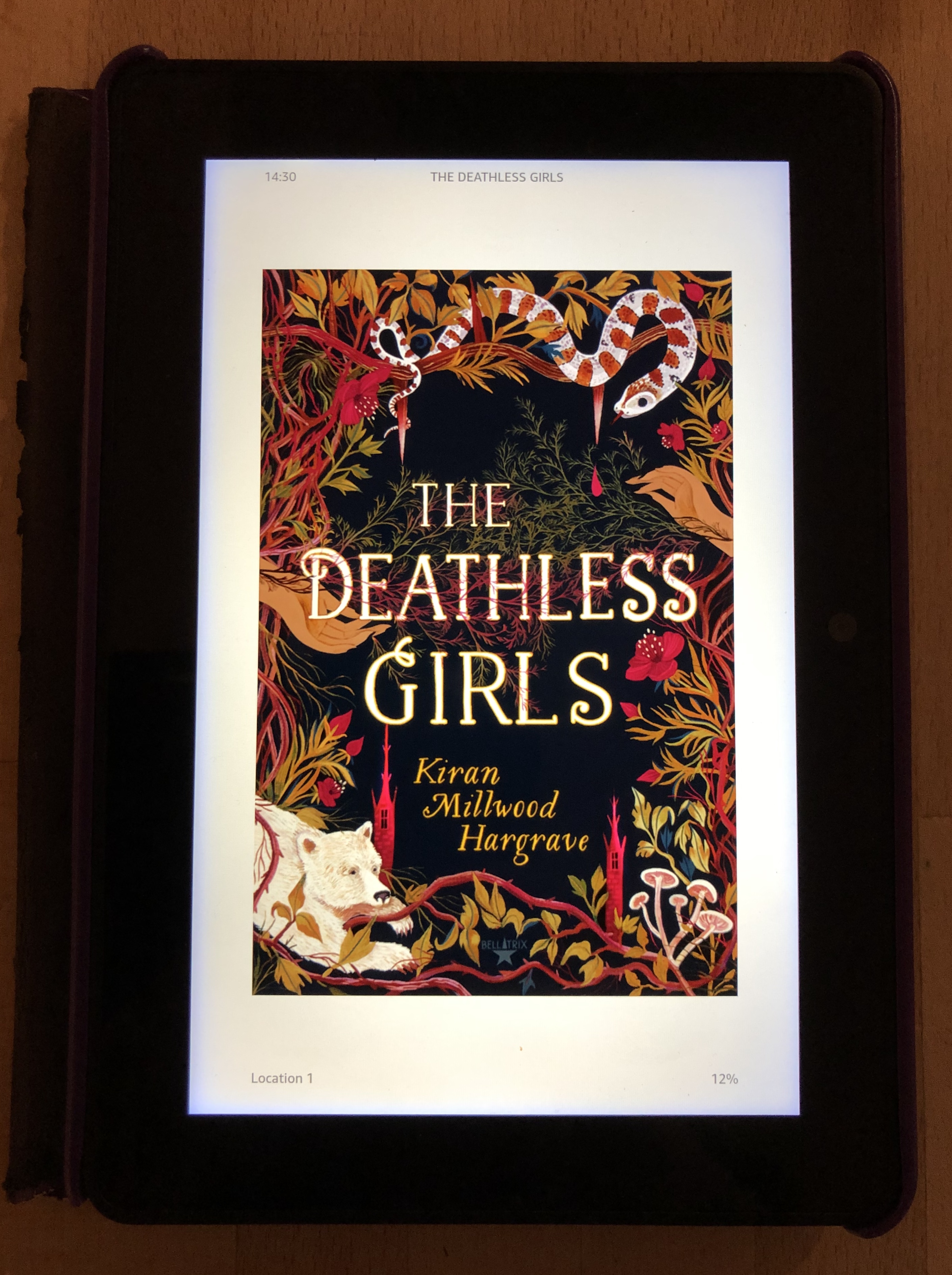
Shortlist Read: The Deathless Girls

Hello! Happy Halloween!

This week, in keeping with the Halloween spirit, I have read the suitably spooky gothic novel The Deathless Girls by Kiran Millwood Hargrave from the YA Book Prize Shortlist 2020. The Deathless Girls is from the Bellatrix (female warrior) series and aims to give voice to female characters in literature that have historically been consigned to the shadows, and in this case – the brides of Dracula.

Hargrave opens with two quotes, Catherynne M. Valente’s ‘that’s how you get deathless’ and Bram Stoker’s ‘She shall not go into that unknow and terrible land alone’. Both quotes set an ominous atmosphere of mystery and suspense with the references to ‘deathless’, ‘unknown’ and ‘terrible land’. The addition of a glossary adds a supernatural quality with the vocabulary ‘Demoni (Demons)’, ‘Iele (Forest spirits)’ and ‘Strigoi (Undead)’. These two pages successfully set the scene for the story of twin sisters Kizzy (Kisaiya) and Lil (Lillai) – Travellers – to unfold. Written in the first person from Lil’s point of view, Hargrave begins the narration with an ‘Aftermath’ where the arrival of the soldiers was the beginning of the end. The combination of the quotes, the glossary and the ‘Aftermath’ establish the gothic nature of the novel with an unnerving darkness that resonates throughout.

The inciting incident of the soldier’s attack opens the main narrative and occurs just before Kizzy and Lil turned seventeen, the day before their ‘divining day’ where they would receive the prophesy of their future. This attack is brutal and described as ‘the circle of blazing wagons was crawling with black-clothed men in crimson sashes, wielding long, glinting sticks’. Kizzy and Lil are enslaved and taken to their fully gothic destination – a castle described as ‘ridiculous and looming’ and ‘its turrets pierced the sky, black needles against the clouds, sharp as bared teeth set in grey gums’. Upon arriving at the castle Lil describes how their friend, Fen, was sold ‘I felt nausea rock my stomach. They were bargaining over Fen and the others like they were livestock’. The link to antebellum slavery runs throughout and speaks to the loss of identity, freedom and choice that the characters experience with some invasive descriptions such as ‘she peered into my mouth, ran her finger along my teeth’ where Lil ‘felt as though I was floating above my body’.

In addition, conflict is established between the ‘Travellers’ and the ‘Settled’ the with the ‘reasons that the Settled hated us [Travellers] were man and stupid: because we had brown skin, because we lived in wagons, because we called no land our own’ further linking to the theme of divisions and a sense of power.

The supernatural features throughout adding layers of tension as the ‘Settled think all Travellers are gifted, or at worst, sorcerers’.  Additionally, the ‘monster’ lurks throughout in the form of the ‘Dragon’ who ‘razes whole villages that disobey his commend. He is an evil man, with a black heart. Some say he’s worse than a man, has no heart at all’ implying his vampire nature. By defocusing on Dracula and the vampires, Kizzy and Lil are successfully brought to the foreground. However, as the gothic horror genre is a firm favourite, I would have liked the vampires to have appeared earlier in the novel fully harnessing the gothic and allowing greater scope to explore the decisions Kizzy and Lil will have to make.

Aside from the strong connection between twins Kizzy and Lil, the relationships between Kizzy and Fen as well as Lil and Mira skim the novel. Because the main focus is on the bond between the twins, Fen and Mira and their connection with Kizzy and Lil could have been explored in greater depth further supporting the main characters and allow the reader to invest more heavily in them. However, the strength of Kizzy and Fen’s feelings are expressed when Fen shouts, ‘Leave her!’ when one of the enslavers ‘placed one of his own foot on one of Kizzy’s wrists’. The deep connection between Kizzy and Fen is alluded to throughout and unfortunately for Kizzy, not supported by the divining prophesy which successfully creates suspense and leads us to wonder if they will ever be together. Lil and Mira’s relationship develops quickly and as the potential third bride of Dracula, Mira’s character and her connection with Lil is significant; the three are described as ‘the three sisters – two dark, one fair […] the beautiful damned […] the deathless girls’.

If you did not pick up on the Dracula narrative undertones, you would be surprised at the turn of events towards the end of the novel. The story of enslavement, liberty and choice ultimately allow for an exploration of the characters’ lives prior to becoming the brides of Dracula. In contrast to the lengthy exploration of Kizzy and Lil’s lives up to this point, the exposition of girls’ decision making is quick; such an important decision could have had greater contemplation and discussion within their dialogue. Despite the fact that the vampires do not make an appearance until nearly the end of the novel, the sisterhood and the bond between twins is successfully conveyed with gothic elements replete with dark castles, mystery, suspense, supernatural, weather, dreams and nightmares. And who doesn’t love a good gothic horror?

Themes: sisterhood, relationships, female love, enslavement, gothic, mythology, magic, travellers, vampires, choice, immorality, superstition, dreams, nightmares, darkness, folklore, persecuted


All pictures and writing are my own unless otherwise credited. Permission must be obtained before any image reproduction and credit must be issued in any image reproduction or quotations. 


Blog, Creative Shorts, New Writing

Red Rock

All I actually remember of that day was that the morning was bright and clear, but by evening the storm had changed everything. What happened in between, I have pieced together from the disconnected threads of my memories, family stories defended at holidays and rumours whispered in the village shop, after church and at school.

We had not been at Red Rock long. A few months, at most. The island, contrary to its name, was not red. It was the lighthouse base that was built of red brick and rose out of the cliff edge like it had grown there as naturally as the trees and rocks that surrounded it. The base was a two-story fortress with a total of twenty small sea salted windows that would never be clean; the only way to really see out was to open them, exposing the room to the heavy damp. The tower was a similar red with the addition of white bricks; it marked the end of the island like fairground sweet. Inside the tower there was a spiral staircase that stretched from the basement to the lantern room where there were two galleries: the main lantern gallery and a watch gallery just below. We were never allowed on either gallery. No one except Pop was allowed to the very top. Pop couldn’t bare it if something had happened to us, after losing Mama and all. That’s what Margaret said. But Pop only pretended to listen to Margaret and when she went to the mainland for supplies, Clarise and I raced up the spiral stairs to the lantern room to watch out for ships until she came back and we were under our stepmother’s thumb again.

That morning, the sea was unusually calm and the sky a deep blue with only a few strands of white cloud that stretched across the from one side to the other like white rainbows. Clarise and I played around the foundation of the tower. It was only out of the corner of my eye that I would ever see him. A shadowy figure always disappearing. Pop said the island was filled with stories of lighthouse keepers past but they were nonsense. He didn’t believe in anything. Not after Mama. There was no God. Margaret was always quick to counter, saying that it’s important to have faith. She never said what to have faith in, but whatever it was, Pop was only interested in keeping the faith of the lantern – that’s what he was hired to do. But when you’re ten, you see everything. And I saw a shadowy figure. Clarise, a year younger, always listened to her older brother. It was a given and if I saw it, she saw it.

Someone had come to the door that day, a man in a suit, and had an argument with Pop. Their voices were raised and coarse as they stood in the doorway; Pop wouldn’t let him in. The man’s car was noisy and rattled as he drove away. Margaret baked a carrot cake – she had opened the window and the fruity sweet smell seeped out and mixed with the salty taste of the air.

Mrs Reynolds from the village shop said that Pop went after him. I don’t remember that. Pop closed door. Or was it the man’s car door that had closed? It’s hard to tell when the wind gets up and as they argued, the wind had grown stronger. I know because our ball rolled farther away. Or did it roll farther away because Clarise had given it a good whack because I wasn’t paying attention to her?

Clarise and I ran after the ball. We could see the road winding in and out of the trees as we approached it. And on the road, I saw the car, the man’s car appearing and disappearing through the trees. Mrs Thatcher, our schoolteacher, said it was Pop’s car. Both cars were dark blue, the man’s was rusted but could I see the rust from where I stood? I don’t remember Pop getting in his car, but the sky had darkened, and it had started to rain. Clarise wanted to go inside. She kept pulling my arm. I pushed her away and she fell in the mud. She cried. I told her I had to get the ball. I didn’t see her leave. I thought she’d wait for me. Margaret said she couldn’t find Clarise. But I was sure she could see us from the open window. When I returned, the window was closed. She said she couldn’t see us through the closed window – that’s what she told the police.

I walked back alone, shouting for Clarise as the rain grew heavy and my voice was lost in the growing storm. Father Vincent said he saw me sitting on the church wall. Did I stop to sit on the church wall in the storm? Did I walk that far? I remember the shadow that grew closer to me as I returned to the lighthouse. I remember hearing the crash. Everyone remembers hearing the crash. The fire rose from between the trees and even the storm did not dampen its intensity. Where was Clarise? Father Vincent said he helped me into the church. I do not remember being in the church. I remember holding the ball. The muddy ball. It was cold in my hands and my fingernails were caked in mud. I can still see my muddy fingernails. Was I chilled because I sat in the church? I remember shivering and the shadow grew so close to me that I could almost touch it.


All pictures and writing are my own unless otherwise credited. Permission must be obtained before any image reproduction and credit must be issued in any image reproduction or quotations. 


Bedside Table Reads, Blog

Longlist Read: Such a Fun Age

Hello!

This week I have read Such a Fun Age by Kiley Reid from the Booker Prize Longlist 2020. Set in Philadelphia and New York, this is the story of Emira Tucker, a Temple University graduate who is trying to find her path in life. It is also the story of Alix Chamberlain who is married with two children and has a career as an influencer. The relationship between Emira and Alix explores racial profiling, parenting, racism, inequality, class and privilege through stereotypical characters and humour.

Written in the third person, the narrative alternates between Emira and Alix. Opening with a racially profiled encounter, Emira (African American) is employed as a babysitter by Alix. On her night off, while at a party, Emira receives a call from Alix asking her to take three-year old (Briar) out as they deal with an incident at home. While taking Briar to Market Depot, Emira is challenged by the guard with ‘Is this your child?’ and ‘Any chance you’ve been drinking tonight, ma’am?’ as well as another customer ‘And I heard the little girl say that she’s not with her mom.’ The exchange is recorded by Kelley Copeland who befriends Emira and emails her the recording promising to delete it. Emira is rescued from the situation by Mr Chamberlain. The plot unfolds from this event and spirals as Emira explores her options without Alix and Alix connives ways to hold on to Emira. This underlying tension successfully pervades the novel.

Emira typifies young graduates today searching for a ‘grown up’ job with health insurance; she is against the clock because ‘by the end of 2015, Emira would be forced off her parents’ health coverage. She was almost twenty-six years old’. For Emira, her babysitting job is more than a job. She bonds with Briar in a way Alix does not. Like many graduates of the ‘slash generation’, Emira is highly identifiable, working additionally as a transcriber for the Green Party Philadelphia typing ‘125 words per minute’ as well as an ‘on-call transcriber’ for Temple University.

Alix, a New Yorker at heart, agrees to the move to Philadelphia, has two children and longs for her city friends: Jodi ‘a casting director’, Rachel ‘proudly Jewish and Japanese, managed a firm that designed book covers’ and Tamara, a ‘principle of a private school in Manhattan’. Alix pines for her New York life and submerses herself in social media, book deals and products while caring for her younger child, Catherine, ‘with her revamped blog, detailing the success of other letter-writing promotion-receiving getting-what-they-want women, had six thousand hits a day’. Many will identify with juggling work, children and a loss of identity. Alix’s relationship with Briar, is challenging and at times comical, but a sadness pervades the relationship. Briar’s voice is one that ‘consumed everything in its path’, ‘it was loud and hoarse and never stopped’ and the relief of Briar sleeping is described as ‘it was as if a fire alarm had finally been turned off’.

Reid sets the stage for the relationship between Alix and Emira to be linked by more than just an employer-employee association and the narrative takes an unexpected twist with Emira dating the pushy Kelley Copeland, who just happened to also have ‘ruined Alex Murphy’s senior year […] before she became Alix Chamberlain’. Kelley is described as ‘one of those white guys who not only goes out of his way to date black women but only wants to date black women’. This successfully establishes further underlying tensions between Emira, Alix and Kelley.

While Emira sees babysitting for the Chamberlain’s as a job, Alix becomes increasingly, and strangely, obsessed with Emira, her welfare and future. Invading Emira’s privacy, Alix checks her phone: ‘Alix felt betrayed by Emira’s cell phone. These were the first plans Emira had in the last month that Alix hadn’t known about before she pretended she didn’t’. Alix makes decisions on what she thinks will be best for Emira stating: ‘you might be too young to understand this right now, but we have always had your best interests at heart’ and emphasising her love for Emira ‘we love you’ as part of the family regardless of the fact that ‘they made her wear a uniform’. This ‘white saviour’ behaviour underscores Alix’s privilege and highlights the further distinctions between them.

The themes of Such a Fun Age speak to very relevant topics that do need discussing. Emira is a highly likeable and believable character. Alix, veers far in to the stereotypical at times and oversteps credibility with her actions, dialogue and obsession. Equally, Kelley’s questionable behaviour gives the impression of harbouring sinister strands. Such a Fun Age does intertwine deeply important explorations of race and privilege while questioning if there is a ‘fun age’ through humorous dialogues, encounters and relationships.

Themes: racial profiling, class, inequality, parenting, motherhood, privilege, white saviour, family relationships, friendships, love


All pictures and writing are my own unless otherwise credited. Permission must be obtained before any image reproduction and credit must be issued in any image reproduction or quotations. 


Blog, Creative Shorts, New Writing

The Phantom

It was an early morning in spring. But it could have easily been midwinter. The fields were covered in a thick frost and a gauzy fog hovered above the ground, stretched thin in long layers and blocked out the dawn. If I waited, the sun would eventually burn through the fog, however, there was no time to delay, she would have the paddle steamer fired up and ready to go. One thief alone – always caught, two thieves – disappear like ghosts.

The frost melted around my canvas trainers as I ran; it formed an undulating water mark of dark blue and my toes were cold even though I had started to sweat in the thick mac. The further I ran into the fog, the thicker it became and before long, it surrounded me. I stopped. It’s always best to stop when you are not sure. Take stock…you know, take a moment and think. If you panic, the answers become blurred. And when you need answers, you need to be clear headed. That was one of my strongest qualities. The ability to think clearly when everyone else is lost in hysteria.

Standing still made my feet feel even colder and wetter. The fog cut close to my face and as I breathed it in, the damp hung in my lungs, seized its membranes, and forced me to take suffocating short, quick breaths. Cold induced asthma took hold, but I stuffed my hand into my coat pocket and pulled out my inhaler. I sucked in two quick puffs and closed my eyes waiting for the drug to work. Slowly, my chest eased, my lungs were released from the freezing fog. I replaced the lid and pushed it back into my pocket and grabbed hold of the silver compass. It was attached to a silver chain, but I had refused to wear it, it was Mother’s and wearing it somehow seemed wrong. I pulled it out. It was cold, the kind of cold where you couldn’t tell if the silver was burning or freezing in the palm of your hand. I rubbed the compass with both hands to get it started; the sapphire set in the centre of the radiating sun rays glowed. I clicked the catch at the bottom, the lid popped open. I watched the arrow spin and then headed due south.

I was slightly off course, but not too far. As I neared the river, my shoulder ached with the weight of the satchel and the leather cut into my collar bone. I had slung it over my head and diagonally across my body so it wouldn’t fall off. I could never carry the school satchel on one shoulder; the strap would always slide off my narrow shoulders. But now, it wasn’t filled with my computer, books, or a pencil case. I carried silver, and silver was heavy and necessary; it was the only chemical that could link the compass with its originator. The brown leather bulged and was held closed by only one of the straps. The other, flapped freely as I followed the compass.

I heard the chugging of the paddle steamer but saw nothing; it was a whispering ghost waiting for me. As I neared the river, the fog thinned, and I caught the glint of gold at the very tip of the bow. If you weren’t looking, you would miss it. The rest of the steamer was veiled in a ripple vacuum, but I knew the small red outline was there, with the paddle wheels at the stern and the smaller thin wheel on the port side. It was as if a small wooden train engine was set in the hull of the boat; it had a small deck at the front and stairs up to helm.

“Run!” Ornella allowed her voice to break through the vacuum.

I looked behind and could see dark shadows growing larger in the fog. There were at least three. I snapped the compass shut, held it tightly and ran towards her.

“Hurry sister!” she said.

Ornella was older than me at fifteen, but only slightly, by ten and a half months. However, that ten and a half months meant the difference between giving orders and receiving them. The compass pointed me directly to the small port side paddle wheel; I trusted in the compass completely and launched myself over the river. Ornella pulled me up onto the deck.

“Let’s go, Odinia!” She shouted as she jumped up to the helm and pushed the steamer into action; it rumbled underneath my feet and we were off.

The shadows had slowed. I knew they couldn’t see anything. I watched as they faded into the fog then joined Ornella at the helm. Dropping the satchel behind her, I sunk into the folding chair by the fire and slipped off the canvas trainers and hung my wet socks over the arm of the chair to dry. Ornella was strong and serious, when she turned and looked at me, she smiled but I knew as soon as her back was to me, her mouth would be drawn in a tight, thin line piloting The Phantom to our next heist.


All pictures and writing are my own unless otherwise credited. Permission must be obtained before any image reproduction and credit must be issued in any image reproduction or quotations. 

Bedside Table Reads, Blog

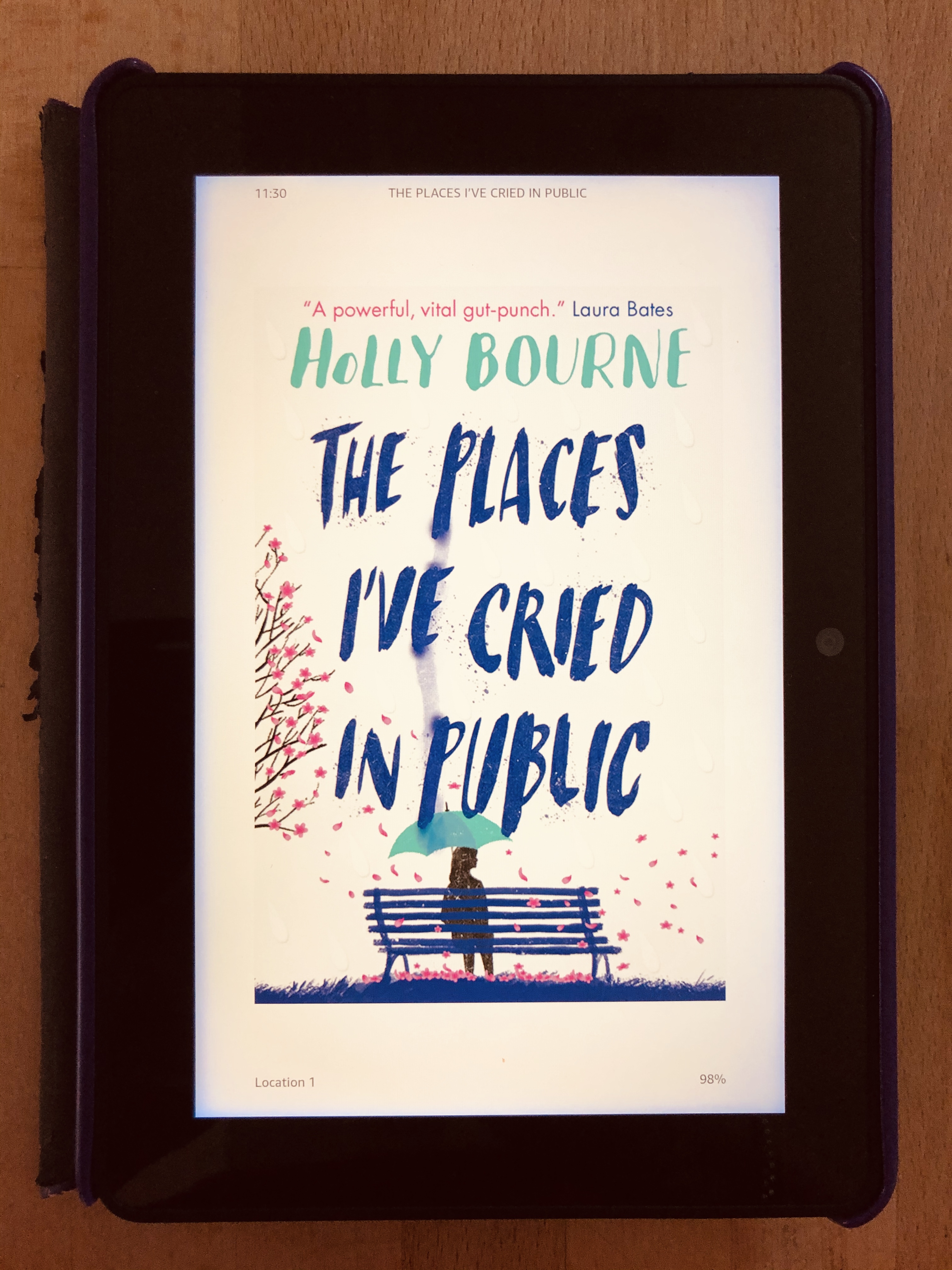
Shortlist Read: The Places I’ve Cried in Public

Hello!

This week I have chosen to read The Places I’ve Cried in Public by Holly Bourne from the YA Book Prize Shortlist 2020. This is a story of Amelie and the boy she loved first (Alfie) and the boy she loved second (Reese). It is the story of Amelie’s journey through the locations that she’s cried to discover why loving Reese was so painful, confusing and frightening and not at all like loving Alfie, who was safe, comforting and gentle.

The narrative is written in the first person and alternates between Amelie’s present and her past as she excavates her memories through flashbacks of where she has cried in public, to discover how she has ended up so hurt and confused. Amelie’s life changes when her family has to move from Sheffield to a town outside of London. She leaves the security of her boyfriend Alfie, her friends, and all that she loves about the North describing it as ‘It’s all duck and pet, and it’s lovely, really it is. You feel like everyone is a friend’.

Starting A-Levels in a new town, a new school and being a painfully shy singer/songwriter who suffers from a ‘shyness rash’ and has a ‘full-blown obsession with cardigans’, Bourne, establishes a vulnerability in Amelie and the ensuing obsessive love/hate relationship with Reese where she ‘fell hard for Reese’ and it ‘looked like love’ and ‘felt like love’ but is not sure if love is ‘supposed to hurt like this’.

Amelie begins her journey on ‘this bench’ which is ‘Dot Number One’, ‘the first place I ever cried in public’ and addresses Reese and his new girlfriend: ‘You’re smiling at her from under your trilby hat. You’re looking at her how you use to look at me. It hurts in such a profound way that there almost isn’t room for it in my body.’ The pain is so acute and so raw that as she contemplates ‘Why am I doing this to myself?’ the reader wonders if her parents, and new friends: Hannah, Liv and Jack, will be able to extract her from the toxic relationship with Reese before she self-destructs.

Reese, like a ‘radiating magnetic force field’ and ‘dressed – like an old-fashioned British dandy’ as ‘his hat matched his waistcoat’ is mesmerising. What starts innocently for Amelie, in hindsight is the beginning of Reese’s manipulation, and she addresses him ‘you were waiting outside my music lesson’ then flashes back to the scenario, ‘He tipped his hat again, leaning against the wall, one knee bent, looking so damn cool.’ Amelie describes the attraction of Reese as ‘J.R.R. Tolkien couldn’t even dream up a quest more enticing than going to the music block with Reese Davies.’

But the closer Amelie gets to Reese, the further away from her new friends and family she becomes, and understands less and less about love and relationships, where ‘even after the best night of my life, you still manage to make me cry’. Reese, like a drug, is described as a ‘giant sexy magnet’ and Amelie states that she felt ‘like I was wearing chainmail’.

Amelie’s journey, ‘the dots on the map where you made me cry’, is self-destructive at points as she believes that she is ‘sure it’s all my fault somehow’ and if ‘only I’d done things differently’ and ‘been…less me, then I wouldn’t have driven you away’. This confusion and misconstrued belief that Amelie is somehow at fault for the destructive relationship, is so powerful, sad and infuriating that as a reader, you want to reach into the book and help her to see that it is not her, but Reese and no one should ever be ‘…less me’.

We have all been there, crying alone in some public location: ‘train station waiting -rooms’, ‘dance floor of clubs’, ‘bus stops’, ‘at the back of lessons’, ‘on the pavement’ and ‘cold concrete’ and in ‘school bathrooms’ – one of the questions The Places I’ve Cried in Public raises is why no one stops to ask if you need help? Being privy to Amelie’s detailed descriptions of psychological abuse, this book is a call to humanity; we are not alone, and we need to help each other. It is a must read, as we all ‘have a voice’ and we all have ‘a song to sing’ and above all, we all need to be able to say, ‘I am safe’.

Trigger warnings: physical, emotional and mental abuse and manipulation

Themes: coming of age, love, first love, grief, abuse, trauma, forgiveness, toxic relationships, manipulation, therapy, mental health


All pictures and writing are my own unless otherwise credited. Permission must be obtained before any image reproduction and credit must be issued in any image reproduction or quotations.