
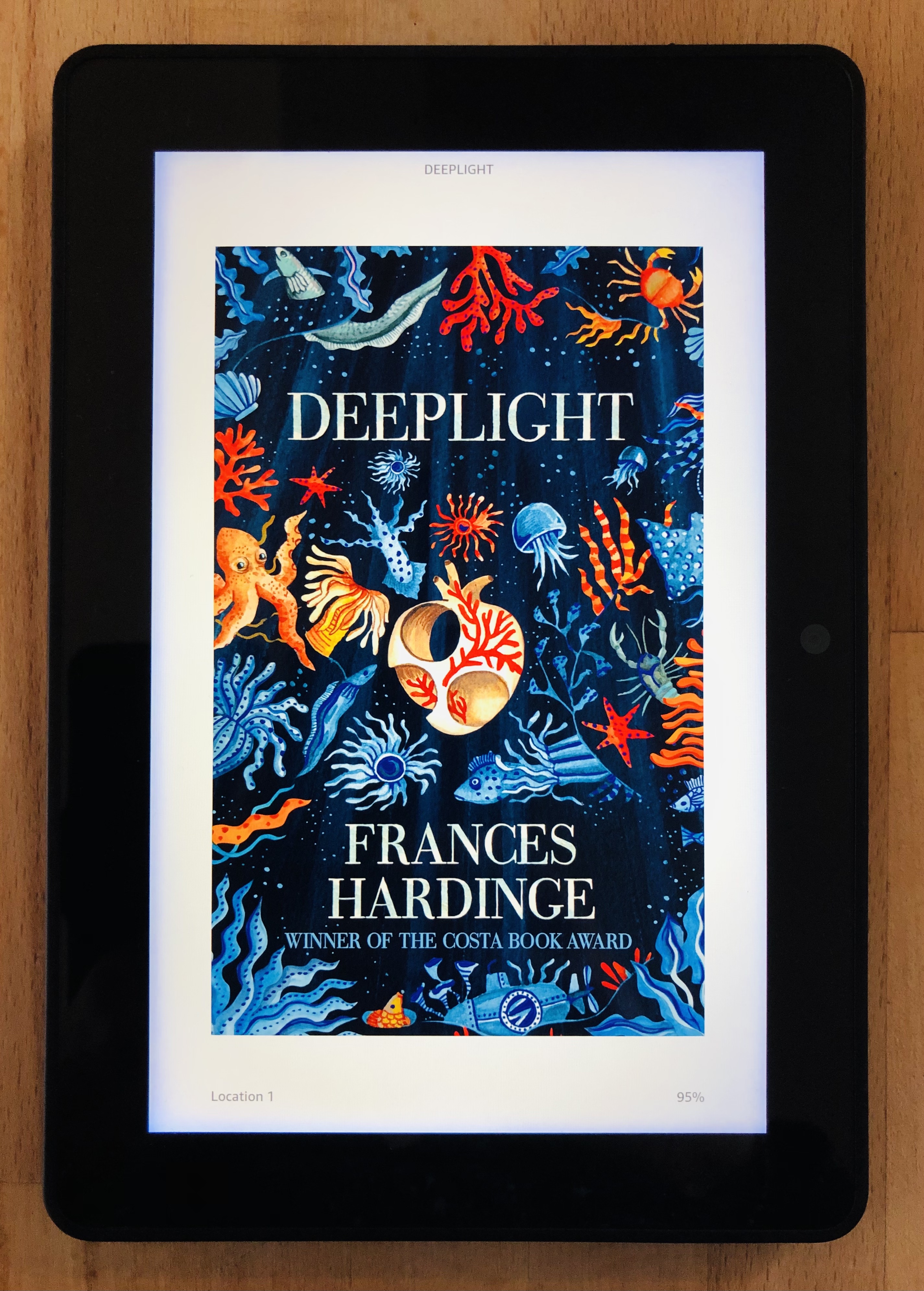
This week I have had the great pleasure of reading Deeplight by Frances Hardinge from the YA Book Prize Shortlist 2020. A fantasy set on the imaginary islands of Myriad where the Undersea gods were ‘as real as the coastlines and currents, and as merciless as the winds and whirlpools’. It is here, where the gods destroyed each other in the event known as the ‘Cataclysm’ and subsequently, the fear of the gods has dissipated. The narrative follows fourteen-year-old Hark, orphaned with his best friend Jelt, as they scavenge an existence together on the island of Lady’s Crave.
The narrative is written in the third person and Hark is presented as a storyteller. His skill in spinning a yarn gets him out of more than one sticky situation. His way with verbal language is juxtaposed with the fact that he cannot read. Two years younger than Jelt, Hark is constantly caught up in Jelt’s schemes and is described always being ‘neck deep in Jelt’s latest plan. It was as though he’d signed up for it in his sleep’. The devotion to their ‘friendship’ and seeing Jelt as ‘family’ drives his commitment to Jelt’s schemes but deep down, Hark questions Jelt, his decisions and escapades. This internal friction for Hark is crucial and drives his conflicted decision making throughout the narrative. However, there are certain points where Hark’s unflinching loyalty to Jelt, in the face of emotional manipulation, is so very frustrating.
Hark and Jelt’s relationship is established from the outset where Hark is ‘the follower’ and Jelt ‘the leader’. While Hark protests ‘You never ask, Jelt.’ and ‘You did have time to tell me.’ Jelt contrives an answer that makes it seem like he is attempting to help Hark, ‘I’m trying to show Rigg what you can do, Hark!’ ‘I brought you in because we’re friends.’ The fact that Hark was ‘mollified’ by this compliment indicates the long road he has to be out from under Jelt’s manipulative control. This is furthered by Jelt’s harsh insistence ‘Oh, grow a spine, Hark! Before I start wishing I’d left you out of this. This is a promotion.’ Will Hark ‘grow a spine’? This question lingers throughout leaving the reader to will him to make the ultimate decision to break with Jelt and go his own way. However, even in the face of a dangerous and suspenseful scheme to climb a cliff edge to put out a lantern in the beacon tower, Hark is bogged down by his conscious ‘But I couldn’t leave Jelt in the lurch, could I? He’d be dead without me.’
From the outset, the beacon scheme is somewhat doomed with Hark caught ‘Appraised and sold’ as a slave, highlighting the inequalities within the Myriad society. While ‘slavery was forbidden within the Myriad’ if you committed a crime and were found guilty, you could be sold as an ‘indentured servant’. Hark’s gift of the gab allows him to combine his lies with ‘fragments of truth’ appealing to his audience of purchasers where he is ultimately bought by Dr Vyne. Hark is transported to the Myriad island of Nest ‘a wild, lonely island…almost ghostly’ where he begins a new life in servitude at the Sanctuary. It is a place where ‘young acolytes’ trained to become priests in the past. Hark explains that these priests are ‘The old, crazy ones whose minds broke when the gods died!’ It is also where Hark makes unlikely alliances providing the reader with some rays of hope.
It is as an ‘indentured servant’ where Dr Vyne sees Hark’s potential stating that ‘some schooling would make you more useful to me…I’ll have someone start teaching you your letters’. Even without Jelt, this was conflicting for Hark who was excited to learn to read but replays Jelt’s words: ‘Reading makes your brain soft.’ ‘You live in the world, or you live in a book. You can’t do both.’ trying to understand Jelt’s idea that ‘illiteracy was a badge of honour.’ The reader is buoyed by Hark’s change of situation away from Jelt, albeit, an enslaved situation. Hopeful that after three months on Nest, Jelt was well and truly out of the picture, however, like a boomerang, Jelt returns with one more scheme. It is this savaging foray that sets off a series of events compromising Hark and forever changing Jelt. This nail biting turn of events leaves the reader on edge and slightly seasick.
Hardinge’s successful world building conveys the Myriad islands and the gods as if they have always existed enabling the reader to suspend any notion of reality slipping into the fantasy world of the Undersea, gods, godware, smugglers and priests with ease. The prose is cleverly crafted and rich with original similes, ‘The sun was as pale as a poached egg’ and ‘Nest’s harbour was a little more than a bare bay, curving like an empty melon rind’. Hardinge expands new notions, such as ‘godware’, which if obtained, means not only having a piece of a god, but for Hark and Jelt, having the heart of a god signifies money, freedom, renewed life and potential death with nail biting consequences.
Hardinge introduces the ‘sea-kissed’ who experience hearing loss due to extensive diving or being in submarines and explains that ‘sea-kissed deafness was the mark of a seasoned aquanaut, and therefore generally respected’. Sign language features throughout and is generally understood by most to greater or lesser extents. ‘Sea-kissed’ Selphin, Rigg’s daughter, is a voice of reason for Hark when her mother wants the godware to heal her deafness. Selphin represents the ‘good’ in contrast to Jelt’s ‘bad’ and she tries to warn Hark of the dangerous changes the god-heart can make, signing angrily ‘So what are you going to do? Change my thoughts? Make me want something I don’t want? If you do that – if you even try – I’ll kill you.’ Selphin also sees Hark as ‘spineless’ exemplified in her ‘one swift, fluid sign. It was the expressive sign for a jellyfish, pulsing its way forward, fingers trailing las tentacles.’ This aquatic imagery transcends the water with readers constantly hoping that Hark will not be further dragged under by Jelt.
The journey through Hardinge’s fantasy world of Myriad, the Undersea, gods, battles between gods and god-killers and the toxic relationship between Hark and Jelt is rich in detail, immersive and believable. It is through Hark’s relationship with Selphin and the old dying priest, Quest who is ‘shrewd and lucid’ with many secrets, that Hardinge drips elements of brightness for Hark. Can Hark escape the manipulative clutches of the monstrous Jelt? Will learning to read and write free Hark from his past? And ultimately, will Hark ‘grow a spine’, become a ‘god-killer’ and have a future of freedom and hope? I wholeheartedly recommend Deeplight – it is easily one of my favourite YA books I have read from the 2020 shortlist.
Themes: friendship, loyalty, enslavement, lies, truth, stories, freedom, manipulation, isolation, loneliness, fear, bravery, literacy, obsession, power, greed, change, old age
All pictures and writing are my own unless otherwise credited. Permission must be obtained before any image reproduction and credit must be issued in any image reproduction or quotations.
 The Gold Shoe Writer