Hello! Happy Halloween!
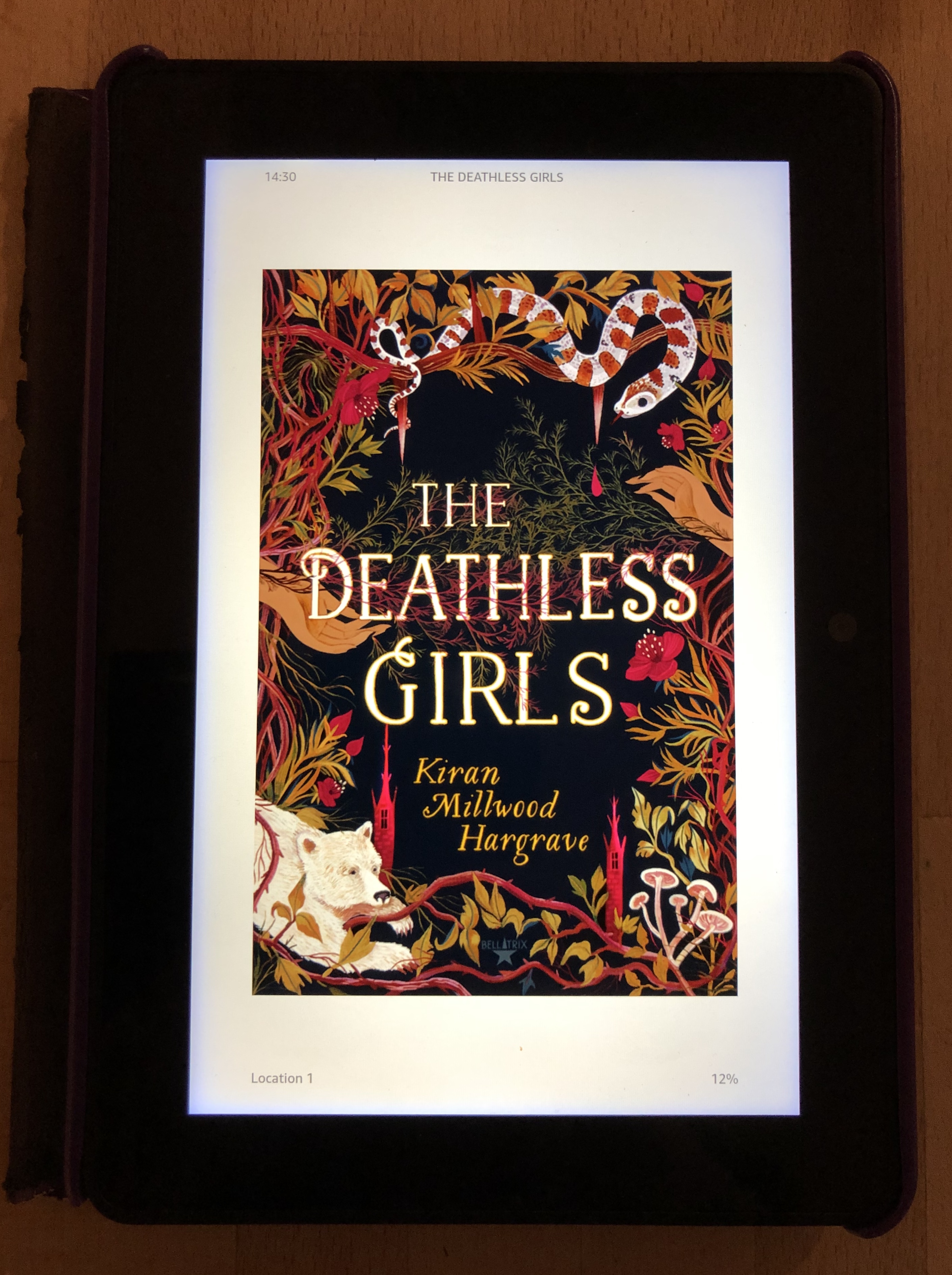
This week, in keeping with the Halloween spirit, I have read the suitably spooky gothic novel The Deathless Girls by Kiran Millwood Hargrave from the YA Book Prize Shortlist 2020. The Deathless Girls is from the Bellatrix (female warrior) series and aims to give voice to female characters in literature that have historically been consigned to the shadows, and in this case – the brides of Dracula.
Hargrave opens with two quotes, Catherynne M. Valente’s ‘that’s how you get deathless’ and Bram Stoker’s ‘She shall not go into that unknow and terrible land alone’. Both quotes set an ominous atmosphere of mystery and suspense with the references to ‘deathless’, ‘unknown’ and ‘terrible land’. The addition of a glossary adds a supernatural quality with the vocabulary ‘Demoni (Demons)’, ‘Iele (Forest spirits)’ and ‘Strigoi (Undead)’. These two pages successfully set the scene for the story of twin sisters Kizzy (Kisaiya) and Lil (Lillai) – Travellers – to unfold. Written in the first person from Lil’s point of view, Hargrave begins the narration with an ‘Aftermath’ where the arrival of the soldiers was the beginning of the end. The combination of the quotes, the glossary and the ‘Aftermath’ establish the gothic nature of the novel with an unnerving darkness that resonates throughout.
The inciting incident of the soldier’s attack opens the main narrative and occurs just before Kizzy and Lil turned seventeen, the day before their ‘divining day’ where they would receive the prophesy of their future. This attack is brutal and described as ‘the circle of blazing wagons was crawling with black-clothed men in crimson sashes, wielding long, glinting sticks’. Kizzy and Lil are enslaved and taken to their fully gothic destination – a castle described as ‘ridiculous and looming’ and ‘its turrets pierced the sky, black needles against the clouds, sharp as bared teeth set in grey gums’. Upon arriving at the castle Lil describes how their friend, Fen, was sold ‘I felt nausea rock my stomach. They were bargaining over Fen and the others like they were livestock’. The link to antebellum slavery runs throughout and speaks to the loss of identity, freedom and choice that the characters experience with some invasive descriptions such as ‘she peered into my mouth, ran her finger along my teeth’ where Lil ‘felt as though I was floating above my body’.
In addition, conflict is established between the ‘Travellers’ and the ‘Settled’ the with the ‘reasons that the Settled hated us [Travellers] were man and stupid: because we had brown skin, because we lived in wagons, because we called no land our own’ further linking to the theme of divisions and a sense of power.
The supernatural features throughout adding layers of tension as the ‘Settled think all Travellers are gifted, or at worst, sorcerers’. Additionally, the ‘monster’ lurks throughout in the form of the ‘Dragon’ who ‘razes whole villages that disobey his commend. He is an evil man, with a black heart. Some say he’s worse than a man, has no heart at all’ implying his vampire nature. By defocusing on Dracula and the vampires, Kizzy and Lil are successfully brought to the foreground. However, as the gothic horror genre is a firm favourite, I would have liked the vampires to have appeared earlier in the novel fully harnessing the gothic and allowing greater scope to explore the decisions Kizzy and Lil will have to make.
Aside from the strong connection between twins Kizzy and Lil, the relationships between Kizzy and Fen as well as Lil and Mira skim the novel. Because the main focus is on the bond between the twins, Fen and Mira and their connection with Kizzy and Lil could have been explored in greater depth further supporting the main characters and allow the reader to invest more heavily in them. However, the strength of Kizzy and Fen’s feelings are expressed when Fen shouts, ‘Leave her!’ when one of the enslavers ‘placed one of his own foot on one of Kizzy’s wrists’. The deep connection between Kizzy and Fen is alluded to throughout and unfortunately for Kizzy, not supported by the divining prophesy which successfully creates suspense and leads us to wonder if they will ever be together. Lil and Mira’s relationship develops quickly and as the potential third bride of Dracula, Mira’s character and her connection with Lil is significant; the three are described as ‘the three sisters – two dark, one fair […] the beautiful damned […] the deathless girls’.
If you did not pick up on the Dracula narrative undertones, you would be surprised at the turn of events towards the end of the novel. The story of enslavement, liberty and choice ultimately allow for an exploration of the characters’ lives prior to becoming the brides of Dracula. In contrast to the lengthy exploration of Kizzy and Lil’s lives up to this point, the exposition of girls’ decision making is quick; such an important decision could have had greater contemplation and discussion within their dialogue. Despite the fact that the vampires do not make an appearance until nearly the end of the novel, the sisterhood and the bond between twins is successfully conveyed with gothic elements replete with dark castles, mystery, suspense, supernatural, weather, dreams and nightmares. And who doesn’t love a good gothic horror?
Themes: sisterhood, relationships, female love, enslavement, gothic, mythology, magic, travellers, vampires, choice, immorality, superstition, dreams, nightmares, darkness, folklore, persecuted
All pictures and writing are my own unless otherwise credited. Permission must be obtained before any image reproduction and credit must be issued in any image reproduction or quotations.
 The Gold Shoe Writer