
Hello!
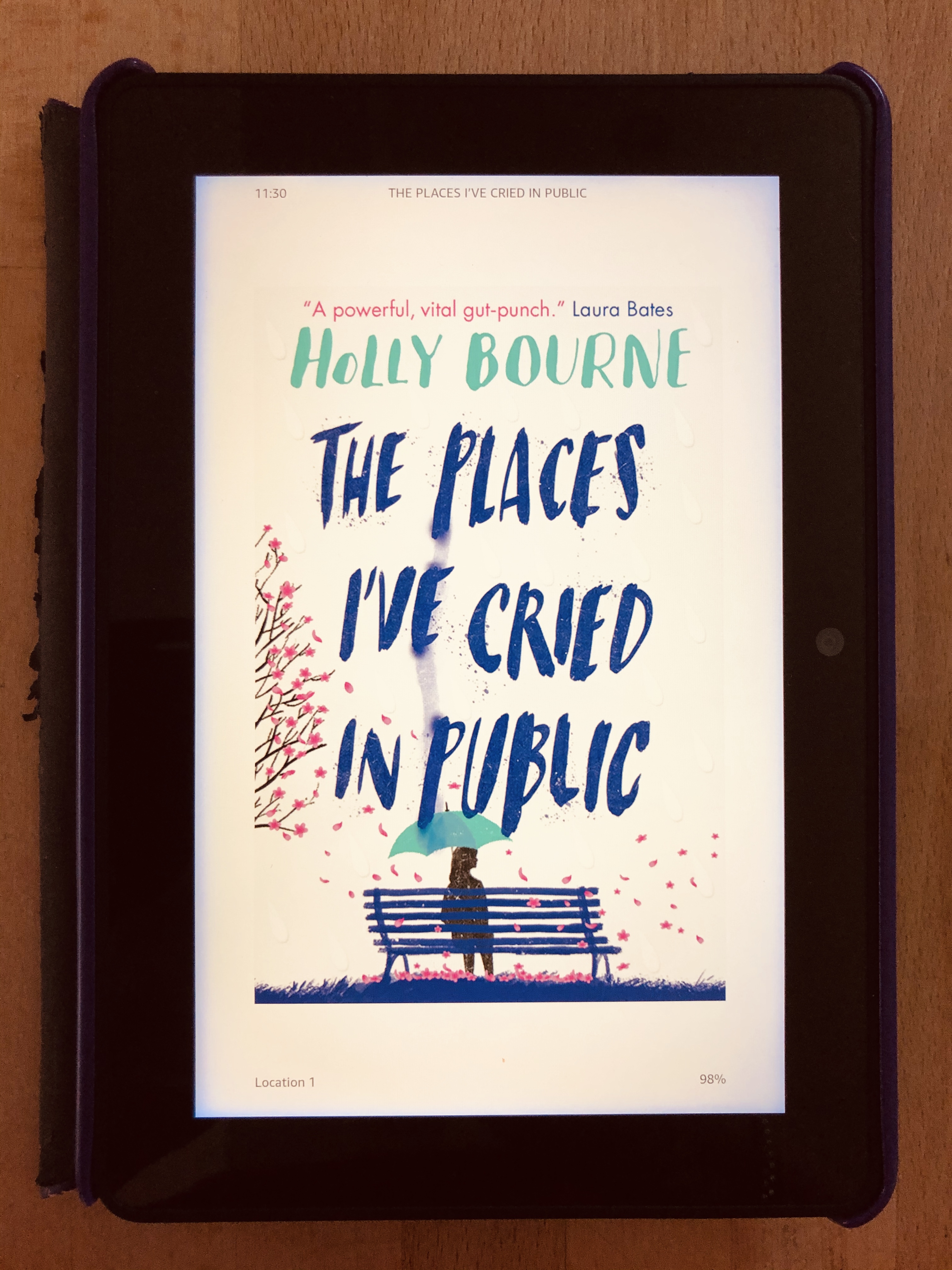
This week I have chosen to read The Places I’ve Cried in Public by Holly Bourne from the YA Book Prize Shortlist 2020. This is a story of Amelie and the boy she loved first (Alfie) and the boy she loved second (Reese). It is the story of Amelie’s journey through the locations that she’s cried to discover why loving Reese was so painful, confusing and frightening and not at all like loving Alfie, who was safe, comforting and gentle.
The narrative is written in the first person and alternates between Amelie’s present and her past as she excavates her memories through flashbacks of where she has cried in public, to discover how she has ended up so hurt and confused. Amelie’s life changes when her family has to move from Sheffield to a town outside of London. She leaves the security of her boyfriend Alfie, her friends, and all that she loves about the North describing it as ‘It’s all duck and pet, and it’s lovely, really it is. You feel like everyone is a friend’.
Starting A-Levels in a new town, a new school and being a painfully shy singer/songwriter who suffers from a ‘shyness rash’ and has a ‘full-blown obsession with cardigans’, Bourne, establishes a vulnerability in Amelie and the ensuing obsessive love/hate relationship with Reese where she ‘fell hard for Reese’ and it ‘looked like love’ and ‘felt like love’ but is not sure if love is ‘supposed to hurt like this’.
Amelie begins her journey on ‘this bench’ which is ‘Dot Number One’, ‘the first place I ever cried in public’ and addresses Reese and his new girlfriend: ‘You’re smiling at her from under your trilby hat. You’re looking at her how you use to look at me. It hurts in such a profound way that there almost isn’t room for it in my body.’ The pain is so acute and so raw that as she contemplates ‘Why am I doing this to myself?’ the reader wonders if her parents, and new friends: Hannah, Liv and Jack, will be able to extract her from the toxic relationship with Reese before she self-destructs.
Reese, like a ‘radiating magnetic force field’ and ‘dressed – like an old-fashioned British dandy’ as ‘his hat matched his waistcoat’ is mesmerising. What starts innocently for Amelie, in hindsight is the beginning of Reese’s manipulation, and she addresses him ‘you were waiting outside my music lesson’ then flashes back to the scenario, ‘He tipped his hat again, leaning against the wall, one knee bent, looking so damn cool.’ Amelie describes the attraction of Reese as ‘J.R.R. Tolkien couldn’t even dream up a quest more enticing than going to the music block with Reese Davies.’
But the closer Amelie gets to Reese, the further away from her new friends and family she becomes, and understands less and less about love and relationships, where ‘even after the best night of my life, you still manage to make me cry’. Reese, like a drug, is described as a ‘giant sexy magnet’ and Amelie states that she felt ‘like I was wearing chainmail’.
Amelie’s journey, ‘the dots on the map where you made me cry’, is self-destructive at points as she believes that she is ‘sure it’s all my fault somehow’ and if ‘only I’d done things differently’ and ‘been…less me, then I wouldn’t have driven you away’. This confusion and misconstrued belief that Amelie is somehow at fault for the destructive relationship, is so powerful, sad and infuriating that as a reader, you want to reach into the book and help her to see that it is not her, but Reese and no one should ever be ‘…less me’.
We have all been there, crying alone in some public location: ‘train station waiting -rooms’, ‘dance floor of clubs’, ‘bus stops’, ‘at the back of lessons’, ‘on the pavement’ and ‘cold concrete’ and in ‘school bathrooms’ – one of the questions The Places I’ve Cried in Public raises is why no one stops to ask if you need help? Being privy to Amelie’s detailed descriptions of psychological abuse, this book is a call to humanity; we are not alone, and we need to help each other. It is a must read, as we all ‘have a voice’ and we all have ‘a song to sing’ and above all, we all need to be able to say, ‘I am safe’.
Trigger warnings: physical, emotional and mental abuse and manipulation
Themes: coming of age, love, first love, grief, abuse, trauma, forgiveness, toxic relationships, manipulation, therapy, mental health
All pictures and writing are my own unless otherwise credited. Permission must be obtained before any image reproduction and credit must be issued in any image reproduction or quotations.
 The Gold Shoe Writer