
Hello!
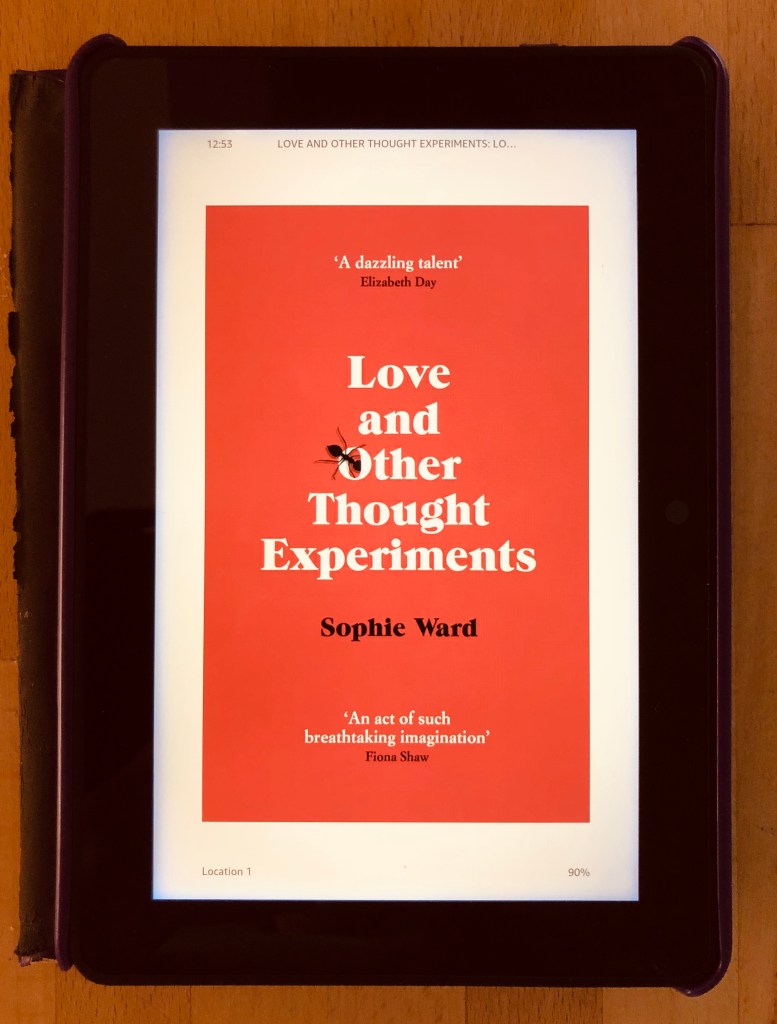
This week I have read Love and Other Thought Experiments by Sophie Ward from The Booker Prize Longlist 2020. At the heart of the narrative is the relationship between Rachel and Eliza, their son Arthur, and Hal (Arthur’s biological father). These characters and their relationships form the springboard for a series of explorations of amorphous realities, what it means to be human and to love.
Each of the ten interlinked chapters begins with a thought experiment: Pascal’s Wager; The Prisoner’s Dilemma; To Be a Bat; Philosophical Zombies; What Mary Knew; The Chinese Room; Twin Earths; The Ship of Theseus; Descartes’ Demon and Gilbert Harman’s Brain in a Vat. The reader, almost as a psychologist, examines the characters within each experiment and must expect the unexpected with changes in point of view, time and space.
In Kafkaesque style, the narrative opens with Rachel who believes that an ant has crawled into her eye while she slept, ‘Something bit me…In my dream…it bit me…it’s gone into my eye.’ Eliza doubting her responds, ‘Nothing there…do you want some antiseptic?’ This singular event brings their very relationship into question with Eliza contemplating ‘in their four years together she had often felt like this, there and not there, connected, yet keeping a part of herself separate’. Regardless, they conceive Arthur on ‘Friday 24th October 2003’, time speeds ahead, Arthur is born – years pass, and Rachel is diagnosed with a brain tumour all within a few pages. It is only with hindsight that the shift to artificial intelligence and science fiction becomes clear and that initial references such as: ‘program’, ‘Helloworld’, ‘uses crt’ and ‘(*Here the main program block starts*)’ begin to make sense.
Once traditional narrative understandings are suspended, Ali, a new character, is introduced in the second chapter, whose memory of swimming out to sea to get a ball where ‘He couldn’t swim hard enough with the ball in his arms but he didn’t want to let go of it’ initially seems to have little connection with the characters in the first chapter. Ali’s story transitions throughout – a different time and location, the Mediterranean or London? It is only in the third chapter that Ali is linked to Elizabeth (Rachel’s mother) in their youth, again a different time and location – Brazil.
The most unnerving chapters are those written from the ant’s (fourth chapter) and the perspectives of Artificial Intelligence – AI (ninth chapter). The ant’s perspective, in the fourth chapter is voyeuristic where the ant ‘watch the sleeping human forms…the rise and fall of their bodies’ to the dangerous where it watches ‘the human women dream and feel the impulse to be closer.’ The violation of Rachel by the ant ‘the first touch of skin’ and the ‘walk over the face’ to find ‘the smallest openings, along the pink ridge of the eye’ is more than unsettling. Similarly, the exploration of Rachel’s brain and tumour is unnervingly described as ‘the soft flesh of the tumour is embedded in the back of the woman’s brain’. Equally, the revelation of Zeus, as the ‘operating system’ reveals the ‘moment in human history when technology advanced enough to allow machine intelligence to connect and learn and from that point become autonomous’ puts the seemingly divergent narratives into perspective. Again, the narration bends time and space. Arthur, an astronaut, exists because of artificial intelligence. Artificial Intelligence (AI) describes this as ‘we need each other, Arthur, and it is this version of you that has the greatest chance of success’. Time shifts to ‘the fourteenth day of May 2041, human years’. Narratives shift, Rachel has not died of a brain tumour. There is ‘this world’ and the ‘other world’. There is ‘this Rachel’ and the ‘other Rachel’.
The story of Arthur and his family, traversed realities and times, bringing the reader to a future world of artificial intelligence. Beyond A Brave New World of Big Brother, Sophie Ward transports us to a time in the not too distant future where Arthur wants to ‘tear the implant from his head’ and ‘let the wires fry’ but Zeus, reading his mind, his body and his vitals placates him. Arthur is ‘a lab rat and the lab was in his head’. Love and Other Thought Experiments is a premonition, nay warning, in true science fiction fashion, of humanities fast track to a brave new dystopian society, inhabited by a part-human, a part-artificial intelligence species.
Themes: relationships, love, death, humanity, human behaviour, artificial intelligence, parenting, family, destiny, fate, reality, truth, philosophy, psychology, time, science fiction, thought experiments, utopia, dystopia.
All pictures and writing are my own unless otherwise credited. Permission must be obtained before any image reproduction and credit must be issued in any image reproduction or quotations.
 The Gold Shoe Writer