
Hello!
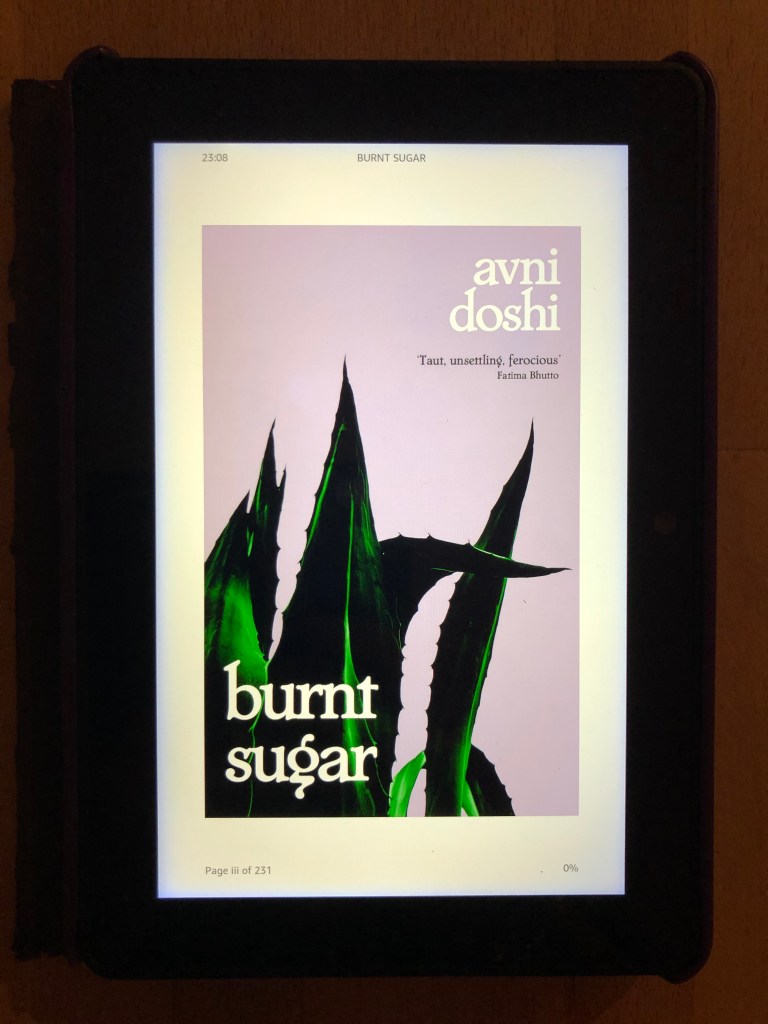
This week I have read Burnt Sugar by Avni Doshi. I am still working my way through the Booker Prize Longlist 2020, but the Shortlist has recently been announced, with Burnt Sugar being one of the six listed.
Burnt Sugar, written in the first person, is set in the Indian city of Pune. The narrative follows Antara’s present life and flashbacks to her childhood. The two narratives mingle with intertwining events as Antara tries to make sense of her relationship with her mother. Antara was named after her mother, Tara. She explains that this was ‘not because she [her mother] loved the name but because she [her mother] hated herself.’ The name, Antara, being opposite to Tara or ‘Un-Tara’. Antara sees this not as a way of differentiating them, but rather that they were ‘pitted against each other’.
Throughout the narrative, Antara attempts to understand her past and her mother’s decision to leave her father and join an ashram (spiritual retreat). The past pushes through the narrative, influencing the present, challenging what Antara understands to be the truth or perceived truths.
Antara struggles with the present. Her mother seemingly suffers from early onset dementia, though her brain scans are normal. Antara seeks doctors and researches the disease stating, ‘I have read that the disease is caused by insulin resistance in the brain’ or ‘some studies…link cognitive health with problems of the intestines’. The absence of her father leaves Antara isolated in the care of her mother. Even her grandmother had ‘only one positive memory […] of her own child’.
The actions of Antara’s mother are unpredictable and at times dangerous. However, this unpredictability is echoed in Antara’s childhood, specifically when mother left her father, when they were beggars and when she was sent to boarding school and was ‘already in the car when they explained to me where we were going’.
The anger Antara feels towards her mother simmers as she is forced into a position not only care for her but prove that that there is, in fact, something wrong with her. This complex relationship oscillates between resentment for her childhood and her duty as an adult. Recalling her year at boarding school, Antara describes how Sister Maria Theresa ‘without warning, stabbed the pencil in the back of my palm’ and how she had to hold her ‘soiled sheets above my head’ as her ‘classmates walked past […] giggling under their breath’.
Antara states that ‘my mother leaving my father, and my father letting us both go, has coloured my view of all relationships’. The theme of dysfunctional relationships extends to Antara’s own relationship with her husband, Dilip. She contemplates leaving him, even ‘packing a small handbag’ with her ‘passport and some jewellery’ only to return that evening with Dilip unaware of her actions.
This dysfunctional relationship between Antara and Tara is summarised by the narration ‘I understood how deeply connected we were, and how her destruction would irrevocably lead to my own.’ The fragility of the relationships is laid bare through the exploration of memory and ‘remaking memories’ into the ‘image of what other people remember’. The making and remaking of memories is a consistent theme throughout with Antara wondering ‘if a falsehood is enacted enough, does it begin to sound factual?’
The strain of the mother-daughter relationship is clear. Antara’s anger at having to care for her mother throughout her cognitive decline leads her contemplate if she is ‘becoming my mother’. She further wonders if she too, would see her own child as ‘a competitor or, rather an enemy’.
Through unravelling the past, secrets are uncovered, and the line between reality and falsehood blurs revealing two generations of women who struggle as mothers. Burnt Sugar is a soul-searching narrative of motherhood and the ‘striking sensation that life is short’. As the title suggests, there is a residue of bitterness that remains for Antara, the relationship with her mother and even for the reader.
Themes: memory, betrayal, mother and daughter relationships, betrayal, Alzheimer’s, love-hate relationship, parenthood, postpartum depression, dysfunctional relationships, motherhood, class inequality
All pictures and writing are my own unless otherwise credited. Permission must be obtained before any image reproduction and credit must be issued in any image reproduction or quotations.
 The Gold Shoe Writer