
Hello!
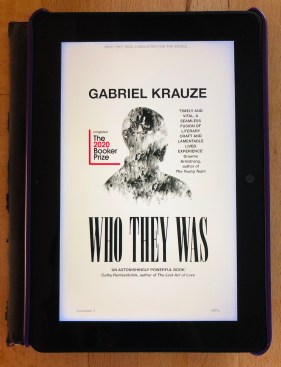
This week I have chosen to read Who They Was by Gabriel Krauze from the 2020 Booker Prize Longlist. A work of autofiction about growing up in South Kilburn, London, Krauze explores his young life of violence, drugs, murder, revenge and reputation but also of family, respect and education. The London Krauze inhabits juxtaposes images of London as a business as well as a tourist capital of the world and conveys a relentless, seething war that lies beneath.
Written in the first person, present tense, Krauze begins in medias res, ‘And jump out the whip and I’m hitting the pavement’ propelling the reader into his world and shockingly, into the mugging he is about to commit describing ‘And I’m creeping up fast to get behind her’. This is contrasted with the narration of when he is closer to the woman ‘I can smell shampoo and softness and then expensive perfume.’ This olfactory sensory impression lingers with the sibilance and walks a fine line between beauty and predatory. The violence of the scene when he ‘clocks she’s got a big diamond ring on her wedding finger’ is simply stated, ‘So I snap her finger back…it’s like folding paper’.
Written in a stream of consciousness, Krauze’s sentences vary from run on passages of action and imagery ‘and I’m running after the whip, inhaling the morning, glass needles of sunlight piercing through the sky and falling all around me…’ to sharp and simple, ‘I go to Uncle T’s.’ The brutal meets the beautiful as the language oscillates between slang, ‘I bell my boy Flipz like you brudda and I just got rushed by a whole bag of man in Grove’ and lyrical illustrations of ‘Grey clouds like heavy sponges tug on the sky’s skin and the sun hides its face from the city’ and sharp metaphors, ‘Two women in suits with bitter lemon-rind faces’.
Running parallel to the violence, jail and drugs, is Krauze’s experience as an undergraduate: ‘I’m doing an English degree at Queen Mary University’ as well as philosophical explorations, ‘one of the points that Nietzsche makes is that the morality is just a rule of behaviour relative to the level of danger in which individuals live.’ The oppositions of violence and education, different as night and day, often literally, as night of violence is followed immediately by a day of university lectures and seminars.
Krauze reflects on writing about prison as ‘feeling dead like I’m giving it something it doesn’t deserve.’ He furthers this portrayal using simple sentences and repetition that contrast with the long descriptions of violence, ‘Days without breath. Nights without silence. Dreams without sleep.’
In opposition to Krauze’s depiction of jail, his relationship with his family is poignantly reflected in how he missed Easter Sunday, ‘I’ve missed painting of the eggs with Tata’. This is a rare break in the armour and a realisation, ‘I don’t know what it is but I feel like somewhere out there I have lost part of myself.’ He further considers ‘time’ as ‘a strange land to walk through.’ This is particularly powerful, representing the transient nature of human life and that ‘this moment is just a whisper in the dark’.
In Who They Was, Krauze’s London explosively reveals modern life and its ghosts. It is a life that sits next to you on the tube, bus or university lecture. It is a life that walks the same streets and breathes the same air but oscillates on a parallel plane occasionally intersecting at tangents. However, amidst the despair, revenge and violence is an exploration of hope and what it means to be human.
Themes: despair, revenge, loss, death, betrayal, prison, education, family, love, hope, friendship
All pictures and writing are my own unless otherwise credited. Permission must be obtained before any image reproduction and credit must be issued in any image reproduction or quotations.
 The Gold Shoe Writer